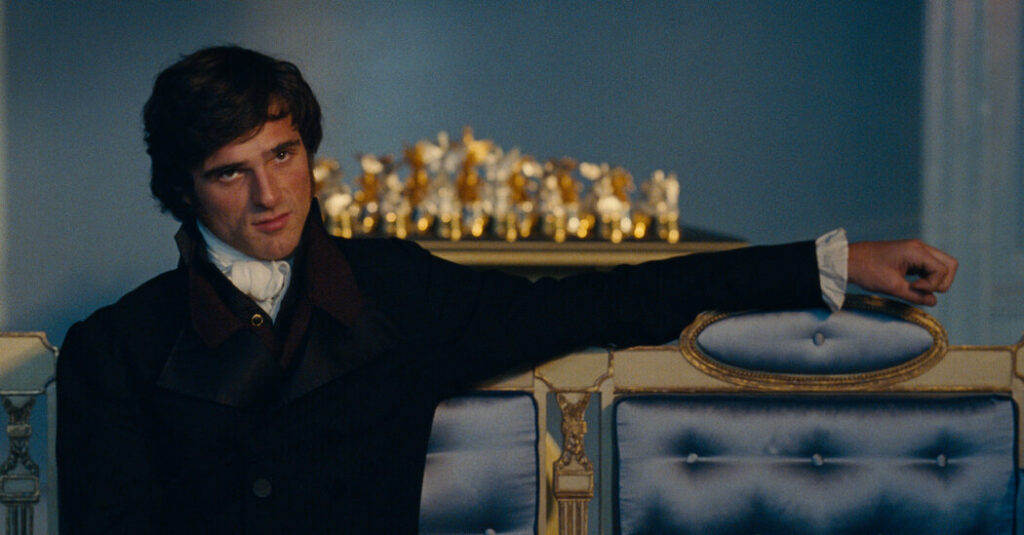
In Emily Brontë’s “Wuthering Heights,” Heathcliff is described as a “dark-skinned gipsy.” In Emerald Fennell’s new film “Wuthering Heights,” the character is portrayed by Jacob Elordi, a white actor from Australia.
Ever since Elordi was announced in the role, the choice has stirred up controversy online, where authenticity in casting is highly prized. Some frustrated fans have argued that the casting whitewashes the role. But Brontë scholars say that much of what the author writes about the character’s race remains up for interpretation, even if the consensus is that he was probably not intended to be white.
As a boy, Heathcliff is brought into the home of Catherine Earnshaw (who becomes his romantic obsession) by her father, Mr. Earnshaw. Quite a few passages in the novel suggest that Brontë, who died a year after its publication, intended to write Heathcliff as a person of color. In addition to being called “dark” and a “gipsy,” he is also referred to as a “Lascar,” a term for South Asian laborers on British ships.
At one point, Heathcliff compares himself with Edgar Linton, whom Catherine will eventually marry, saying, “I wish I had light hair and fair skin.” The servant Nelly Dean suggests that Heathcliff could be a “prince in disguise,” continuing, “Who knows but your father was emperor of China, and your mother an Indian queen.”
Susan Newby, learning officer at the Brontë Parsonage Museum in Haworth, England, said, “There is a sense that he is not white Anglo-Saxon, he’s something else, but you don’t know what that is.”
Some scholars believe that Brontë was using Heathcliff to comment on the Liverpool slave trade. Mr. Earnshaw brings Heathcliff from Liverpool, and Nelly, who narrates this part of the action, explains that Earnshaw saw Heathcliff starving and asked after his “owner.”
It makes sense that Brontë would be interested in slavery. Her father, Patrick Brontë, was associated with the abolitionist politician William Wilberforce, who, according to the Parsonage Museum, helped pay for Patrick to study at Cambridge.
Reginald Watson, an associate professor of literature at East Carolina University, has studied questions of Blackness in the works of the Brontës, including Emily’s sister Charlotte, the “Jane Eyre” author. “My belief is that because of the father’s involvement in abolitionism that both of the authors included connections to slavery in some form,” Watson said. His position is that while Heathcliff “may not be totally Black,” he is mixed.
Another theory, however, is that Brontë was using Heathcliff to comment on prejudices against the Irish, since her father was from Ireland and she was writing at the start of the potato famine there. “Think about Heathcliff who was brought from Liverpool and speaks a sort of gibberish,” said Elsie Michie, a professor of English at Louisiana State University. “The description of Heathcliff conforms almost exactly to the caricatures of the Irish.”
Michie added that the “dynamics of this novel are about otherness in various ways, and that otherness is in Heathcliff.”
Onscreen, however, Heathcliff has largely been played by white actors, including Timothy Dalton, Ralph Fiennes and, perhaps most famously, Laurence Olivier in William Wyler’s 1939 version opposite Merle Oberon as Catherine. (Oberon actually was South Asian but hid that to ascend in Hollywood at the time.) A notable exception is Andrea Arnold’s 2012 adaptation, in which the adult Heathcliff was played by the Black actor James Howson. In an interview with NPR at the time, Arnold said, “In the book it was clear he wasn’t white-skinned. I felt that Emily was not committing exactly; she was playing with her own difference as a female.”
Fennell’s version does away with references to Heathcliff’s race, instead largely focusing on his tortured romance with Cathy (Margot Robbie). Still, the cast doesn’t lack diversity entirely. Nelly is played by the Vietnamese American actress Hong Chau, and Shazad Latif, who is of Pakistani descent, plays Edgar Linton.
Asked about the Heathcliff casting by The Hollywood Reporter, Fennell emphasized that her decision was based on how she saw the text. “I think the thing is everyone who loves this book has such a personal connection to it, and so you can only ever make the movie that you sort of imagined yourself when you read it,” she said.
Speaking at the Brontë Women’s Writing Festival, hosted by the Parsonage Museum last year, Fennell said she thought Elordi “looked exactly like the illustration of Heathcliff” on the first copy she read.
Fidelity in casting has continued to be a hot topic. After Odessa A’zion was hired for the forthcoming adaptation of Holly Brickley’s novel “Deep Cuts,” there was an uproar because her character is described as half-Jewish, half-Mexican, and A’zion has no Mexican heritage. She dropped out of the project and explained on Instagram, “I hadn’t read the book and should have paid more attention to all aspects of Zoe before accepting.”
But while Newby, for instance, said she believes that Brontë presents Heathcliff as nonwhite, she also thinks the author leaves room for discussion. “She deliberately keeps it ambiguous,” Newby said.
At the same time, Newby isn’t bothered by Elordi’s casting, in part because Fennell has been so explicit about the film being from her own perspective. The director makes a number of major changes, getting rid of some characters and altering details of Cathy and Heathcliff’s interactions. “Somehow I feel more bothered by some past adaptations that have very unquestionably, unthinkingly showed him as being white without ever really reading the book and thinking, ‘Right, this is how it’s described,’” Newby said. “It was almost that was a default. You won’t be taken seriously as a lead if he’s not white.”
The mystery is also part of the appeal of Heathcliff: We never do learn his origins before Earnshaw brings him into that household.
The post Jacob Elordi, Heathcliff and the Controversy Over ‘Wuthering Heights’ appeared first on New York Times.