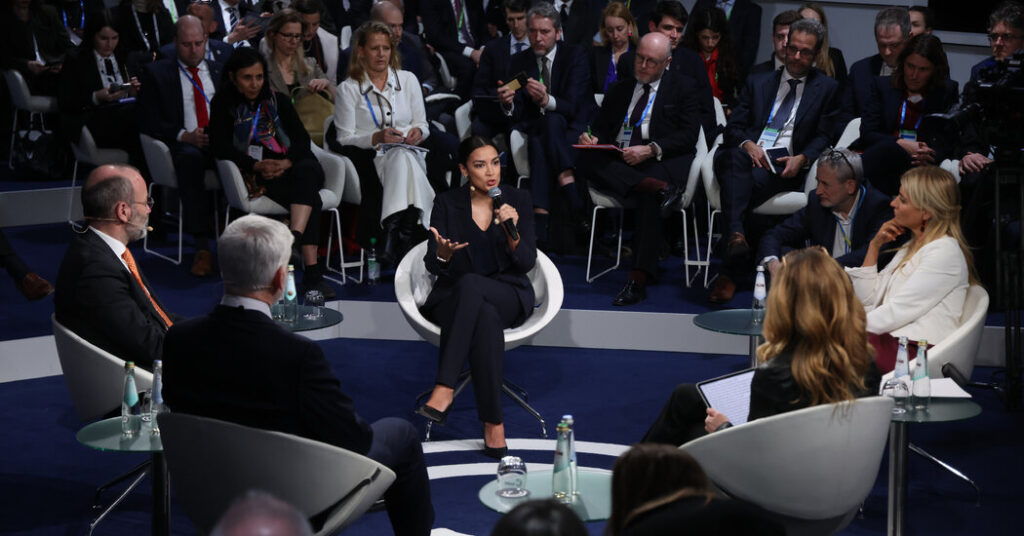
Representative Alexandria Ocasio-Cortez of New York, a progressive who made a name for herself focused on economic problems at home in America, might have seemed an odd fit for the Munich Security Conference, an annual gathering of foreign leaders and diplomats focused on international security.
But at a Friday panel on populism, she tied worsening income inequality to the rise of authoritarianism, weaving her working-class worldview into a broader message about combating far-right populism. Everyday people, she argued, were turning away from democracy because wealthy elites had failed to address their needs.
“Extreme levels of income inequality lead to social instability,” she said, adding that it was an “urgent priority that we get our economic houses in order and deliver material gains for the working class, or else we will fall to a more isolated world governed by authoritarians that also do not deliver to working people.”
Ms. Ocasio-Cortez has stepped up her visibility in recent months as a leader for Democrats as they oppose President Trump. Speculation about her future political ambitions — she has long been considered a potential presidential candidate — was rife in Munich. Her mere presence was scrutinized as a hint that perhaps she was considering a White House bid and brushing up on world affairs.
“So when you run for president, how are you going to impose a wealth tax?” asked Katrin Bennhold, a New York Times reporter who was moderating the panel. Ms. Ocasio-Cortez laughed and shook her head.
A host of other Democrats, including some seen as possible presidential contenders, also traveled to Munich, seeking to offer reassurance that their party remained committed to European allies. Mr. Trump has shaken the Western world by pulling away from NATO, carrying out military action in Venezuela, mulling an invasion of Greenland and threatening retaliatory tariffs against countries that defy him.
In Munich, Gov. Gavin Newsom of California promised that his state was a “stable and reliable partner” in the battle against climate change, while Senator Chris Murphy of Connecticut condemned Mr. Trump for engaging “in a consistent campaign to alienate our friends in Europe.” Other possible 2028 Democratic presidential candidates who attended included Senators Ruben Gallego and Mark Kelly of Arizona, Gov. Gretchen Whitmer of Michigan and Gina Raimondo, the former commerce secretary.
Foreign policy has never been a particular focus of Ms. Ocasio-Cortez’s, and she did not weigh in substantively on Friday on any international conflicts in her limited speaking time, which started with a microphone problem. She had a few stumbles, including a reference to a “Trans-Pacific partnership” that she later corrected on social media.
But she sounded strongest when drawing a direct contrast with Mr. Trump’s vision of the world.
“They are looking to withdraw the United States from the entire world so that we can turn into an age of authoritarians that can carve out a world where Donald Trump can command the Western Hemisphere and Latin America as his personal sandbox, where Putin can saber-rattle around Europe,” Ms. Ocasio-Cortez said. She urged the United States to instead deepen its bonds with allies and recommit to global projects like the United States Agency for International Development, the aid agency Mr. Trump dismantled.
And she suggested that monopolistic corporations with huge market share and wealth were also to blame, arguing that billionaires were “throwing their weight around in domestic politics and in global politics as well.”
The panel also included Petr Pavel, the president of the Czech Republic; Manfred Weber, the president of the European People’s Party; and Daiana Fernández Molero, a member of the Argentine legislature. But Ms. Ocasio-Cortez was clearly the draw, with conference attendees buzzing about her presence. Audience members at the panel slouched and checked their phones at times when someone else was speaking, then perked up as she weighed in.
Düzen Tekkal, a German human rights activist in the audience, said she was impressed by Ms. Ocasio-Cortez. “She’s strong,” Ms. Tekkal said. “It’s important that voices like her become powerful.”
Ms. Fernández Molero said she did not agree with Ms. Ocasio-Cortez on every issue; she was encouraged by Mr. Trump’s ousting of Nicolas Maduro, the former authoritarian leader of Venezuela, for instance, and said Latin America had not benefited in the past from the kinds of wealth taxes the congresswoman supported.
But Ms. Fernández Molero appreciated that they shared similar goals, and she snapped a selfie with Ms. Ocasio-Cortez as they waited to take the stage — even though she knew some of her followers might not approve.
“If I put the picture with her on Twitter, probably many people will say, ‘Oh, you’re with a socialist, with a leftist,’” she said.
But would she post the photo anyway?
“Yeah, of course,” Ms. Fernández Molero said. “I mean, she’s A.O.C.!”
Jonathan Wolfe contributed reporting.
Kellen Browning is a Times political reporter based in San Francisco.
The post In Munich, Ocasio-Cortez Ties Income Inequality to Rise of Authoritarians appeared first on New York Times.