The harsh speech of Vice President JD Vance at the Munich Security Conference a year ago began a long period of deterioration in the trans-Atlantic relationship, marked by economic and ideological confrontation, contempt and insult.
This year in Munich, at Europe’s main annual security gathering, which started on Friday, the effort so far has been one of de-escalation, especially from the American side. There have been no insults, and American officials have displayed what they call “pragmatic realism.”
But there is little evidence that American policy has changed. Both European and American leaders spoke on Friday of an international order that has been irrevocably upended since President Trump returned to office last year. Officials from both sides of the Atlantic called for Europe, after eight decades of military dependence on Washington, to stand on its own feet. It was an acknowledgment from both sides that the United States should no longer be relied on to underwrite the Western alliances and institutions that it has led since the end of World War II.
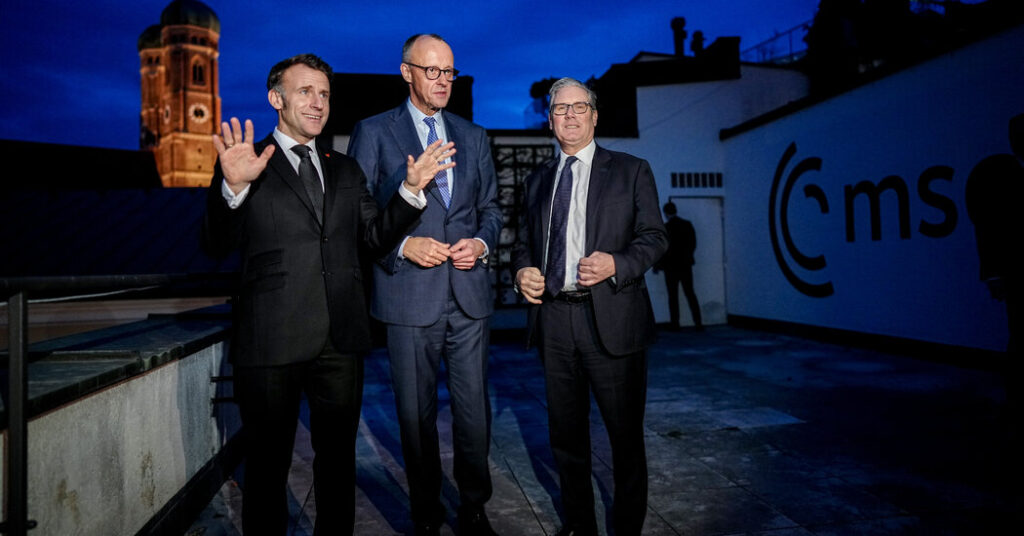
The international rules-based order “no longer exists,” said Chancellor Friedrich Merz of Germany, in a speech marking the start of the conference. Partly as result, Mr. Merz said, the United States’ claim to global leadership had been “challenged, and possibly squandered.” Both Mr. Merz and President Emmanuel Macron of France spoke of Europe’s push for military autonomy — Mr. Merz discussed a joint European nuclear deterrence — partly to improve its defenses and partly to act as a stronger ally to the U.S. “A stronger Europe,” Mr. Macron said, “will be a better friend for our allies, especially the United States.”
What went largely unsaid was that Mr. Trump had focused European minds by pushing to seize Greenland, the territory of Denmark, a NATO ally, while mocking European leaders last month at the World Economic Forum in Davos, Switzerland. Europeans like Mr. Macron now refer to that as “the Greenland moment,” the ultimate wake-up call. European trust in America’s commitment to shared values, European security and even territorial integrity was already damaged, but after Davos many of Europe’s leaders gave up hope for a return to the old trans-Atlantic relationship.
In Munich, American officials appear to have taken notice. There has been no open mockery. There has been praise for allies like Germany that are spending more on their military and for NATO’s commitment to increase spending on core military needs to 3.5 percent of national income by 2035. There is talk of a more equal partnership if Europe does its part for conventional defense.
Secretary of State Marco Rubio is in Munich, not President Trump or Mr. Vance. A more traditional Republican, Mr. Rubio is regarded by Europeans as trying to keep the train on the tracks on key issues, including Greenland and the war in Ukraine.
Elbridge Colby, the under secretary of defense for policy, is in Munich, not the more vocal and ideological Pete Hegseth, the secretary of defense. Mr. Colby came from Brussels, where he gave a well-received speech to NATO defense ministers about America’s continued commitment to NATO, to collective defense and to the American nuclear umbrella over Europe, a key element of deterrence against Russia.
As Senator Thom Tillis, Republican of North Carolina, said in Munich on Friday, “We’re not in a civil war with our partners in Europe. We’re in a frank discussion over what needs to be done.”
But if the words are more gentle, the policies have not changed, said Mark Leonard, director of the European Council on Foreign Relations. “They’re engaging here in a more positive way, but they’re pretty stark in terms of the end of the old order,” he said.
And Europeans remain skeptical and wary. Many, like Wolfgang Ischinger, the conference chairman, said that once trust is broken, it is extremely difficult to rebuild and often impossible to restore fully. A series of opinion polls show that ordinary Europeans have a deep distrust of Mr. Trump and an unfavorable view of the United States.
As he traveled to Munich, Mr. Rubio said, echoing Mr. Merz, that “the old world is gone — frankly, the world that I grew up in — and we live in a new era in geopolitics, and it’s going to require all of us to sort of re-examine what that looks like and what our role is going to be.”
Mr. Colby, too, said that NATO was in transition and that Europe must eventually take responsibility for its own conventional defense. The last year, he said, was intended to “reframe” and “reorient” the relationship, and that now we are in a “transition period.”
But he also made it clear that the Trump administration had little use for talk of “the international rules-based order” or shared values. “You can’t base an alliance on sentiment alone,” he said. What mattered, he said, was Europe’s commitment to share a much bigger part of the burden of defense to build a new security relationship with the United States that was more resilient.
If anything, European leaders have gotten that message: that they must do more in their own interest to reduce their dependency on a United States that Mr. Macron earlier this week called “openly anti-European” and the source of “minute-by-minute instability.”
Mr. Merz led off the conference with a tough speech, acknowledging “the rift” in the trans-Atlantic relationship. He also listed the ways that Mr. Trump’s policies had broken with the values Germans and other Europeans once believed they shared with America, including opposition to hate speech, the fight against climate change and support for free trade.
At the same time, he said, it was up to Europe to build a stronger European pillar within the NATO alliance in the interests of both Europe and the United States.
In essence, his speech was less an analysis of rupture than an appeal for repair.
A more vigorous Europe, better able to defend itself and its own interests, he said, is in Europe’s interest and would help “forge a healthier trans-Atlantic relationship.” It is up to both sides, he said, to “repair and revive trans-Atlantic trust together,” arguing that being part of NATO is also to America’s advantage.
As tough and even angry as Mr. Merz can sound, what he is proposing is very close to what Mr. Rubio and Mr. Colby are demanding.
But while holding out a wary hand, Mr. Merz also warned the Trump administration not to make things worse and further squander the trust of its allies.
And he warned Washington, after shifting from German to English, that it needs friends. “In the era of great power rivalry, even the United States will not be powerful enough to go it alone,” he said.
The prime minister of the German state of Bavaria, Markus Söder, bluntly summed up the mood for many at this conference, in his opening remarks. “We will respect your leadership,” he said, addressing the Americans. “But maybe you pay us a little more respect.”
Jim Tankersley and Mark Landler contributed reporting.
Steven Erlanger is the chief diplomatic correspondent in Europe and is based in Berlin. He has reported from over 120 countries, including Thailand, France, Israel, Germany and the former Soviet Union.
The post Europe Concedes a Point to Trump: It Needs to Stand on Its Own appeared first on New York Times.