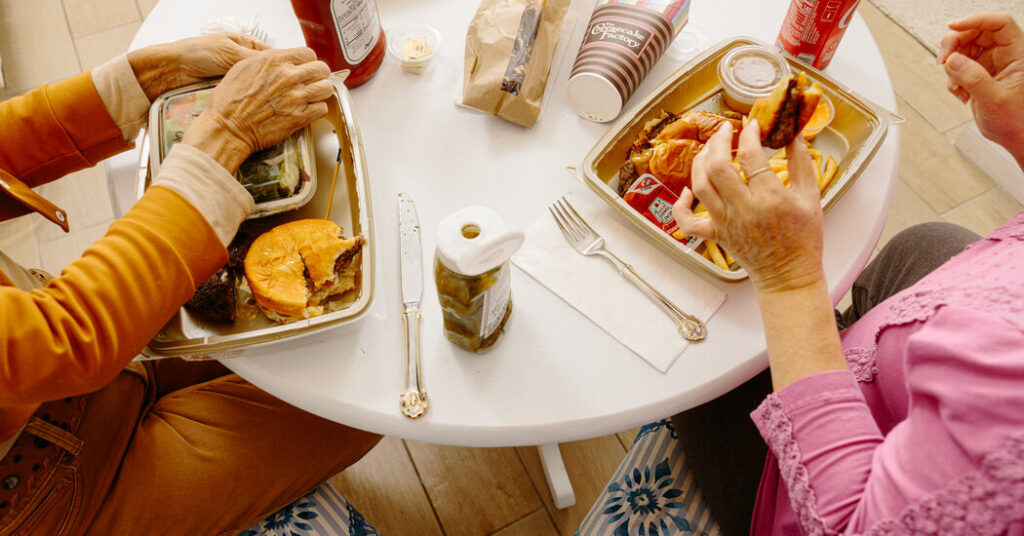
What’s a typical dinner for you? Is it usually a home-cooked meal, a sit-down dinner at a restaurant, or takeout eaten on the couch?
Which do you prefer, and why?
In “Freedom With a Side of Guilt: How Food Delivery Is Reshaping Mealtime,” Priya Krishna writes that in 2024, almost three of every four restaurant orders in the United Statesin weren’t eaten in a restaurant:
There’s pasta in the pantry and jarred sauce in the refrigerator. So what compels Kiely Reedy to keep having spaghetti with marinara delivered from the restaurant down the street, for several times the cost of cooking the dish herself?
It’s not that the restaurant dish is particularly good, she said. “It’s the instant gratification.”
From her roughly $50,000 annual salary as a data processor in San Diego, Ms. Reedy, 34, spends at least $200 to $300 a week on food delivery. Ordering in has eaten away at her savings, she said, and led her to socialize less. She tips generously, but worries that the delivery drivers are poorly paid.
“I feel reliant upon it,” she said, “but guilt for using it.”
Food delivery, which skyrocketed during the pandemic as a practical necessity, has become even more entrenched in the years since as a convenience, an everyday alternative to cooking or eating out. DoorDash is now a verb. And the new delivery economy is transforming the way Americans live — reshaping budgets, mealtimes and social habits.
In 2024, almost three of every four restaurant orders were not eaten in a restaurant, according to data from the National Restaurant Association. The number of households using delivery had roughly doubled from 2019, just before the pandemic, the group said. And in a survey last year, about one-third of American adults told the association that they ordered food for delivery at least once a week.
The New York Times asked readers to share their feelings about food delivery. Most of the nearly 900 people who responded said they prized the extra time and freedom it gave them. But they also expressed misgivings about the costs for delivery drivers, the environment and their own wallets at a time when affordable living feels increasingly out of reach.
Ms. Krishna writes:
Many readers said they had impulsively ordered a single item for delivery: a coffee, a milkshake, a scoop of ice cream. Erin Molnar, a marketer in Ferndale, Mich., once paid about $15 for a tiny chocolate lava cake.
“I remember feeling kind of crazy for having one single thing delivered,” she said, adding, “It is a blessing and a curse that we are financially privileged. There is not much of a financial pressure to not order out as much.”
Millions of Americans, of course, are struggling to put any kind of food on the table as grocery prices continue to rise. And for people who can’t leave the home, food delivery is essential. The three major providers — DoorDash, Uber Eats and Grubhub — said in email responses that they’re proud of the extra time and countless choices they offer busy customers.
The article discusses Gen Z consumers and their food delivery habits:
Many Generation Zers who came of age during the pandemic can barely recall a life without delivery, and their social lives now revolve around it.
Mercuri Lam, a Yale sophomore, said there’s almost always a delivery driver outside her dorm, even though undergraduates living on campus are required to pay for a meal plan.
She and her friends spend many evenings ordering food to share, which she says costs less than going out and takes up less time. To keep in touch, she and her long-distance boyfriend order the same meal and eat it together over FaceTime.
While Ms. Lam, 19, has concerns about the pollution caused by the driving involved, she said delivery has expanded her palate. The first time she tasted Indian food was when a friend ordered it. And because delivery apps offer more photos and detailed descriptions than restaurant menus do, she is more likely to try something new.
Students, read the entire article and then tell us:
-
Which do you prefer: having a home-cooked meal, eating at restaurants or getting takeout, and why? What’s most important to you when deciding: the taste of the food, the convenience, the cost or the quality time spent with family or friends?
-
How often do you have takeout? What do you and your family usually get? Do you ever worry about your monthly takeout bill?
-
What’s your take on the growing popularity of takeout? Do you see it as a positive or negative trend?
-
Ms. Krishna writes: “Many Generation Zers who came of age during the pandemic can barely recall a life without delivery, and their social lives now revolve around it.” Does that ring true for you? How has the rise in the popularity of food delivery reshaped your eating habits and your social life?
-
Huy Do, a market research manager, suggests that on-demand lifestyles might prevent consumers, including young people, from developing critical skills like problem solving and planning ahead. Do you agree? How might relying on apps for food and other daily needs affect how you handle challenges in other parts of your life? Is it healthy to live in a world where most things — such as food, clothing and entertainment — are available at the click of a button?
Students 13 and older in the United States and Britain, and 16 and older elsewhere, are invited to comment. All comments are moderated by the Learning Network staff, but please keep in mind that once your comment is accepted, it will be made public and may appear in print.
Find more Student Opinion questions here. Teachers, check out this guide to learn how you can incorporate these prompts into your classroom.
Jeremy Engle is an editor of The Learning Network who worked in teaching for more than 20 years before joining The Times.
The post Do You Prefer Home-Cooked Meals, Restaurant Dining or Takeout? appeared first on New York Times.