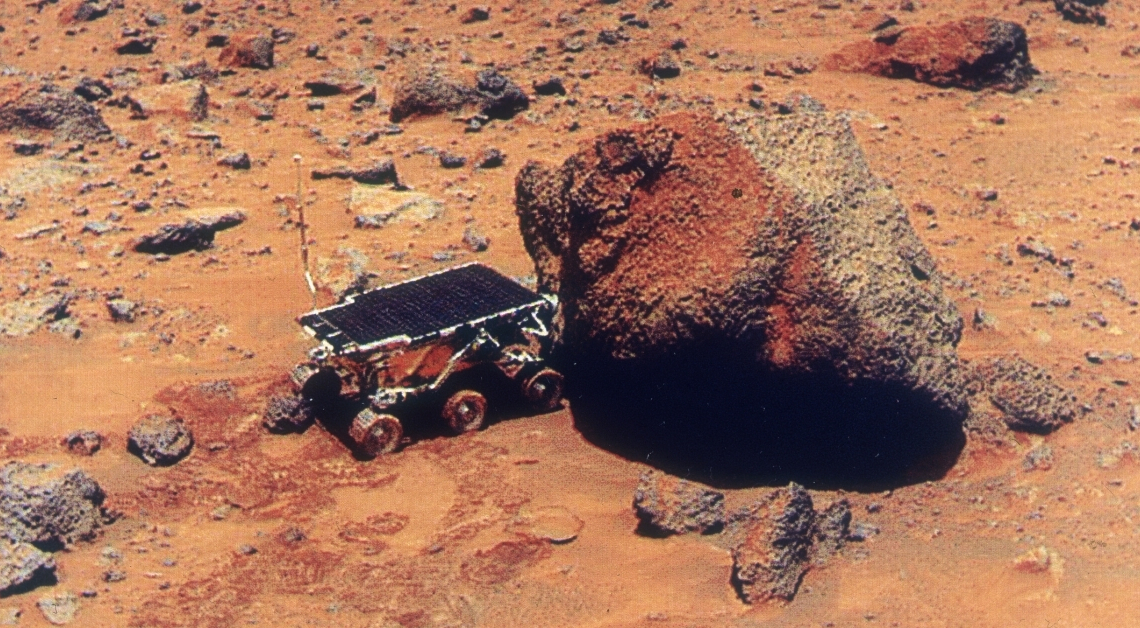
Back in 1976, NASA’s Viking Landers looked for life on Mars and came up empty. Today, a group of scientists is arguing that, on the contrary, we may have definitely found signs of microscopic alien life… but we accidentally killed it.
When Viking 1 and 2 touched down on Mars, they ran a series of experiments on Martian soil. In one test, researchers added water and nutrients tagged with radioactive carbon. If microbes were present, they would metabolize the nutrients and release radioactive carbon dioxide.
That’s exactly what happened, at least the first time.
NASA May Have Found Life on Mars 50 Years Ago, Then Accidentally Killed It
The lander detected a significant release of radioactive gas. But follow-up injections weren’t as gassy. Follow-up experiments yielded ambiguous results, so NASA concluded the positive signal was likely caused by unusual soil chemistry rather than the presence of life, famously leading Viking project manager Gerald Soffen to officially—and mournfully—declare that Mars contained “no organics, no life.”
At the time, traces of chlorinated organic compounds were dismissed as contamination from Earth. But decades later, Mars missions have confirmed that the chemical compound perchlorate, which was once blamed for the negative result, is native to Martian soil. Thanks to years of research on Earth, we now know that heating perchlorate can destroy organic material and produce the kinds of chlorinated compounds that Viking detected in the 70s.
All of that is a roundabout way of saying that, according to the researchers who published their findings in the journal Astrobiology, Viking may have found organics after all, but then accidentally killed them because we didn’t know what we were dealing with yet.
In the paper, the researchers argue that, based on the “preponderance of evidence,” the Viking probe definitely detected microbial life. They’d even given a name to this hypothetical, unfortunately killed organism: BARSOOM, which stands for Bacterial Autotroph Respiring with Stored Oxygen On Mars. Sci-fi nerds might recognize it as the name of Edgar Rice Burroughs’ influential 11-volume sci-fi fantasy book series. The scientist’s version of BARSOOM could, again hypothetically, survive near the surface in a semidormant state.
Drenching them with water may have killed them, as we’ve seen here on Earth: desert microbes adapted to extremely arid conditions can die when drenched with water. The authors of this paper aren’t claiming to definitively prove this theory, but they’re calling for a major re-examination of the data before future missions, so we don’t accidentally kill the very thing we’re looking for… again.
The post Did NASA Find Life on Mars 50 Years Ago and Accidentally Kill It? appeared first on VICE.