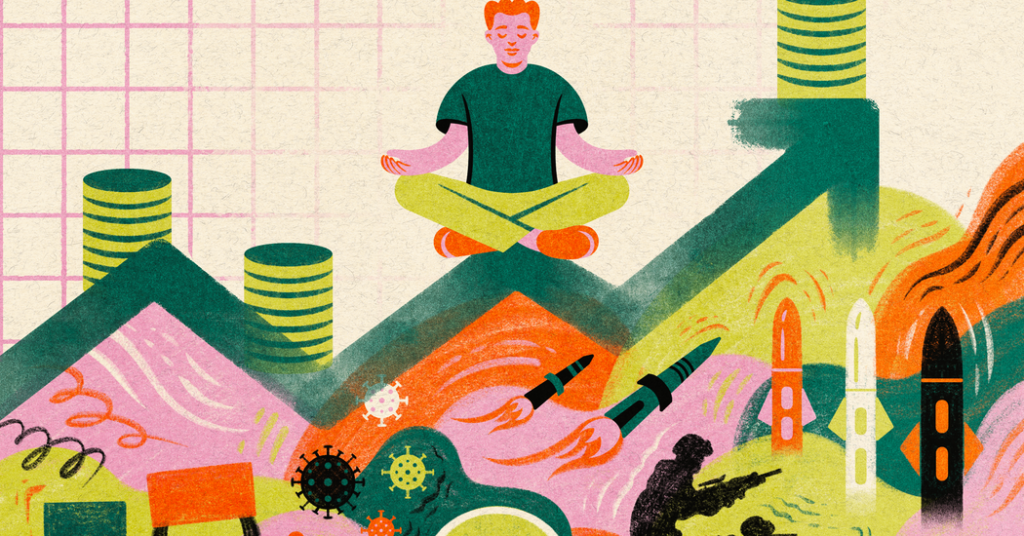
The world sometimes seems to be lurching into a state of permanent crisis, but no matter. Despite occasional setbacks, the stock market is booming.
This dissonance between real-world distress and glorious financial wealth is a permanent feature of the markets, not a bug. Markets have prospered through civil unrest, pandemic, glaring racial inequality, recession, severe unemployment, tattered alliances, tariff conflicts and outright war. To set off a boom, all that’s needed are enough people believing they can make money.
Plenty of people believe that now. The Dow rose above 50,000 this month, and Wall Street is bullish. Ignoring world crises is a smart strategy for investors — until, at some point, the markets themselves fall into crisis.
“At a time like this, the best investors may be able to do is keep calm and carry on,” said Eswar S. Prasad, an economist at Cornell and the Brookings Institution. Carry on, but be prepared for reversals. Don’t forget that there is danger lurking.
For the last few years, Professor Prasad has immersed himself in studying global danger. He has come out with an ambitious book that provides an up-to-date model for the toxic mix of economic, social and political disruption afflicting the world. The book is called “The Doom Loop: Why the World Economic Order Is Spiraling Into Disorder.” We chatted about these problems for a couple of hours recently. The book isn’t cheerful reading. We had a disturbing and mind-bending conversation.
Surveying the Havoc
How bad is the current situation? I don’t want to ruin your day, but this chat didn’t help mine.
Booming financial markets aside, Professor Prasad said, major world problems are feeding one another in a vicious circle. He calls this social, political and economic vortex a “doom loop.”
If it helps, remember your gains in the fabulous stock market before considering the disconcerting global backdrop.
A former International Monetary Fund official, Professor Prasad talked about the battered trend known as globalization. A system of free trade and commerce and global supply chains that knitted much of the world together, it lifted the status of desperately poor people in countries like India and China, but caused hardship in industrial regions of countries like France, Germany, Britain, Italy, Japan and the United States.
That already looks like the distant past. In no small part because of President Trump, Professor Prasad said, the system “is being shredded.” So are multilateral institutions that had worked to ensure some degree of world peace and stability. I would include the I.M.F., the World Bank, the World Trade Organization and the United Nations in that list.
At the same time, he said, political turmoil in many countries is fueling a breakdown in global economic and political relations. For example, the Trump administration’s widening immigration crackdown, which has kindled domestic unrest, is often seen in other countries as an integral part of “America First” policies that are shattering illusions of global cohesion. And anti-immigrant sentiment is rife in other countries.
“This is all part of the doom loop,” he said.
The war between Russia and Ukraine grinds on. The last nuclear arms control treaty between Russia and the United States has expired. China is rushing to acquire a bigger arsenal, Europe is discussing the creation of its own larger deterrent force, and countless smaller powers are grasping for nuclear arms, if they don’t already have them. The possibility of direct conflict between the United States and China in the Strait of Taiwan or the South China Sea can’t be ruled out.
Follow the Money
Professor Prasad sees the economy as the ultimate source of power. Therefore, the United States and China are superpowers, in his view. Russia, with an economy ranked smaller than Brazil’s, is not. It remains a potent military force, however, endangering much of Europe and retaining the capacity to wreak destruction anywhere on the planet. Traditional U.S. allies in Europe — and, indeed, on all other continents — have been forced to realize that they can’t count unconditionally on a Trump-led United States.
Thanks largely to the Trump tariffs, the old free trade system is devolving into a series of incipient trade wars, inflaming other conflicts. Mr. Trump is using tariffs to inflict punishment — or reward acquiescence — on issues unrelated to trade itself. Greenland, immigration, the flow of drugs: When countries oppose the president’s demands, he imposes more tariffs. Douglas Irwin, a Dartmouth economist who is an expert on the history of trade, told me in a phone conversation that using tariffs this way “is just extraordinary in U.S. history.”
In our conversation, Professor Prasad, who, like me, is an old China hand, said China shared responsibility for the breakdown in global commercial relations. It is causing immense harm by flooding the world with more exports than most countries can easily absorb, he said. China has long needed to tilt its economy toward domestic consumption — which would make it less reliant on aggressive exports for growth — but has been unable or unwilling to do so.
China’s internal repression, its increasingly autocratic leadership, and its often punitive international aid and trade terms make its economic and political model unpalatable to many countries. But today, Professor Prasad said, the United States is no paragon, either.
There’s a looming danger that the United States and China will slice much of the world into blocs, with middle and smaller powers forced to navigate as best they can between the superpowers. The world outlook depicted in “The Doom Loop” is overwhelmingly bleak.
And Yet, Those Markets!
Still, for investors, there is the cheering reality that many markets have been splendid.
Big tech companies in the United States are churning out enormous profits while spending staggering sums on the development of artificial intelligence. Investors may be worried, but they are thriving.
After the Dow Jones industrial average reached 50,000 for the first time last Friday, Edward Yardeni, an economist and strategist with a bullish bent, reiterated that he expected the Dow to reach 70,000 — a 40 percent gain — by 2029. Mr. Yardeni has been talking for a long time about, as he puts it, the “Roaring 2020s stock market.” A.I. will increase productivity throughout the economy and generate broad-based earnings improvements, he said, and that will keep the bull market going.
Many stock markets elsewhere are outperforming the market in the United States. The falling dollar has helped to bolster international returns — especially, but not solely, for those investing in dollars. Professor Prasad, an expert on the dollar, expects that the U.S. currency, for better and for worse, will remain the dominant means of global exchange, though many other countries are trying to avoid it. Despite problems lately in speculative markets like commodities and cryptocurrency, the global financial system so far is holding steady.
Even so, Professor Prasad said, complacency would be unwise. “There’s real trouble right now,” he said, even if it’s not showing up in portfolio returns.
“We are seeing that the institutions are getting shredded,” he said. “We are seeing domestic politics becoming even more polarized and infected in a way that is having a very negative effect on geopolitics as well.”
Financial markets were calm in the years leading up to the great financial crisis and recession of December 2007 through June 2009. The doom loop now, he said, may well plague the markets later.
So don’t relax too much, Professor Prasad said. “I think that it is a good time, when things appear to be good, to worry a little more about all these unfavorable dynamics lurking under the surface.” He shrugged, with a rueful grin. “This is cheerful stuff, no?”
Well, no. It’s depressing to contemplate, but the world is in a difficult place. I think it’s worth pondering all of this carefully. For investors, it makes sense, as I’ve been writing, to buffer your stock holdings with bonds and cash if you are likely to need your money soon.
In a review of “The Doom Loop,” The Economist praised the book’s sweeping analytical power but said it came up short on solutions. That was true of my conversation with Professor Prasad, as well, but I don’t fault him. Without major political shifts, it’s hard to see how to turn around the global situation. Ordinary people will need to try to protect themselves as institutions fray.
Jeff Sommer writes Strategies, a weekly column on markets, finance and the economy.
The post Crises Everywhere, but the Markets Don’t Seem to Mind appeared first on New York Times.