When a disruptive government shutdown nears, the Capitol is usually occupied by tense lawmakers struggling to avoid an embarrassing halt in government services and the accompanying political fallout. Even if a lapse in funding is a certainty, members of Congress typically want to look like they are trying to avert it.
Not this time.
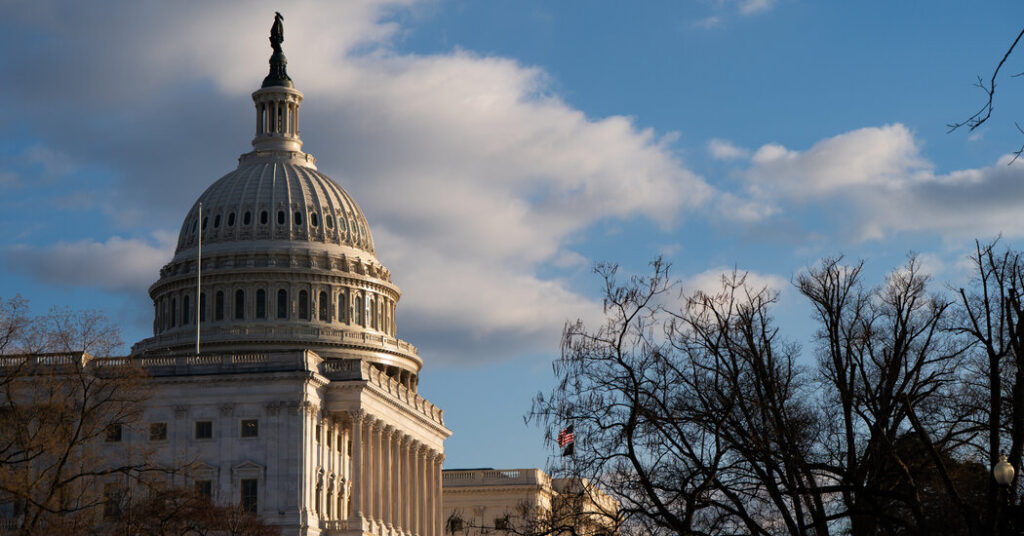
The Capitol emptied out on Thursday, a full day before the midnight Friday deadline for funding the Department of Homeland Security. Lawmakers who were deadlocked over new restrictions on immigration officers jetted off to Munich for a security conference or headed home for a weeklong recess, seemingly unconcerned with the looming closure. It was a jarring change from the past, when lawmakers were reluctant to seem like they were giving up for even a moment before time ran out for a deal.
“We are not even going to pretend that we are trying to figure it out,” said Senator Lisa Murkowski, Republican of Alaska, one of those bound for Germany. “It doesn’t look great.”
The blasé attitude reflected a conviction on the part of both parties that they were in the stronger political position in this round of the shutdown wars.
Republicans, who only weeks ago appeared to be pivoting on immigration following the killings of two U.S. citizens by federal agents in Minneapolis, appear to have snapped back to a bellicose stance, buoyed by polls that show voters are firmly behind President Trump’s handling of the issue.
Democrats note that polls also show broad disapproval of ICE’s tactics, and argue that public opinion is solidly on their side, after many Americans recoiled at footage of masked agents shooting U.S. citizens and of small children being taken into custody.
In their defense, lawmakers noted that it was only about 4 percent of the government that would be without money, since Congress had belatedly but successfully funded everything but the Department of Homeland Security.
Plus, leaders of both parties said, negotiations were ongoing between Democrats and the White House, and members of the House and Senate could be quickly summoned back if a breakthrough occurred and a deal was ready for a vote.
It made no sense, they said, to keep members of Congress sitting around cooling their heels if there was nothing to put on the floor of the House and Senate. Members of both parties who were headed to Munich also said it was vital that the United States have a strong presence there, to reassure European allies rattled by Mr. Trump’s unpredictable foreign policy maneuvers.
Still, the pain for lawmakers is usually an integral part of any deal to avert or end a shutdown, as members’ unhappiness, restiveness and occasional sheer boredom has in the past helped force a resolution. Not to mention that it is not great optics for members of Congress to race for international flights as Transportation Security Administration workers are among those likely to work without pay if the shutdown — the third in a matter of months — drags on.
The stalled funding measure also covers the Federal Emergency Management Agency and Coast Guard, among other entities. Immigration and Customs Enforcement, the agency at the heart of the dispute, as well as Customs and Border Protection, have funds from an earlier bill and can continue to operate without interruption.
“We are where we are,” Senator John Thune, Republican of South Dakota and the majority leader, said as he acknowledged that the Senate would continue with its planned weeklong Presidents’ Day recess, unless an agreement was reached and lawmakers were called back.
Reaching that agreement was not going to be easy given what appeared to be the gulf between what Democrats were demanding and what the White House was willing to surrender. In the aftermath of the two fatal shootings in Minneapolis, Democrats were insisting on meaningful new limits on immigration officers, including an end to mask wearing and a requirement for court-approved warrants for arrests and searches. Essentially, they want the immigration agents to operate under the same standards as other police forces in the United States.
“Democrats will not support a blank check for chaos,” Senator Chuck Schumer, Democrat of New York and the minority leader, said after all but one Democrat, Senator John Fetterman of Pennsylvania, voted to block funding unless new requirements were made law — a substantial show of unity and force. “If Republicans want to keep D.H.S. funded, they need to get serious.”
What the White House was offering remained confidential, but Democrats preparing a counteroffer said it fell far short. People familiar with the negotiations said the White House was silent on many of the Democratic asks, and watered down others.
The White House also instituted demands of its own, such as increased penalties for doxxing federal agents, the people said.
Mr. Thune made clear that the Democratic push for court-issued warrants was not something on which the White House was ready to concede much ground.
“Administrative warrants have been used effectively by agencies going back many decades,” Mr. Thune said.
He and other Republicans, after initially easing off the blame-gaming that is traditionally a main element of any shutdown fight, also sought to ratchet up the pressure on Democrats, taking a more accusatory tone.
“Democrats don’t seem to be determined in any way to fund the Department of Homeland Security,” Senator John Barrasso of Wyoming, the No. 2 Republican, said on Thursday. “They seem determined, however, to protect illegal immigrant criminals.’’
Though Democrats in the past have shown great reluctance to be held responsible for shuttering even a portion of the government, conditions are different in this round. For one, Democrats believe they defied the odds and came out of last year’s record-long government shutdown on the political offensive over health care costs, as Republicans allowed popular subsidies for coverage under the Affordable Care Act to expire.
And they point to polls indicating widespread disapproval of the tactics being employed in Mr. Trump’s immigration crackdown.
“Republican policies with respect to immigration enforcement are completely under water at this point, which is a dramatic change from a year ago,” said Representative Hakeem Jeffries, Democrat of New York and the minority leader. “The public wants immigration enforcement to be fair, just and humane, and they know that’s not taking place with the Trump administration right now.”
One lawmaker said the congressional exodus from Washington could actually be a positive development if Republicans encounter constituents who are unhappy with the immigration crackdown.
“Republicans are in a bubble and do not understand the depth of the anger out there in the world,” Senator Brian Schatz, Democrat of Hawaii, said. “Maybe this break will allow them to go home and get yelled at.”
Michael Gold contributed reporting.
Carl Hulse is the chief Washington correspondent for The Times, primarily writing about Congress and national political races and issues. He has nearly four decades of experience reporting in the nation’s capital.
The post Congress Jets Off as D.H.S. Shuts Down appeared first on New York Times.