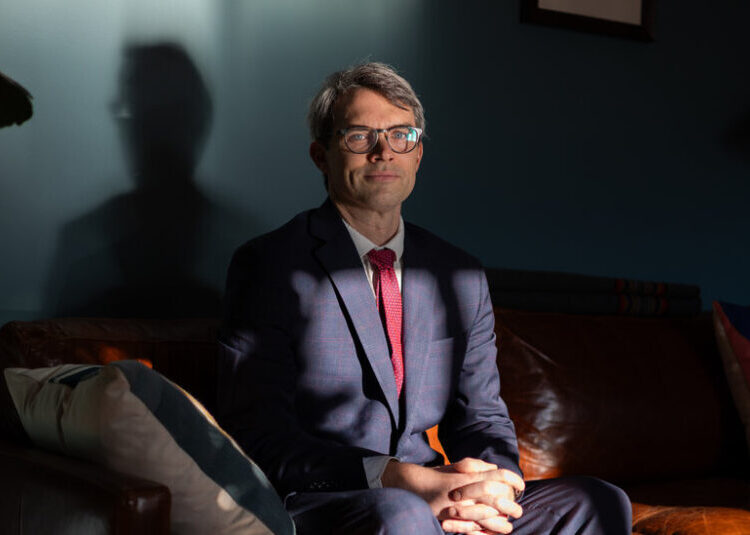
Two weeks ago, David Brooks wrote his last column for The Times, after 22 years on the job. So many of us will miss his words, and that was evident by the overwhelming response; thousands of people wrote in to ask him questions, a sample of which he answered below.
If you were 18 going into college (me right now) and feeling morally unsure about the state of the world, what would you do to try to make a difference? — Ali Ibanez, Tampa, Fla.
Your generation has inherited from mine a society in a state of social, emotional and spiritual crisis. If I were 18, I think I’d work really hard to try to learn the skills that would enable me to treat other people with consideration and respect in the concrete circumstances of life: How do you sit with someone who is depressed or grieving? How do you ask someone out, fall in love and, when necessary, break up with someone without crushing his or her heart? How do you become a great conversationalist? These are the skills that artificial intelligence will not replace, and they are the ones that will make you a good person who has a glowing influence on the people right around you. There are many people teaching these social skills in books and online, but many people don’t bother to master them.
I’m a high school teacher. A majority of my students are people of color from disadvantaged backgrounds. What would you say to them to give them hope of a better future? You mentioned colleges in your column, but what about high schools? What can I do as a teacher? — Thuc Nguyen, San Jose, Calif.
First, thank you for teaching. As most college professors will tell you: “We get them too late. If you want to form young people, get them in high school.” So I salute the impact you are having. I would ask them to read history. There is no decade we would want to go back to. The 1890s? An era of rampant political corruption, brutal poverty and racial terrorism. The 1920s? Nativism and authoritarian police state tactics. The 1960s? Riots, assassinations, bombings, urban decay. History puts our current problems in perspective and serves as a reminder that we stumble, but generally we stumble forward.
If you could recommend one book for every high school student in the country to read, what would it be? — Laurie Wilson, Hillsborough, N.C.
“Man’s Search for Meaning” by Viktor Frankl. He teaches that the animating human drive is not the desire for money, fame or popularity. It is the desire to feel that your life has purpose. I assign this in my college classes, and it changes a few lives every time.
What aspects of conservatism place you, as such a deep-thinking humanist and a lover of the liberal arts, where you are on the political spectrum? That is, what elements of conservatism do you ardently embrace? — David Anderson, Kentucky
My brief history of conservatism goes like this. After the 17th-century wars of religion, everybody decided: Enough! We need to build our society on something other than religious strife. Some thinkers in France decided to build their society on reason and started the French Enlightenment. Modern progressivism is descended from that. Other thinkers, mostly in Scotland, decided to base their society on the sentiments — the way manners and mores shape our values, emotional reactions and moral intuitions. Conservatism is descended from that.
I fervently believe that our emotions, when well educated, are wiser than each individual’s naked stock of reason. I also believe in epistemological modesty: The world is very complicated, and we should be humble about how much we can understand, so when we do social change, it should be constant but incremental, not swift and radical. Those conservative ideas remain the gold standard to me. When I have deviated from them, it has led me into error.
Which is the most difficult column you ever had to write, and why? — David Semo, Candor, N.Y.
On April 17, 2004, I wrote a column called “A More Humble Hawk,” in which I began to grapple with my support for the Iraq war. I didn’t sleep the night before it appeared, because I knew my friends would be angry and my critics would sense weakness and pounce. It was the beginning of a hard process of self-examination.
What has been the most surprising change in your beliefs since arriving at The Times? — T. Carl Hardy, Kansas City, Kans.
On one level, little has changed, and on another, everything has. My intellectual heroes are the same as when I started: David Hume, Edmund Burke, Samuel Johnson, George Eliot, Jane Jacobs, Alexander Hamilton, Isaiah Berlin, Simone Weil. But while I’ve followed their consistent example, my views have been transformed: I have come to faith. I’ve switched from being solidly right to vaguely centrist. I’ve moved left on the death penalty, rightward on abortion and leftward on economic policy. In the 1980s I thought stagnation was the core social problem, so I sided with Republicans. By the 2000s, I concluded that inequality was the core social problem, so I sided more with Democrats. Berlin once said he was happy to be on the rightward edge of the leftward tendency. That’s where I’m happy to be today: a conservative Democrat.
We met you and your wife at Becco in New York City on July 15, 2021. We were all on our way to see “Springsteen on Broadway.” You were very cordial and agreed to a selfie. All I could think about during the show was that I just met David Brooks. Just goes to show you don’t have to play a guitar to be a rock star. With that said, what is your favorite Bruce Springsteen album? — Jim Den Uyl, Beach Haven, N.J.
I was once waiting for a Springsteen concert to start in Charlottesville, Va., when a lady came up to me and said, “I’m more excited to meet you than to see Springsteen.” I replied, “Wait three hours.” She came up to me after the concert and said, “You were right. That guy is fantastic!” I suppose my favorite album of his is “Darkness on the Edge of Town,” but if you go on YouTube, my favorite individual performances are “Racing in the Street” at the Paramount Theater in 2009; “Prove It All Night” at Largo, Md., in 1978; and “You Never Can Tell” in Leipzig, Germany, in 2013.
I’m saddened and embarrassed that evangelicals helped elect President Trump, which I think proves your point about our lack of teaching morality. I’d like to teach an ethics class at my church, with the Bible as a foundation. Could you recommend a text or syllabus that would structure or collect those important morals as a backbone for the class? — Bruce Richard Burnham, Albuquerque
My obvious recommendation is to assign anything by my friend the Presbyterian pastor Tim Keller. My less obvious suggestion is two books by another friend, Rabbi Jonathan Sacks. His book “Morality” is a beautiful essay on how morality works. His book “The Home We Build Together” is a look at how we can use biblical wisdom to create a just society.
I would like to know more about your new role and goals in New Haven, Conn. Will you continue on “PBS NewsHour”? — Roger Toland, Buckhead, Ga.
I will definitely continue on “PBS NewsHour.” I’m going to write for The Atlantic, rejoin the Yale community and host a podcast that will be a partnership between those two venerable institutions. I figure there are a lot of great podcasts about politics, business and tech but not enough about the permanent questions that get addressed as part of a great liberal arts education: How do you lead a life of purpose? How can you be ambitious without being a jerk? Does America still have a national narrative we can all believe in? I think there’s a great hunger to talk about these existential matters, and it will be fun to talk about them with great teachers from across the various spheres of American life.
As an old lefty liberal, I have read most everything you have written, to help me understand those who think differently from me, for which I am profoundly grateful. How have you managed to keep the faith and hope in our country when so many have given up and are screaming into the abyss? How can you look at the current administration’s wanton destruction of our shared cultural values and see the possibility for a better, shared cultural future? One last infusion of hope for us readers? Farewell and good luck in your new adventure. — James Wallace, Easton, Md.
Greetings to Easton. I have come to love the Eastern Shore of Maryland with a passion I never could have predicted. And thank you for reading a guy you disagree with. People like you are the reason it has been so rewarding to be part of the Times community. The Trump administration would test anybody’s sense of optimism. But America has bounced back from far worse. The good news is this: For centuries, we did not take advantage of most of our national talent, because of racism and sexism and all that. Today we have more talent in this country than ever before. The history of America is the history of convulsions and periods of rupture, followed by creativity and periods of repair. We’ve lived through the rupture; now, Times readers, let’s do the repair.
The Times is committed to publishing a diversity of letters to the editor. We’d like to hear what you think about this or any of our articles. Here are some tips. And here’s our email: [email protected].
Follow the New York Times Opinion section on Facebook, Instagram, TikTok, Bluesky, WhatsApp and Threads.
The post Catching the Light appeared first on New York Times.