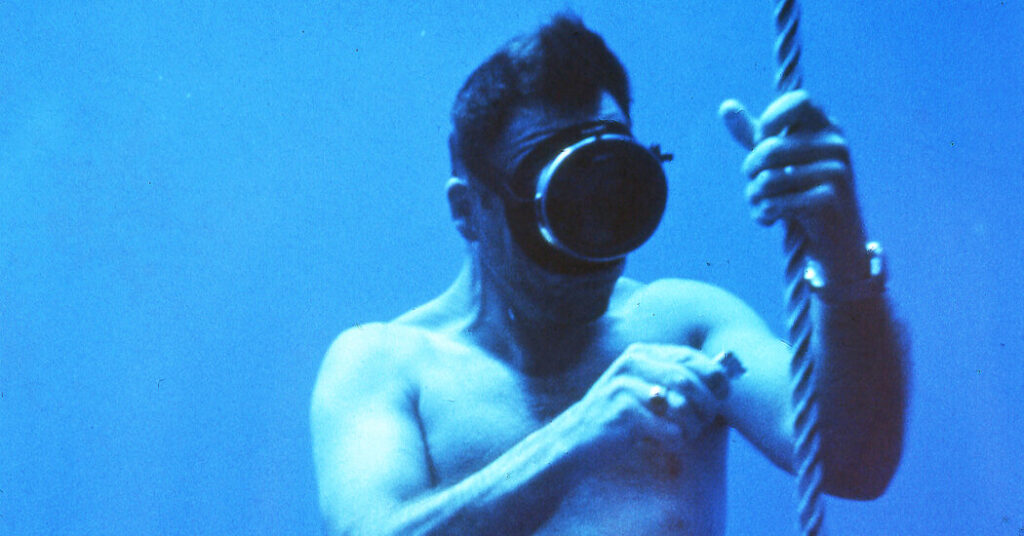
Bob Croft, a daring Navy diver whose unusual ability to inflate his lungs well beyond normal human capacity enabled him to make record plunges of up to 240 feet into the Atlantic Ocean on a single breath — without a scuba tank or fins — died on Jan. 9 in Lebanon, Pa. He was 91.
His son Jeff confirmed the death, in a hospital.
Mr. Croft’s feats — called free diving for its lack of breathing equipment — were the subject of a study in the journal Science; a CBS News documentary that showed him in action during one of his record dives; and a picture spread in Life magazine, which covered another of his dives.
“Physiological measurements indicated that blood flow to Croft’s vital organs had picked up as he went lower,” Life reported in 1968, “an adjustment that occurs in diving seals and may indicate that man is more at home under water than he thinks.”
When he made his first record-setting dive, in 1967, Mr. Croft was a U.S. Navy petty officer first class working as a research subject on submarine escape procedures at the Naval Submarine Base in Groton, Conn. In a test dive at the 40-foot mark in a 118-foot-deep water tank there, he held his breath for 6 minutes 10 seconds — an astonishingly long time — by inflating his lungs 50 percent longer than normal human beings could.
The achievement suggested that a very deep dive was possible.
In a video interview with the scuba instructor Alec Peirce in 2021, Mr. Croft said the Navy manual at the time “stated that if you went beyond 120 feet, you’d get a thoracic squeeze — and you’d die,” referring to how water pressure would fatally compress the lungs.
But a Navy physiologist had disagreed, telling Petty Officer Croft that by holding his breath he could probably “make a free dive beyond 200 feet without a problem.”
He then embarked on a private expedition, financed largely by himself, to break the free-dive record of 197 feet set in 1966 by Jacques Mayol, one of his main rivals in the sport. On Feb. 8, 1967, about two miles off the coast of Fort Lauderdale, Fla., Mr. Croft made his first attempt to top that mark, but fatigue and the water’s cold temperatures forced him to turn back at 185 feet.
Inclement weather prevented a second attempt.
On his third try, Mr. Croft descended holding a weighted metal device called a sled, which was attached to a rope.
At 100 feet, one of his escort scuba divers slapped him on the back, to tell him that he had passed his first significant depth. At 150 feet, a second diver gave him a slap. At 200, a third diver gave him a final slap.
“All I was thinking about was, Where was that next man?” Mr. Croft later told United Press International. “After I felt that third slap, I knew I’d done it.”
Once he passed 200 feet, he continued to 212.7 feet — the deepest point of his descent — where he activated the sled’s hand brake and fastened an alligator clip to the rope. He then climbed the rope, hand-over-hand, to the surface.
In all, he had spent 2 minutes 6 seconds underwater.
Back on the boat, he demonstrated that he was not tired by performing a set of push-ups. “I couldn’t have been tired if I had wanted to,” he said. “I was so happy.”
Mr. Croft, a brawny 5-foot-8, raised his record to 217.5 feet in late 1967 and then to a remarkable 240 feet in August 1968, breaking a record of 231 feet that had been set by Mr. Mayol that January.
Mr. Croft retired from free diving after the 240-foot dive, still believing he could have gone deeper. He left his goal of 250 feet to others. It has long since been exceeded: In 2023, Alexey Molchanov of Russia set the current record of nearly 512 feet.
Robert Arthur Croft was born on July 19, 1934, in Manhattan and grew up in Connecticut and Rhode Island. His father, John, was an engineer at General Dynamics’ Electric Boat division, which builds submarines in Groton. His mother, Jennie (Robinson) Croft, ran the home.
Living in Rhode Island, Bob swam in Narragansett Bay during the summers, dropped out of school at 13 and joined the Navy four years later. By then, he had developed a breathing technique called lung packing, which involves quickly gulping air and overinflating the lungs. He believed he was aided in this by a childhood case of rickets, which he said had softened his bones and expanded his rib cage.
In the Navy, he served on submarines and the Trieste II, a deep-sea research submersible. He also became a scuba diver and a trainer based at the submarine escape-training tank in Groton.
As a research subject at Groton, Mr. Croft was involved in underwater studies that showed evidence of the mammalian dive reflex in humans; it includes a shifting of blood from the body’s extremities to the thoracic cavity to prevent lung collapse, and it helped explain Mr. Croft’s tolerance of the ocean’s depths.
Doug Peterson, a free diver who trained Martin Stepanek, who in 2009 became the first person to reach the 400-foot depth on a single breath of 3 minutes 36 seconds, said that in addition to lung packing, Mr. Croft’s should be rightly recognized for the research he participated in and for being the leading American in free diving.
Divers still use lung packing, Mr. Peterson added, but have adopted other training techniques to dive deeper than Mr. Croft did.
“Bob was wonderful at sharing his ideas and techniques,” Mr. Peterson said. “When Martin and I started setting records, we wanted to be exactly the same. We shared everything with anybody that asked — no secrets, no secret techniques, just hard work and probably a genetic predisposition.”
After retiring from the Navy in 1974, Mr. Croft helped make recompression chambers for oil rig divers, taught scuba diving in the Bahamas and made training videos for Dresser-Rand, a compressor manufacturer.
He donated the rope and sled he had used to make his record dives to the History of Diving Museum in Islamorada, Fla. The museum opened a free-diving exhibit, built around those implements, in 2016. “He was adorable,” said Lisa Mongelia, the museum’s executive director. “A typical salty dog.”
That year, he received the NOGI Award, a prestigious diving honor, from the Academy of Underwater Arts and Sciences.
In addition to his son, Mr. Croft is survived by his wife, Edna (Haskins) Croft; and two other children, Jennifer Schaadt and Randall.
Before his first record-setting dive in 1967, Mr. Croft sold sewing machines, worked part-time in a department store, used savings and signed an endorsement deal with Rolex to help fund the $11,000 expedition (almost $119,000 in current dollars).
“It’s no longer a fun thing — it’s a job,” he said at the time in an interview with the New London, Conn., newspaper The Day. “I’ve been working my tail off.”
Richard Sandomir, an obituaries reporter, has been writing for The Times for more than three decades.
The post Bob Croft, Who Dived Deep Into the Ocean on a Single Breath, Dies at 91 appeared first on New York Times.