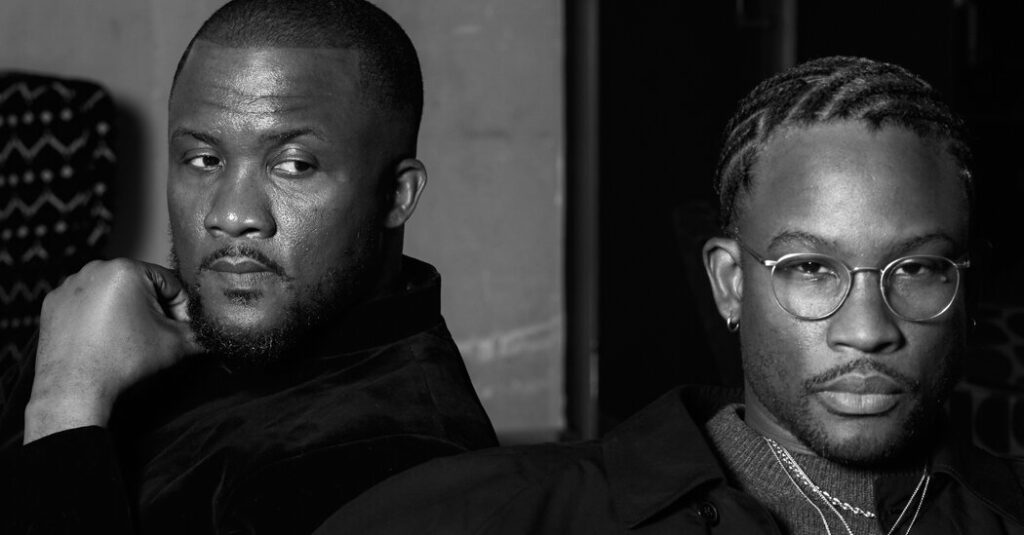
When Akinola Davies Jr. was 20 months old and his brother, Wale Davies, was 4, their father died after an epileptic seizure. The loss shaped them in markedly different ways.
Akinola said that his brother was “drawn to other people’s fathers,” while he felt “repelled” from them. Wale said he had often searched for a father figure and added, “It was weird for me to find out that my brother didn’t feel the same.”
That dynamic has shaped the brothers’ debut feature film, “My Father’s Shadow,” a BAFTA-nominated coming-of-age saga that won prizes at this year’s Gotham Awards and comes to U.S. theaters on Friday.
The film follows two Nigerian boys, Remi and Akin — played by real-life brothers Chibuike Marvellous Egbo and Godwin Chiemerie Egbo — who spend a day running errands with their somewhat distant father as one of Nigeria’s most politically significant moments unfolds.
Written by Wale and directed by Akinola, the story is loosely based on “the lack of experiences with my father,” Wale said, and moves to “imagining what those experiences could be.” Because his understanding of his dad came from talking to other people, he said, he had to “piece together a narrative as to who this person really is,” though the story is not a replica of any real person or events.
Sope Dirisu, who plays the father and is one of the movie’s executive producers, said that Akinola had told him before filming began that he did not want him to play a copy of his father. Instead, he said, Akinola asked him to paint a complex picture of men in Nigeria. For Wale, Akinola and Dirisu, the character — who spends many days away from his rural home to work in the city — becomes an exploration of masculinity.
“What’s really lovely about the journey that he goes on,” Dirisu added, was seeing the character’s love for his children change “from this space of duty to emotional connection,.”
Wale and Akinola were born in Britain and raised between there and Nigeria, and both said that the film’s location — in Lagos, Nigeria’s largest city — was central to the story’s evolution. Over the course of a single day, Remi and Akin traipse around the city with their father as he tries to collect his unpaid wages. As they traverse Lagos, they overhear grown-ups talk about fuel shortages and difficulty getting money out of the bank. The military is a regular and ominous presence, and people are eagerly watching TV screens in hopes of good news.
It is 1993, and Nigeria is set to announce the results of its first democratic election after a decade of dictatorship. The anticipation is palpable.
“I think the only thing that’s ever given us that collective excitement is maybe football,” said Wale, who was 11 at the time, the same age as Remi in the film. “It was a sustained feeling of something being about to change and, even as a child, I felt it.”
But when the leader of Nigeria’s military government, Gen. Ibrahim Babangida, annulled the results less than two weeks after the vote, unrest spread across the country and, Wale recalled, turned the sense of joy “into deflation.”
The juxtaposition of the family dynamic and the fraught historical context offered an opportunity to represent Nigeria with “nuance” and “authenticity,” Akinola said. It also influenced the choice of supporting actors, many of whom are prominent in Nigeria’s Nollywood film industry.
Akinola explained that diasporic directors might be “worried about the theatricalness of Nigerian acting” and whether Nollywood actors can play more muted roles. But he said, “a lot of those people have so much experience that it just takes a certain level of confidence in a director to say, ‘Look, what we’re doing is not theatrical.’”
As would be the case for a working-class family in Nigeria, the film moves between three languages: English, Yoruba (one of Nigeria’s official languages), and Pidgin (which borrows from Indigenous languages and English). Dirisu, a British actor of Nigerian heritage, said he had spent weeks honing his speech and intonation for the film and had worked with a dialect coach on set.
“My parents spoke Yoruba at home, but they didn’t speak it to us growing up,” he said, “so it’s not a language that I have in my back pocket.”
“Being of the diaspora rather than the country has, for many of us, created this internal dissonance of belonging,” Dirisu said. “It was something for me to battle and tackle over the course of the production period.”
As committed as the movie is to verisimilitude, it is not without moments of wonder. In one emotionally charged and seemingly surreal scene, people storm at a whale on the beach, and Wale said many viewers had asked him how he came up with the idea. Yet in reality a similar episode happened during his time living in Lagos over the past two decades, he explained.
“A whale had washed up, and I went to see it,” he said. “When I got there, to my surprise, people were cutting meat from it to take to their families or to sell.”
Akinola said that some aspects of the film might be “more universal than maybe we give credence to,” but “the specifics of what this character goes through is completely Nigerian” — making its success a significant moment for films coming out of the country. “The film is a love letter to Lagos,” Wale added.
When it premiered at the Cannes Film Festival last May, “My Father’s Shadow” was the first Nigerian film to feature in the festival’s official selection. Its inclusion has made Akinola optimistic for other African stories yet to be told and hopeful that stories by filmmakers of “mixed identity and mixed heritage” can be added to the canon.
He said that attending screenings of the film had felt rich for him — and for others, too.
“What I would say from those experiences is that people feel seen,” Akinola said. “They feel humbled to see their experiences onscreen and feel even more overwhelmed to see their family’s.”
The post A Family’s Memories and a Nation’s Struggles in ‘My Father’s Shadow’ appeared first on New York Times.