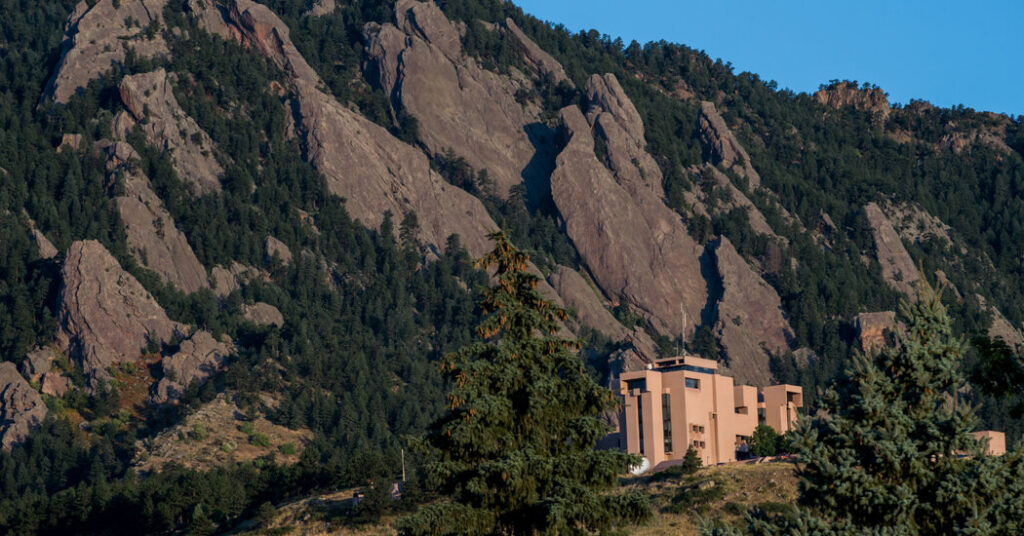
The U.S. National Science Foundation said on Thursday that the management and operations of a supercomputer used by more than 2,000 climate and weather scientists across the country would be transferred from a leading research lab to an undisclosed third party.
Science foundation officials said stewardship of the supercomputer, located at a National Center for Atmospheric Research facility in Cheyenne, Wyo., would “transition to a third-party operator” but declined to give details about the new operator or the timeline.
The national center, known as NCAR, has 835 scientists and engineers at its headquarters in Boulder, Colo., and has managed the Cheyenne facility since it opened in 2012.
The announcement took many scientists by surprise.
Ramalingam Saravanan, a professor of atmospheric sciences at Texas A&M University, said he was concerned that he would no longer be able to run computer models that predict weather and climate conditions around the globe down to a scale of one square kilometer.
“If you are able to use the computers just as before, we can do business as usual,” Dr. Saravanan said. “But there’s a bigger context, which is, they’re dismantling other parts of NCAR as well, and this seems to be related to that.”
“There’s certain synergy in having different parts of an institution that work together,” he added. “If it is dismantled, those synergies could be lost.”
Marc Alessi, a climate science fellow at the Union of Concerned Scientists, a science advocacy group, said researchers like himself were “freaking out a little bit” because of the uncertainty. “If you talk to any meteorologist, climate scientist, we have all used this supercomputer,” Dr. Alessi said. “But now, there’s no clear guidelines about who it will go to or if scientists can continue using it.”
The National Science Foundation said in a statement it was “working with all parties to ensure continuity of operations, and additional information will be shared as it becomes available.”
A spokesman for the National Center for Atmospheric Research declined to comment.
The center, founded in 1960, is responsible for many of the biggest scientific advances in humanity’s understanding of weather and climate. Its research aircraft and sophisticated computer models of the Earth’s atmosphere and oceans are widely used in disaster warning and weather forecasting around the United States.
The supercomputer, named Derecho for a fast-moving and powerful type of wind storm, has the theoretical ability to perform 19.87 quadrillion calculations per second, using 328 graphics processing units built by Nvidia. That computing power is the equivalent of every person on the planet solving one calculation every second for a month, according to the NCAR website.
About 2,000 scientists use Derecho to study air pollution, wildfires, hurricanes and solar storms, among other climate and weather events. Scientists say understanding these phenomena requires the analysis of millions of pieces of data to identify trends that can help with warnings and emergency preparedness as well as basic science.
In December, White House officials announced that they planned to dismantle the National Center for Atmospheric Research. Russell Vought, the director of the Office of Management and Budget, called the center “one of the largest sources of climate alarmism in the country” and said that the federal government would be “breaking up” the institution.
Mr. Vought wrote that a “comprehensive review is underway” and that “any vital activities such as weather research will be moved to another entity or location.”
Lisa Friedman contributed reporting.
The post A Climate Supercomputer Is Getting New Bosses. It’s Not Clear Who. appeared first on New York Times.