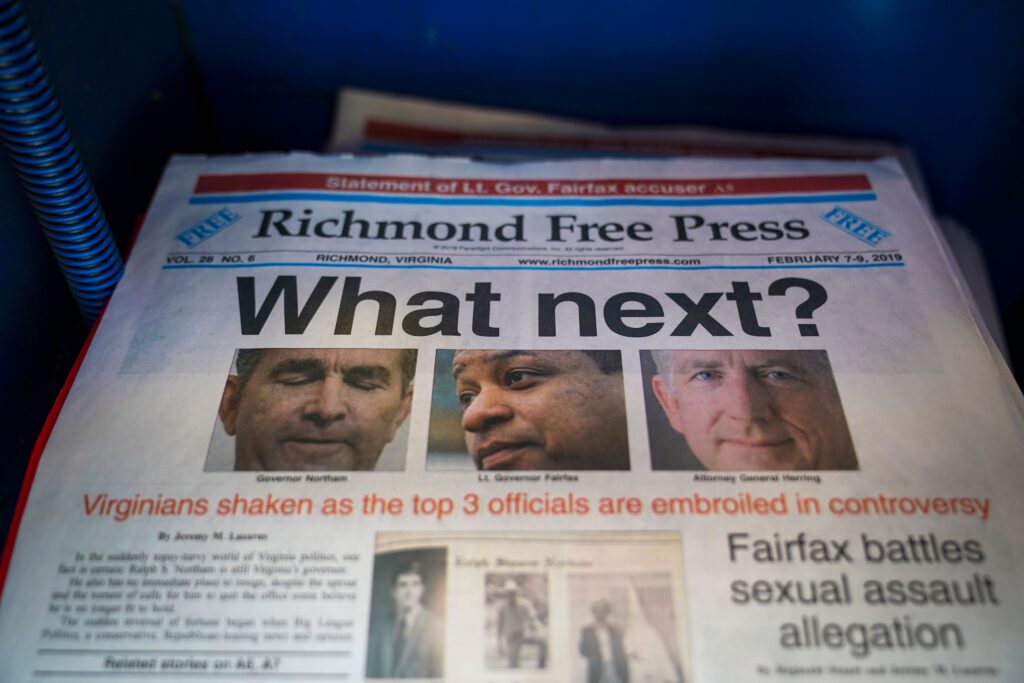
The Richmond Free Press, a Black-owned weekly newspaper that has served Virginia’s capital city for more than three decades, announced Thursday that it is ceasing publication, citing a collapse in advertising revenue that made the paper unsustainable.
“We know for sure that we do not have the advertising support to continue,” publisher Jean Patterson Boone wrote in a farewell message on Instagram. “All goodbyes are not forever. And this may be. Or not.”
Raymond H. Boone Sr., a newspaper reporter turned journalism school professor, founded the paper in January 1992 after leaving his job teaching at Howard University. In Richmond, the former capital of the Confederacy, Boone saw a media landscape that he thought failed Black readers.
“You see, newspapers to a large degree ignored the principles of journalism of being fair,” he said in a 2003 interview. “Instead, they promoted segregation, and they promoted what was popular rather than honoring the First Amendment which stands for giving free expression to all segments of the community.”
He hailed Black newspapers as an antidote to these ills. “The Black press was founded with the mission of telling the other side of the story, to be a protest instrument against injustices.”
Julian Maxwell Hayter, a historian at the University of Richmond, said the city’s Black newspapers, including the Richmond Afro-American and Richmond Planet, were “effectively the only voice for African Americans in Richmond for a very long time.”
The mainstream newspapers, Hayter said, were not an option for the Black community. “The Richmond Times-Dispatch and the Richmond News Leader were pro-segregationist papers,” Hayter said. “These [Black] papers were the epicenter of massive resistance. So African American newspapers in a certain way were about as close as you were gonna get to objective journalism in the South.”
Raymond Boone died in 2014, and Jean, his widow, continued as publisher, keeping the paper alive for more than another decade alongside a small staff that included family members: Their son, Ray Jr., served as vice president of new business development, and daughter Regina was a photojournalist.
The closure adds to a shrinking landscape of Black-owned newspapers nationwide. Once numbering in the thousands during the 20th century, Black papers have faced decades of consolidation and closure as advertising revenue migrated online and readership habits shifted.
In her Instagram post, Jean, who did not respond to a request for an interview, questioned the root causes of the paper’s collapse. “Each week our advertising lineage has diminished. Yet the quality remains,” she wrote on Instagram. “Payment has become slower and slower. Is it racism? Is the Free Press no longer relevant?”
The Free Press is also the latest casualty in a brutal stretch for local journalism, which has been hit hard by the migration of advertising dollars to digital platforms and flagging subscriptions. Nearly 40 percent of all local U.S. newspapers have vanished since 2005, according to a report from Northwestern University’s Local News Initiative.
Brandon Nightingale, senior project manager for the Black Press Archives at Howard University, called the Free Press’s closure unfortunate. “I just hate to hear it,” he said. Howard’s project has preserved Free Press editions from 2001 to 2021 as part of an ongoing digitization effort.
Still, Nightingale said, the closure isn’t indicative of a total collapse of the Black press, pointing to long-standing newspapers like the Baltimore Afro-American, first published in 1892, and the Washington Informer as models of success.
That the Free Press survived as long as it did, Hayter said, “is a miracle.” But he noted that the decline of the Black press is tied to broader demographic shifts — gentrification and the dispersion of Black communities to the suburbs — that have eroded the concentrated readership these papers once served. “The communities that made those newspapers possible,” he said, “no longer exist like they once did.”
Virginia Attorney General Jay Jones said the paper’s loss hurt the community. “A pillar of Virginia’s Black community, it told our stories and demanded justice,” Jones wrote in a post on X. “Growing up, my grandma Corrine had my dad bring copies home to Norfolk from Richmond as those pages carried our voice and our history.”
Gov. Abigail Spanberger (D) thanked the paper for its service to the Richmond community in lamenting its end. “The closing of the Richmond Free Press is another major loss to those who value independent journalism and speaking truth to power,” she wrote on X.
The paper’s final print edition ran last week. The paper offered a digital-only version on Thursday that covered several stories: the City Council’s push to increase pay for janitors, an obituary for a longtime Virginia NAACP leader, and a centenarian quilt-maker who rejected a Black History Month tribute from a member of Congress after learning he’d recognized her on the House floor without her knowledge.
The lead story? Its own closure, replete with details of the most worrying times of its three-decade past, including threatening phone calls, vandalism of its news boxes and “hostility from white-owned publications.”
In her Instagram post, Jean seemed to leave the door open for a possible return. “And so, this chapter ends. Perhaps, dear Reader, we’ll meet again.”
The post A Black newspaper in the former capital of the Confederacy is closing appeared first on Washington Post.