The Trump administration’s surprise announcement on Thursday that it was pulling immigration agents out of Minnesota ends an operation that started late last year, drew fierce opposition from residents across the Twin Cities, and resulted in the fatal shootings of two U.S. citizens by federal agents.
A drawdown in agents has already begun, said Tom Homan, the White House border czar, and will continue next week. The administration brought thousands of agents into Minnesota to help crack down on illegal immigration, officials said, making more than 4,000 arrests.
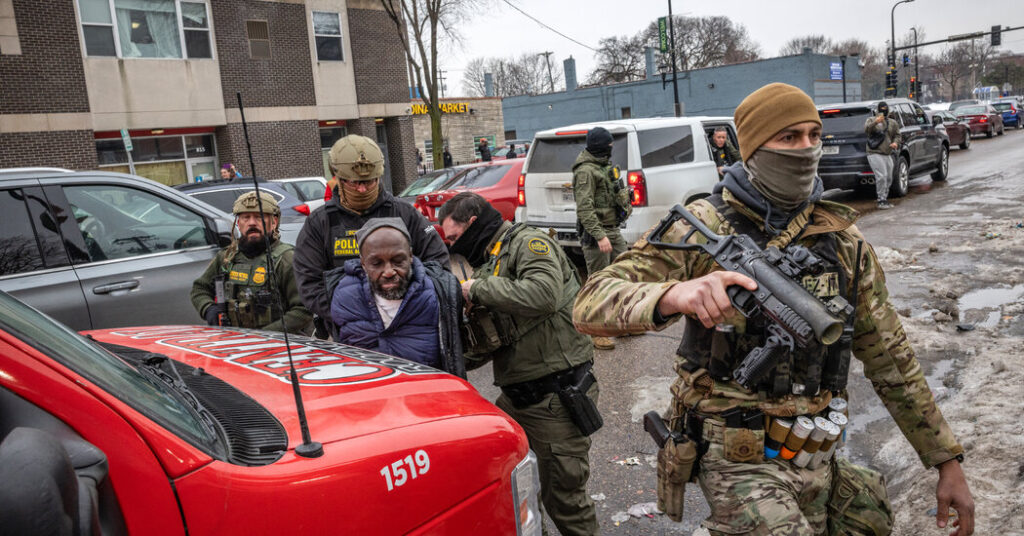
But many Minnesotans saw the effort as a frightening invasion in which masked agents physically confronted and assaulted civilians.
Here are five takeaways from the last two months in Minnesota.
Agents’ use of force intensified in Minnesota.
In Los Angeles and Chicago last year, the Department of Homeland Security swept into residential neighborhoods and busy commercial areas, making arrests of people they suspected were in the country illegally and often deploying tear gas or pepper spray if civilians shouted at them or tried to get in the way.
Those tactics were widely criticized by the public, particularly since federal agents rarely warned civilians to disperse before they used tear gas. In several clashes in Chicago, people breathed in tear gas even while inside their own homes and cars.
In the Twin Cities, the confrontations grew more intense and turned more violent. Agents were captured in widely shared cellphone videos breaking car windows, pushing passers-by to the ground, pointing guns at residents and fatally shooting Renee Good and Alex Pretti.
The administration also increased the number of agents assigned to a single operation. While hundreds of agents from Immigration and Customs Enforcement and the Border Patrol participated in the operations in Los Angeles and Chicago, more than 3,000 agents were sent to the Twin Cities.
Thousands of people were arrested, an answer to a Trump campaign promise.
More than 4,000 people were arrested during the crackdown, called Operation Metro Surge, a number that surpassed arrests in Los Angeles and Chicago during the surges in those cities.
President Trump frequently accused Democrats during his 2024 presidential campaign of failing to secure the nation’s borders and vowed that if elected, he would institute the largest deportation campaign in American history. Republicans and moderates supported his efforts, saying that they were looking to Mr. Trump to fix a broken immigration system.
Kristi Noem, the homeland security secretary, said that the crackdown in Minnesota has yielded the arrests of many people who have committed violent crimes but were not detained under the state’s legal system.
The local economy has suffered a deep blow.
The damage to the economy in the Twin Cities has been obvious from the street level. For months, many immigrants, including those with U.S. citizenship or legal residency status in the country, have been too afraid of ICE agents to leave their homes to go to work or go shopping.
Cafes and restaurants in Minneapolis, especially in neighborhoods with large immigrant populations, have stood empty. Foot traffic in once-bustling Hmong markets in St. Paul has dropped precipitously.
Business owners said that the last two months have felt as terrible economically as the Covid pandemic.
It’s not clear how quickly the economy can recover. “They left us with economic ruin in some cases,” Gov. Tim Walz of Minnesota said on Thursday.
Some Minnesotans said that they were skeptical that Mr. Homan was telling the truth about the drawdown of agents, and that it would take weeks or months before they feel comfortable moving around their communities as they once did.
Neighbors formed hyperlocal networks to help one another and watch for ICE.
As immigration agents depart Minnesota in the coming days, they leave behind an unusual network that residents of the Twin Cities built to communicate about the crackdown.
Tactics used by Minnesotans who opposed ICE operations were also employed in Los Angeles last year, when neighbors formed Signal chats and Facebook groups to track and monitor immigration agents’ activities. In Chicago, volunteers and activists expanded those tactics, handing out whistles to warn of ICE presence and holding “know your rights” trainings sponsored by local aldermen.
Minnesotans took it further, informed by groups in Chicago, Los Angeles and even 1960s radical organizations like the Black Panthers and the American Indian Movement.
Some conservatives said it was those Minnesotans — often called “agitators” by Trump officials — who were contributing to the tension and causing clashes if they interfered with agents. Dozens of people have been charged with impeding federal officers.
Andrew Fahlstrom, a Minneapolis activist who operates a site called Defend the 612, credited the opposition to ICE for the administration backing out of the state.
“Minneapolis has become safer because tens of thousands of neighbors united together in common purpose to openly and courageously respond to the violent and immoral ICE surge day after day,” he said.
Polls show that most Americans have soured on ICE.
There are signs that Americans, even some who favor stronger immigration laws, are not happy with the administration’s methods. A poll in January from The New York Times and Siena University, conducted before Mr. Pretti’s death, found that 61 percent of voters, including nearly one in five Republicans, said the tactics used by ICE had “gone too far.”
And the Republican Party’s advantage on immigration could be shrinking, according to a new poll from The Associated Press and the NORC Center for Public Affairs Research. That poll showed that Republicans now hold only a 4-percentage-point edge over Democrats on which party Americans trust to handle immigration, down from a 13-percentage-point advantage in October.
When asked about how Mr. Trump has handled immigration, 58 percent of voters polled in January said that they disapproved, and 40 percent said that they approved.
Ruth Igielnik contributed reporting.
Julie Bosman is the Chicago bureau chief for The Times, writing and reporting stories from around the Midwest.
The post 5 Takeaways From Trump’s Immigration Crackdown in Minnesota appeared first on New York Times.