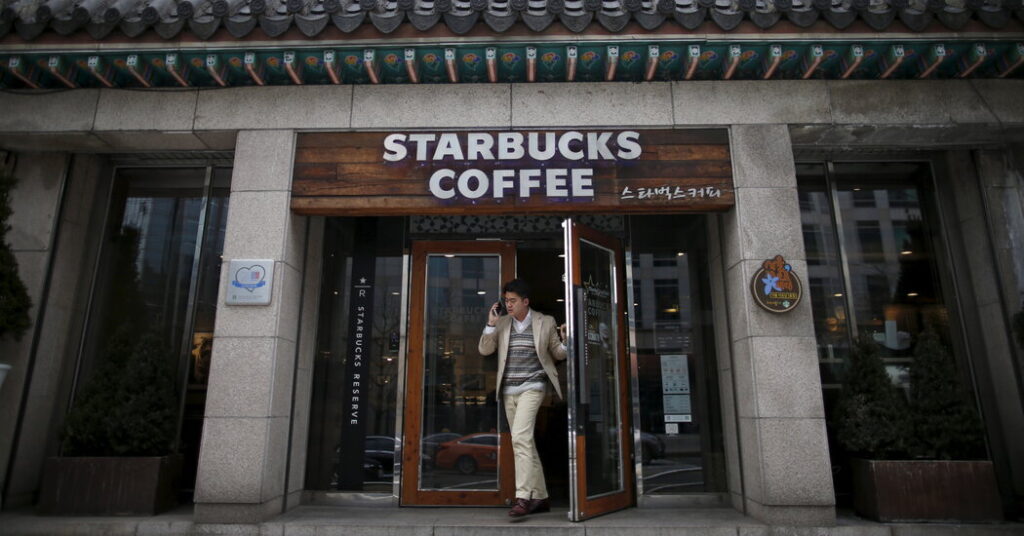
A group of flight attendants walked into a Starbucks in Seoul on Monday and set down their bags, taking over nearly all the seating in the coffee shop. They ordered their drinks, picked them up and then left — without taking their belongings.
They returned hours later and retrieved their bags, which had remained untouched.
It was the fourth or fifth time this chain of events had occurred at the store in recent days, a Starbucks employee said. Eventually some other customers looking for a spot to sit walked out because there was no room.
The commotion, minor as it was, made it to local news media on Tuesday. One report on YouTube got more than a million views, with many viewers leaving comments criticizing the airline employees for claiming space for hours without actually using it.
The comments were devoid of any concern over the safety of the bags themselves.
This is the culture in South Korea, where low crime rates and high surveillance rates have contributed to a sense of trust and safety in public spaces.
It is common for South Koreans to leave their personal belongings to claim seats in public places like cafes and restaurants.
During lunch hour on Wednesday in downtown Seoul, nearly 20 cafes had at least one table strewed with unattended items. A Gucci bag was left on a chair near the entrance of one. A black Marni purse was on top of a table that faced the window in another. Smartphones, laptops and jackets were scattered across seats in others.
South Korea relies heavily on video cameras to monitor public spaces. Since 2008, the nation has drastically increased the number of CCTV cameras in public places from less than 200,000 to nearly two million in 2024, according to government data.
The number of thefts has decreased by a third in the past decade, government data show, even as other problems such as cybercrimes have increased.
Kim Lee-jung, an office worker in Seoul, said he often leaves his belongings to mark his seat when he goes to coffee shops.
“The thought of having my stuff stolen has never occurred to me,” he said. “It feels natural to just leave it.”
Like many cafes and restaurants in South Korea, Starbucks does not prohibit customers from leaving their personal belongings in their seats, but has in the past restricted the use of large items like desktop monitors and printers. Its staff has the authority to ask customers to leave if they are disturbing others. That was the case with the flight attendants, who were asked to leave because their bags were turning other customers away, according the company.
“We apologize for inconveniencing Starbucks and the other customers,” Asiana Airlines, which the flight attendants worked for, said in a statement. An airline spokeswoman said the flight attendants had left the cafe to attend visa interviews required for work at the nearby U.S. Embassy, where large bags are prohibited.
The Starbucks store in question, in Gwanghamun Square, was not very busy when a reporter visited it on Thursday morning.
South Koreans may have traded a bit of privacy for increased safety, but that’s why the country is incredibly safe, said Han Min Kyung, a criminology professor at Korean National Police University.
“Women can walk outside at night without having to fear major crime,” she said. “I wonder in how many countries we can do that.”
Jin Yu Young is a reporter and researcher for The Times, based in Seoul, covering South Korea and international breaking news.
The post Would You Leave Your Bag Unattended at a Starbucks? They Did. For Hours. appeared first on New York Times.