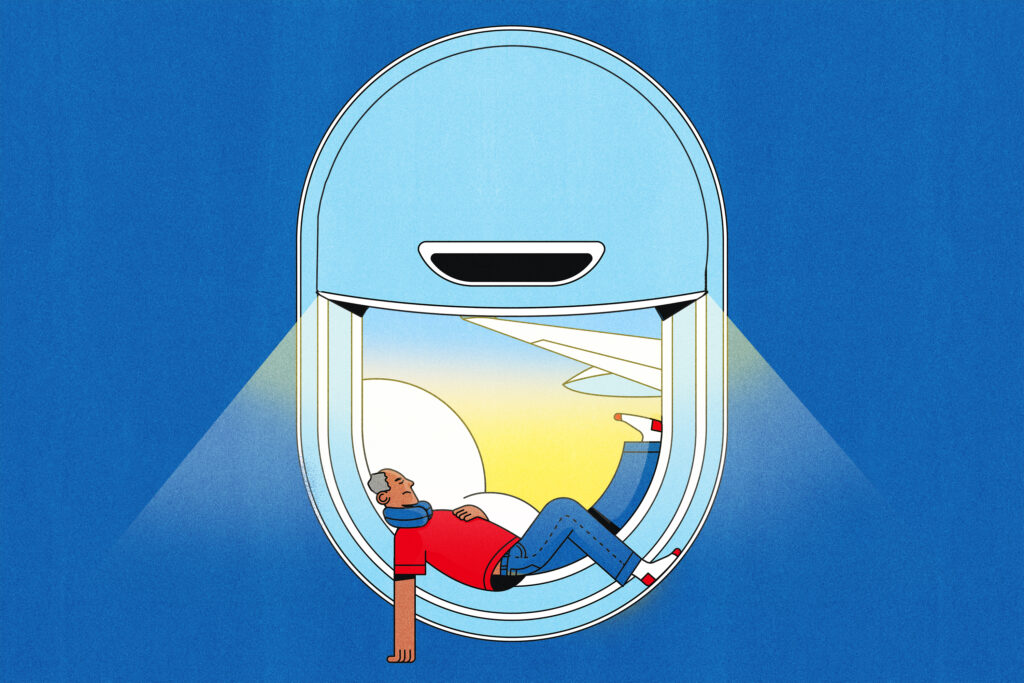
Jeffrey Morgenthaler was flying home from Grand Cayman last month when he noticed something distressing: The view was “gorgeous,” but he was the only one enjoying it.
“Every single other window is closed,” the Portland, Oregon, bartender and author said. He took his observation to social media.
“Can we re-normalize leaving the windows open on daytime flights?” he asked in a post on Threads. “I’m flying over the beautiful Caribbean in a dark metal tube right now.”
The reactions poured in. Many were pro-darkness. Some were hostile. Someone asked what Morgenthaler thought he would see from 35,000 feet.
“Am I crazy?” the 54-year-old said in an interview. “I just think it’s very beautiful! It’s the miracle of flight and it’s stunning out there! It’s the planet Earth!”
With his question, Morgenthaler unknowingly waded into a debate that has been raging in public discourse for years. “Why Window Shades Should Be Kept Closed On Your Next Flight,” reads a headlineon the travel blog View From the Wing. The Wall Street Journal chronicled“The Showdown at the Window Seat” in 2019. A take from Slate: “Flying is better with an open window shade.” Guides to window shade rules abound.
On social media, feelings run hot. Tales fly about people reaching across passengers to lower their shades. But keeping them closed is a “borderline sociopathic trend,” according to some. Others say having the window open while people try to sleep is “diabolical.”
Even the president of the United States has weighed in, kind of. According to media reports, President Donald Trump recently said at the National Prayer Breakfast that he doesn’t sleep on planes and prefers “looking out the window, watching for missiles and enemies, actually.”
Marisel Salazar, a cookbook author and food and travel writer, posted a pictureon Threads of a bright window and part of an arm in the row in front of her on a December flight. She said the glare was bothering her and others around the man, but she didn’t ask him to lower his shade — and wasn’t sure if etiquette would even allow for that. She put on sunglasses to ward off a headache and kept her own shade closed.
“It’s pretty annoying to be wide awake and not be able to do anything else on an airplane because somebody else is causing a disturbance,” Salazar told The Washington Post. She called the reaction to her post “viral and divisive” — skewed toward the crowd who believed whoever paid for the ticket had the control — and eventually turned the comments off.
“People are extremely passionate about it,” she said. “I think it’s like the new reclining seat.”
Window Open Gang I’m that girl
#windowseat #flyin #travel #imjustagirl #cancunmexico #caribbean
♬ Hypnotize (Instrumental) [2014 Remaster] – The Notorious B.I.G.
Window etiquette
Etiquette expert Jacqueline Whitmore, a former flight attendant, said there are no strict rules about the position of a window shade, just personal preference and common sense. But it’s clear who gets to make the call, she said: The person sitting in the window seat has the “responsibility or privilege” of controlling the shade.
If neighboring passengers in the middle or aisle seats are suffering from the glare, she said it’s fine to politely ask the person by the window if they could lower their shade. If they can tell there’s an issue with the light, most people will accommodate the request, she said.
One irritating habit travelers should avoid: constantly opening and closing the window. “That’s something you really shouldn’t do,” Whitmore said.
It’s okay to ask if someone is willing to open their window, too, as long as they’re not sleeping. Maybe the pilot just announced you’ll be passing over something picturesque and you’d like to try to sneak a peak. No guarantees, though.
“If you feel like you’re missing out, I would just say book a window seat,” Whitmore said.
Rich Henderson, a Philadelphia-based flight attendant for a major U.S. airline and a host of the podcast “Two Guys on a Plane,” said passengers sometimes ask flight attendants if they can intervene to get shades lowered, but he prefers that customers try to work it out between themselves.
“You try first and I’ll come in as backup as needed,” he said.
Henderson said he’s witnessed the debate between “some people who want darkness and some people who don’t” for the nearly 13 years he’s been in the profession.
“Both sides of the spectrum are so die-hard about it,” he said.
Those favoring the dark often want to see the screen of their electronics better, or sleep to readjust to a time zone even in broad daylight. Fans of open windows praise the views, but also say the position helps them deal with claustrophobia, anxiety or motion sickness.
Henderson likes the windows on the Boeing 787 Dreamliner, which can be electronically dimmed to varying degrees rather than just open or shut.
“Just dim it a little; you can still look out the window and you’re not bothering anyone,” he said.
Henderson said that when he flies as a passenger, he’s glued to the window at takeoff and landing to observe the conditions and make sure there’s nothing that would need immediate attention.
“At cruise, the window is shut,” he said.
‘Best practice’
The Federal Aviation Administration does not regulate window shade position, though individual airlines might make requests. United, for example, said in a statement that it encourages customers to open their shades before takeoff and landing but does not have a requirement in place.
Delta may ask passengers in exit rows to keep their shades up for “safety visibility,” the airline said in a statement.
“Flight attendants are safety professionals and may request a window shade to be opened or closed during specific events and ask that customers comply with these requests,” the carrier said.
Delta noted that most airlines in Europe and Asia require window shades to be open when the plane takes off and lands so crew members can see conditions outside and so people’s eyes can adjust to the outside light in case of an emergency.
The International Air Transport Association, a global trade group, said it is “best practice” to have open shades during the taxi, takeoff and landing portion of flights. That position “allows all cabin occupants including the cabin crew to improve situational awareness and be aware of any external emergency situation which may require evacuation.”
‘A new thing’?
Morgenthaler said he has noticed a greater shift toward in-flight darkness in the past few years, as well as flight attendants asking passengers to close their windows as they leave to keep the plane cool. He’s noticed the trend particularly on U.S. flights.
“This just seems like a new thing where everybody seems to want to sit in the dark and play on their phones,” he said. He’s been asked “many times” to close his window and abides by generally accepted norms of air travel.
“If [the sun’s] blazing in and making everything hot, pull the shade down,” he said. “I understand what the rules of etiquette are. I’m not a monster.”
Kelly Meng, 27, a cooking and lifestyle content creator, was on a January flight from Chicago to Tokyo that stayed sunny as it headed over the Arctic. She recounted in a video on TikTok how exactly one person on the plane — who had the window seat in her row — refused to fully dim their window, even after a flight attendant asked.
A man in the middle section of the plane held an airline pillow up to the side of his face for nearly an hour to block out the sun, Meng said in an email.
“I am usually an avid aisle-seat lover,” she said. “But this has made me reconsider for long-haul flights.”
The post Window shade up or down on a plane? You’ll make enemies either way. appeared first on Washington Post.