Show me your YouTube watch history, and I will tell you who you are.
In my household, many of the videos on rotation are eye-rollingly on-the-nose for a modern Brooklyn couple in their 40s: deep dives into ancient Roman history, interviews with professional chefs, outtakes from the British comedy show “Taskmaster.”
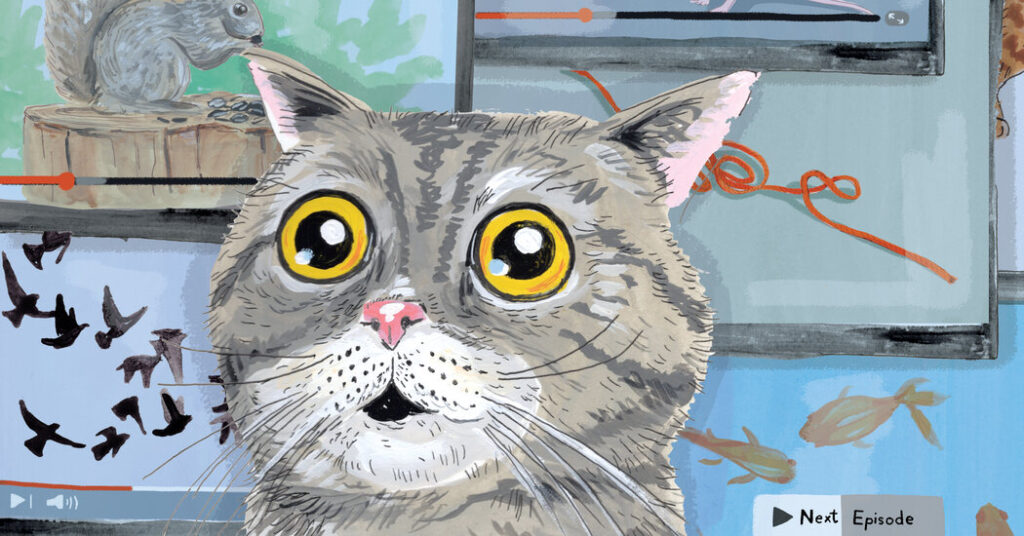
But the most-viewed video in our apartment is a more curious artifact: footage of a strand of yarn being dragged across the screen. The video, created by the YouTube channel TV BINI, lasts over an hour and is scored with recordings of birdsong. Its devoted viewer? Our 2-year-old cat Goose.
Once upon a time, back in those young, halcyon days of the internet, cats were the stars of social media, muses for early memes and viral videos. Over the last two decades, however, we have progressed from making videos of cats (still a popular pursuit, of course) to making videos for them.
YouTube alone offers more content than my own three pets — two cats and a dog — could watch in a lifetime: videos of squeaky toys and squirrels, animated fish and feathered balls, eight hours of British birds and 21 hours of puppies playing. Roku users can download apps like “Happy Dog TV” and “Relax My Cat.” And DOGTV, a television channel and streaming service, has cinematographers who shoot original canine content in more than 20 countries, said Ron Levi, the company’s founder and chief content officer.
It’s a development that seems, somehow, both surprising and inevitable — the product of a society in which pets have become bona fide family members and fragmentation has become a defining feature of the media ecosystem. Media companies now offer niche content designed to satisfy every conceivable kind of viewer. Why not four-legged ones?
Animal audiences
When I first heard about DOGTV, more than a decade ago, it was easy for me to dismiss it. The original idea, which came to Mr. Levi in 2006, was to create a television channel that could keep lonely dogs company while their owners were out of the house. “The idea is really to help them feel a little bit more relaxed and not anxious,” he told me. At the time, traditional TV was still king, and when DOGTV rolled out across the United States in 2013, it did so primarily as a premium cable channel, available for $4.99 a month.
I didn’t even consider subscribing. Sure, I happened to have my own Velcro dog (highly attached, determined to follow me everywhere), but I was also a freelance writer who spent most of my workdays at home and had a limited budget for cable.
But television evolved, and pet TV right along with it. DOGTV added a multiplatform streaming service and app, offering videos, many of them free, for seemingly every canine circumstance: videos for playtime or bedtime, breed-specific playlists, collections of dog-free videos for “reactive” dogs and others designed to desensitize nervous dogs to everyday noises.
At the same time, the rise of social media and streaming video platforms like YouTube meant that content creators didn’t need to start a full-fledged television network to get in on the pet TV game.
I didn’t realize how many people had done just that — or how creative their efforts had been — until my husband and I adopted Goose and Juniper, who is also a playful, active 2-year-old. Hoping to find more outlets for their seemingly endless energy, we cycled through some conventional feline fare (birds, mice, fish) before stumbling upon a whole library of videos of string.
And while our cats seem to enjoy a variety of genres, it’s the string videos that they respond to most reliably, jumping up and clawing at the moving strands. Goose, in particular, seems to enjoy the experience so much that whenever he hears the signature bloop of the TV turning on, he gallops into the living room and sits expectantly in front of the screen.
Pet preferences
Goose and Juniper appear to have company. Their favorite string video has 3.2 million views, and TV BINI’s most popular video — black mice scurrying across a yellow background — has more than 150 million views.
Still, those statistics reveal only how often humans are pressing play. There’s vanishingly little data on how pets are actually reacting to and engaging with all of this new content. (Cats are especially understudied, as is typical.)
One clear finding, however, is that not all animal content is created equal. A recent survey of American dog owners suggested, for instance, that dogs had little interest in videos of vehicles and only moderate interest in videos of people. Instead, dogs seemed to prefer videos of other animals, and one species in particular.
“Dogs like to watch dogs, just like humans like to watch humans,” said Dr. Freya Mowat, a veterinary ophthalmologist at the University of Wisconsin-Madison and an author of the study, which was published in 2024. “Which is kind of hilarious, if you bring it truly back to basics. It’s essentially soap operas for dogs.”
Such parallels only take us so far. A handful of studies have suggested that dogs are not exactly binge watchers, tending to pay attention in very short bursts — on the order of seconds, rather than minutes or hours.
And while we humans might settle deep into the couch to unwind with our shows, dogs are often activated by theirs, wagging their tails, barking and rushing toward the screen — a behavior that doesn’t necessarily indicate enjoyment. “You don’t know if that means, ‘I was just excited to go greet the thing that was on the TV and sniff its butt,’ or whether it was, ‘Oh my gosh, that’s a predator. I need to go attack it before it attacks me,’” Dr. Mowat said.
Pets with different personalities also seem to react differently. In a study published last summer, scientists found that dogs with excitable temperaments were especially likely to try to track objects, like balls or birds, off screen, while those with fearful temperaments were especially likely to respond to non-animal stimuli, such as doorbells, car horns and thunder.
I recognized my own anxious dog, Watson, in the fearful category. Watson has never shown much interest in TV, but he has been known to run out of the room when he hears certain sounds, like a referee’s whistle, coming from the speakers.
“You might be causing stress for some dogs with some of the videos you’re showing,” said Jeffrey Katz, a cognitive scientist at Auburn University and an author of the personality study. Although TV might be enjoyable for many dogs, he added, “we can’t assume it’s going to be that way for all dogs.”
Pressing paws
Indeed, for as much as some animals might truly enjoy pet TV, the genre would not have taken off if it didn’t also serve our own human interests and needs.
As Marek Jancovic, a media studies scholar at Vrije Universiteit Amsterdam, pointed out to me, we find it entertaining to watch our pets being entertained by screens, so much so that videos of pets reacting to TV has become its own content category online.
Turning on an eight-hour video of birds can also alleviate our own anxiety about leaving our pets alone, even if the cat gives it only a passing glance.
And sometimes, I confess, my husband and I turn to the string videos in desperation, when Goose, who also loves fetch, won’t stop meowing at us to throw his toy mouse for the thousandth time. (I had to resort to the string video more than once to finish this column.)
Still, we do sometimes feel guilty about outsourcing our cat enrichment to a screen. It’s a dynamic that is likely to be familiar to parents of young children, and it is already prompting discussions on Reddit about how much screen time is too much screen time for a pet. Seen in the worst light, pet TV can seem almost dystopian — just the latest way to commodify animals and a superficial fix for the fact that many modern pets may be lonely and understimulated.
But videos designed for animals could also, potentially, be used to strengthen the bonds between people and pets. Ilyena Hirskyj-Douglas, who directs the animal-computer interaction lab at the University of Glasgow, and her colleagues recently created MewTube, a tablet-based app designed to help visitors to a cat cafe interact with the feline residents by playing videos for the cats. (Results were mixed.)
Thoughtfully designed media systems could also give animals more “control and choice” over their lives and environments, Dr. Hirskyj-Douglas said. For a previous project, she built an immersive at-home theater that her dog, Zach, could turn on and off on his own, simply by approaching or retreating from the semicircle of screens.
Could pet-controlled remotes be next? It wouldn’t shock me. For all that remains unknown about animal audiences, what does seem clear is that our pets are highly discerning spectators, with their own preferences, interests and tastes — even if those preferences are as inscrutable as string.
Emily Anthes is a science reporter, writing primarily about animal health and science. She also covered the coronavirus pandemic.
The post TV, It’s Not Just for Humans Anymore appeared first on New York Times.