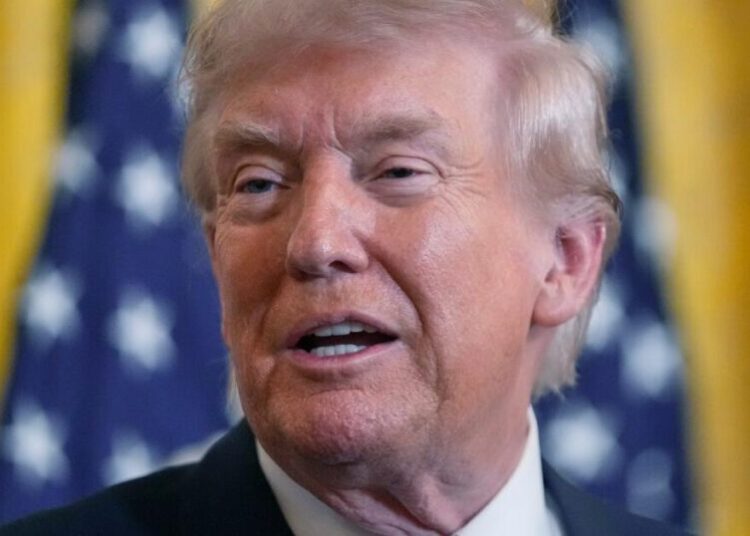
President Trump on Thursday announced he was erasing the scientific finding that climate change endangers human health and the environment, ending the federal government’s legal authority to control the pollution that is dangerously heating the planet.
The action is a key step in removing limits on carbon dioxide, methane and four other greenhouse gases that scientists say are supercharging heat waves, droughts, wildfires and other extreme weather.
Led by a president who refers to climate change as a “hoax,” the administration is essentially saying that the vast majority of scientists around the world are wrong and that a hotter planet is not the menace that decades of research shows it to be.
It’s a rejection of fact that had been accepted for decades by presidents of both parties, including Richard Nixon, whose top adviser warned of the dangers of climate change and the first President George Bush, who signed an international climate treaty.
And it is a knockout punch in the yearslong fight by a small group of conservative activists as well as oil, gas and coal interests to stop the country from transitioning away from fossil fuels and toward solar, wind and other nonpolluting energy.
“This is about as big as it gets,” President Trump said at the White House as a smiling Lee Zeldin, the administrator of the Environmental Protection Agency stood by. “We are officially terminating the so-called ‘endangerment finding,’ a disastrous Obama-era policy,” he said.
Mr. Trump called it a “radical rule” that became “the basis for the Green New Scam,” a label the president gives to any effort to curb emissions or develop renewable energy.
Mr. Zeldin called it “one of the largest deregulatory actions in American history.” The administration claimed it would save auto manufacturers and other businesses an estimated $1 trillion, although it has declined to explain how it arrived at that estimate.
At issue is what’s known as the endangerment finding, a 2009 scientific conclusion that greenhouse gas emissions pose a danger to Americans’ health and welfare.
For nearly 17 years, the E.P.A. had relied on the bedrock finding to justify regulations that limit carbon dioxide, methane and other pollution from oil and gas wells, tailpipes, smokestacks and other sources that burn fossil fuels.
By repealing the endangerment finding, the United States is likely to add up to 18 billion metric tons of emissions to the atmosphere by 2055, according to the Environmental Defense Fund, an advocacy group. That is about three times the amount of climate pollution the country emitted last year.
The added pollution could lead to as many as 58,000 premature deaths and an increase of 37 million asthma attacks between now and 2055, the group said.
But on Fox Business on Wednesday, Doug Burgum, the interior secretary, revived a debunked myth to sum up how the Trump administration views carbon dioxide, the main greenhouse gas.
“CO2 was never a pollutant,” he said. “When we breathe, we emit CO2. Plants need CO2 to survive and grow. They thrive with more CO2.”
While carbon dioxide can help plants grow, the extraordinarily high levels in the atmosphere are overwhelming natural processes and increasing the frequency and severity of drought, heat waves and other damaging events, according to scientists.
Democratic governors and environmental leaders immediately said they would challenge the administration’s actions in a high-profile legal battle that is likely to reach the U.S. Supreme Court.
“If this reckless decision survives legal challenges, it will lead to more deadly wildfires, more extreme heat deaths, more climate-driven floods and droughts, and greater threats to communities nationwide,” Gov. Gavin Newsom of California said in a statement. He said the state “will sue to challenge this illegal action,” and continue to regulate greenhouse gases.
“We will see them in court, and we will win,” added Manish Bapna, the president of the Natural Resources Defense Council. “The science and the law are crystal clear, and E.P.A. is issuing a rushed, sloppy and unscientific determination that has no legal basis.”
In revoking the endangerment finding, the Trump administration made the legal argument that the Clean Air Act only allows the government to limit pollution that causes direct harm to Americans, and only in cases where the damage is “near the source” of the pollution.
Greenhouse gases, however, collect in the atmosphere where they form a kind of blanket around the Earth, trapping heat from the sun. That is altering the Earth’s climate and intensifying heat waves, drought, hurricanes and floods while also melting glaciers, causing sea levels to rise.
The planet has warmed on average by about 1.4 degrees Celsius, or 2.5 degrees Fahrenheit, since the Industrial Age, according to Europe’s Copernicus Climate Change Service.
The action announced on Thursday eliminates limits on greenhouse gases produced by motor vehicles. Transportation is the largest single source of greenhouse gases in the United States. The Biden administration had sought to tighten limits on tailpipe emissions to encourage automakers to sell more nonpolluting electric vehicles. (Restrictions on other pollutants from automobiles, such as nitrogen oxides and benzene, are still in place.)
Getting rid of the endangerment finding clears the way for the E.P.A. to repeal limits on greenhouse gases from stationary sources of pollution, such as power plants and oil and gas wells, a process that it has begun.
.
The United States is currently the world’s second-largest climate polluter after China but is the nation that has pumped the most greenhouse gases into the atmosphere since the Industrial Revolution. That distinction matters because past emissions of long-lived greenhouse gases significantly contribute to current warming.
Numerous rigorous scientific findings since 2009 have showed that greenhouse gases and global warming are harming public health and even directly causing deaths.
Recent research has found that if the planet continues to warm at its current rate, exposure to wildfire smoke would kill an estimated 70,000 Americans each year by 2050, just one example of the health dangers posed by a heating planet. Another study found that deaths from extreme heat in the United States have more than doubled in recent decades.
And as the weather globally gets warmer and wetter, disease is spreading. Last year, 4,947 travelers from the United States contracted dengue, a mosquito-borne disease prevalent in tropical and subtropical climates, while abroad, a 30 percent increase over the previous year, according to the Centers for Disease Control.
Under the 2015 Paris Agreement, nearly all nations agreed to try to reduce their greenhouse gas emissions to limit global warming to 1.5 degrees Celsius, or 2.7 degrees Fahrenheit, above preindustrial levels. That goal has been seen as crucial to avoiding the worst effects of climate change.
Scientists now expect the Earth to warm by an average of around 2.6 degrees Celsius, or 4.7 degrees Fahrenheit, by the end of the century. Mr. Trump has withdrawn the United States from the Paris Agreement, making it the only nation among nearly 200 to do so. He also pulled the country out of the underlying United Nations climate treaty and a Nobel Prize-winning group made up of the world’s leading climate scientists.
Senator Chuck Schumer of New York and Senator Sheldon Whitehouse of Rhode Island, both Democrats, said the E.P.A. had abandoned its responsibility to protect public health and the environment.
“This shameful abdication — an economic, moral, and political failure — will harm Americans’ health, homes, and economic well-being,” they said in a statement. “It ignores scientific fact and common-sense observations, to serve big political donors.”
Despite decades of established science, President Trump has said projections of the Earth’s warming were done by “stupid people.” He has imposed policies to make it cheaper and easier to keep burning coal, gas and oil while throttling efforts to build cleaner energy sources such as solar and wind.
Reversing the endangerment finding has been seen as the holy grail for those who deny the science of climate change. That’s because if the repeal is upheld in court, it could also prevent future administrations from restoring regulations to curb greenhouse gases.
Mr. Zeldin and other administration officials said the endangerment finding had been a drag on the economy. They argued that requiring the E.P.A. to tackle climate change harmed consumer choice by limiting the types of automobiles available to purchase.
Some business groups supported the administration’s actions, but others were silent or muted in their response. That’s because trade groups that once opposed the endangerment finding, like the U.S. Chamber of Commerce, have in recent years acknowledged the scientific reality of climate change.
Several also told the E.P.A. that they were concerned about the legal implications of the agency’s proposal. They said they worried that some states would enact stricter greenhouse gas policies in response, forcing companies to respond to a patchwork of laws in different parts of the country.
Mike Sommers, the president of the American Petroleum Institute, which represents oil and gas companies, said the industry wants to end the regulations that apply to automobiles but that the government should continue to limit carbon dioxide as well as methane emissions from power plants and oil and gas wells. Most of the major oil and gas companies had already invested millions of dollars in pollution controls.
“One of the reasons why we wouldn’t support that is because we do support the federal regulation of methane, and we’re focused on reducing our emissions as an industry,” Mr. Sommers said in a recent call with journalists.
The drive to repeal the endangerment finding began well before President Trump was re-elected to the White House. It was an objective in Project 2025, the conservative blueprint for overhauling the federal government.
“The endangerment finding has been abused by the E.P.A. to justify regulations that do not comport with the Clean Air Act,” said Thomas J. Pyle, president of the American Energy Alliance, a conservative research group that promotes fossil fuel energy. “If Congress thinks the E.P.A. should regulate CO2 as a pollutant they should say so affirmatively in law so that E.P.A. has a clear mandate.”
In discarding the endangerment finding, Mr. Zeldin is reversing positions he took as a member of Congress from Long Island from 2019 to 2023. During that time, he voted several times to address climate change, including a vote against an amendment to a spending bill that would have prohibited the E.P.A. from applying the endangerment finding. He even joined the Climate Solutions Caucus, a bipartisan group of House members.
In 2022, he ran unsuccessfully for governor of New York on a pledge to allow and accelerate natural gas drilling. After becoming Mr. Trump’s E.P.A. administrator, Mr. Zeldin ridiculed climate change and said he hoped to “drive a dagger” through it by repealing the endangerment finding.
Lisa Friedman is a Times reporter who writes about how governments are addressing climate change and the effects of those policies on communities.
The post Trump Administration Erases the Government’s Power to Fight Climate Change appeared first on New York Times.