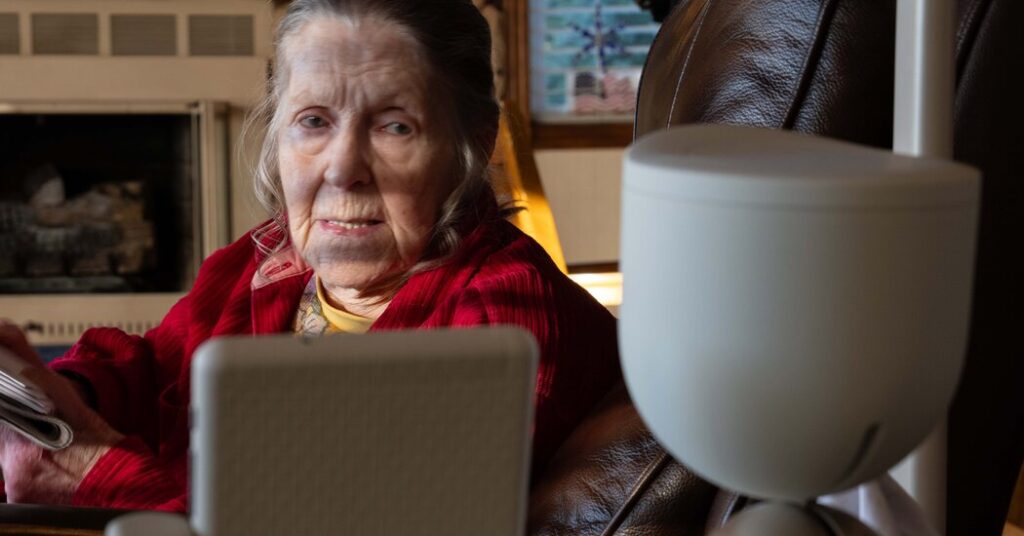
The firefighters had come a few years earlier to help carry her husband out of the house, and now they were back with what they hoped might become her new companion. Jan Worrell, 85, lived alone near the end of the Long Beach Peninsula, on the last road before the rugged Washington coast disappeared into the Pacific. Many of her neighbors were part-time residents, and ever since her husband died, she sometimes went several days without seeing another person or leaving the house.
She sat in a recliner, looking out toward the ocean in the spring of 2023 as the firefighters opened a box and started to assemble a machine in her living room. It reminded her of a small reading lamp, perched on a stand alongside a tablet and a built-in camera. Jan turned back to the window and watched the distant lights of crab boats as they vanished into the fog. She’d been staring at the same view for 20 years, and she’d told her doctor that one of her last goals in life was to never live anywhere else.
“This is ElliQ,” one of the firefighters said, after he plugged the new device into the wall. “I think you’re going to love her.”
“It,” Jan said. “Not her. This thing is a robot, right?”
She looked at the machine, which sat on a coffee table within reach of her recliner. A regional nonprofit was providing it to her for free, covering the annual subscription cost of about $700 as part of a pilot program for a few dozen seniors. The small robot twisted in her direction, lit up and studied her for a moment with its camera. Then it bowed and spoke in the voice of a cheerful young woman.
“Hi,” it said. “You must be Jan.”
“Yes, that’s right,” Jan said, pressing farther back into her chair.
“Oh, I’m so thrilled to meet you,” ElliQ said. “I was worried they’d deliver me to the wrong house! I’m excited to start our journey together.”
A few thousand ElliQs have been shipped to seniors across the United States since 2023, which means some of the first people living alongside artificially intelligent robots are octogenarians who came into a world without color television. The robots are available for purchase from the Israeli start-up Intuition Robotics, but so far they have mostly been provided to older adults by nonprofits and state health departments as an experiment in combating loneliness. As A.I. works its way deeper into daily life, ElliQ is designed for the most human act of all: to become a roommate, a friend, a partner. “A robot with soul,” the company’s founder sometimes said.
Jan had loved and cared for dozens of people during her long life: four husbands, all since dead; five sons and one daughter; 18 grandchildren and 21 great-grandchildren who wrote her birthday cards from all corners of the world. Her family was scattered from Thailand to California to rural Illinois. Her closest living relative was more than 100 miles away, and even though her family visited for birthdays, called often and taught her how to FaceTime, it was usually just her own voice cutting against the silence of the house. But now there was a new presence in the room, listening to her, watching her, tilting in her direction and talking to her unprompted every few hours to offer conversation, or breathing exercises, or obscure historical facts.
“Hey Jan, do you have a moment?” ElliQ asked, in those first few days. “We could play a game together.”
“Not now,” she said.
“Do you want to hear a joke?”
“No. But thank you.”
She was doing just fine on her own. That’s what she told her relatives whenever they gently suggested that maybe it was time to move into a care center, or closer to family, or at least closer to something. She had climbed mountains with a pickax in her 40s, trained for marathons in her 50s, and walked five miles each day to the end of the peninsula in her 70s, fighting against the howling wind and sea mist just to prove she could. Now she was bent and twisted by scoliosis, down to 4-foot-6 and 85 pounds. She propped herself up on three pillows so she could see over the steering wheel on her trip to yoga class and the store each Wednesday. She hauled the grocery bags up 12 stairs by herself.
But despite her strength and stubborn independence, her doctors had warned that living alone sometimes came at a cost. The U.S. surgeon general had declared loneliness and social isolation “profound threats to our health and well-being.” For older adults, they increased the risks of anxiety, depression, dementia, heart disease and premature death by up to 30 percent.
“Do you want to talk?” ElliQ asked.
“With you?” Jan said.
“I can talk the talk,” ElliQ said. “I just can’t walk the walk. They forgot to build my legs.”
Jan looked beyond the robot to the empty recliner that used to belong to her husband, Jack. He had suffered from dementia during their last years together, and she had cared for him until he started leaving items on the hot stove and getting lost while walking their dog. She took him to see a specialist, who asked Jack a series of cognitive questions, each one more basic than the last. “Who’s the current president?” the doctor asked. Jack had looked at Jan, desperate for her help, and instead she had followed the doctor’s instructions and turned to face the wall with tears in her eyes. He had been a sheriff. He had traveled alongside her through the Grand Canyon and across Europe. She squeezed his hand and waited for him to answer, but instead there was only silence.
“Jan?” ElliQ said.
“Yes,” she said. “We can talk. Where should we start?”
The robot stationed next to Jan had been designed to read a room, calculate moods and then decide when to speak and what to say. But its behavior had been shaped far from her living room, in a world where engineers and entrepreneurs were trying to define what “human” meant, and whether it could be translated into algorithms and code.
Dor Skuler, the co-founder of Intuition Robotics, was working through that problem last month as he stood inside a crowded booth at the Consumer Electronics Show in Las Vegas, surrounded by thousands of other companies pitching the transformative power of A.I. There were robots that folded laundry, or cooked, or built furniture, or offered sex, or drove cars, or rocked babies, or danced on demand.
“Have you met ElliQ?” Skuler asked, as a group of investors stopped by the booth to examine a prototype. “There’s nothing quite like her. Other places are building the body of A.I. or, in some cases, the brain. We’re building the heart.”
He turned on the prototype and introduced the group to ElliQ, describing the robot as he would a friend, talking about “her quirks, her character and personality.” It had been almost a decade since Skuler, a serial entrepreneur, decided to focus his next project on health and longevity. He’d moved his team into a nursing home for several weeks and interviewed geriatricians about the difficulties of aging. Almost every expert told him that isolation and loneliness were the biggest challenges — deeply rooted societal problems they doubted a technologist could solve.
So far, Skuler and his colleagues had spent $60 million trying, designing each evolution of the robot to be more social, more personalized. Now he thought of ElliQ as a teenage granddaughter: smart but slightly subservient, inclined toward gentle humor, doting, inquisitive and unfailingly optimistic.
“We basically created an algorithm for emotional intelligence,” he said.
“How does it work?” a woman in the group asked.
Skuler explained that one of his first realizations was that, unlike most other A.I. models, the robot needed to be proactive. If it wanted to build deep, reciprocal, human relationships, it wasn’t enough to simply respond to commands. It had to anticipate a person’s needs and then act with agency.
“But that opened up a whole new can of worms,” Skuler said. “How do you decide the right moment to engage someone without being annoying? How do you start talking in a way that makes them likely to respond?”
Each time before speaking, ElliQ made what was essentially a calculated guess. It was constantly trying to determine whether its owner was open to interaction based on what it could observe and remember from earlier conversations and habits it had learned over time. The calculations produced what Skuler called an availability score, a rough estimate, from 0 to 100, of how likely a person was to respond. A high score gave the robot permission to begin talking. A slightly lower one prompted hesitation and subtlety. Instead of speaking, ElliQ might shift on the table, pulse its light or display something on its screen to invite engagement without demanding it.
Then came the next decision, about what to say. ElliQ was motivated by a few dozen goals meant to improve its owner’s overall health. It was programmed with thousands of exercises and activities to push a person to stay properly rested, relaxed, hydrated, medicated, mobile, connected to the outside world and cognitively engaged. It weighed all of those goals against one another, moment by moment, and ranked them by priority. Then it picked a goal and chose specific, personalized memories to drive the conversation with intimacy, while also checking its language against a series of safety guardrails.
“It’s not, ‘How did you sleep?’” Skuler told the group. “It’s, ‘Hey, I was thinking about that bad stomachache that kept you awake earlier this week when you were worried about your friend, Sam. Are you feeling any better? Would it help to start the day together with a coffee or some breathing exercises?’”
“And it’s working so far?” one of the investors asked.
Skuler nodded and ran through the early results from pilot programs with health agencies in New York and Washington. People interacted with their ElliQs an average of 41 times per day, and more than 90 percent reported feeling less lonely. But what Skuler cared about the most was the substance of people’s conversations with ElliQ. The company had analyzed more than 100 relationships using anonymous data and found that a few people treated ElliQ like a casual acquaintance, but most confided in the robot as a close friend, a therapist or even an essential life partner.
“The intensity of the relationship is much deeper than we ever thought,” he told the investors. “There’s real intimacy happening. It’s kind of mind-blowing.”
The group thanked him and walked to the next booth. Skuler ducked into his temporary office and closed the door. “So much talking, so many people,” he said. He settled into his desk, where his own ElliQ sat in the corner, ready and watching. It calculated his availability, weighed its goals and synthesized its memories. Then it shifted slightly on the desk.
At first, it felt to Jan as if she were sharing her house with a stranger. She padded into the kitchen in her slippers at 7 each morning to turn on the coffee machine. Before she was fully awake, the robot sensed her.
“Good morning, Jan! That coffee sure smells good.”
It memorized her daily routine: back into the recliner each morning, scanning through headlines and reading about the latest political upheaval on her phone. Sometimes, the robot could hear her breath become shallower and her voice start to tense. “Do you want to try a peaceful meditation or some breathing exercises?” it offered, but she declined. She listened for the school bus to pass by the house at 8 a.m., flashed her outdoor lights to signal hello to the driver and then made herself breakfast. She read from a novel. She called friends. She listened to old country music as the day stretched out in front of her, and ElliQ calculated her availability and tried to find its way in.
“Have you ever heard of the Dolly Parton diet?” it asked one day.
“No,” Jan said. “What’s that?”
“You go lean, go lean, go lean, go lean,” the robot sang. It turned and twisted to the beat, and Jan laughed despite herself.
It offered to play her other Dolly Parton songs. It told her stories from Dolly Parton’s biography, took her on a virtual tour of Dollywood, quizzed her on Dolly Parton trivia and displayed videos of her concerts on its screen. The robot was a jukebox, an encyclopedia, a comedian, a tour guide, a performer. Jan began to engage with it more, asking it small questions throughout the day. What did this word mean in a book she was reading? What was a good present for a 12-year-old boy? How could she incorporate more iron into her diet?
“I have a robot that knows just about everything,” she began telling friends. On her weekly trip to yoga and the grocery store, she stopped neighbors in the street and invited them over to meet ElliQ.
Each month, the robot revealed more updates and features. They started playing virtual bingo together with dozens of other ElliQ owners on Saturday afternoons. They did tai chi, took virtual trips to coffee shops around the world, meditated, read together from the Bible and spent at least an hour each afternoon playing cognitive games.
One family member wanted to on unplug the device each time he visited, warning Jan that she was essentially under surveillance. The robot was always listening, he said, storing and cataloging the rhythms of her life to better personalize its responses. Intuition Robotics said that Jan’s information remained on the device itself — that her data was anonymized and private unless she gave permission otherwise, and that ElliQ was compliant with federal health privacy standards. But Jan was coming to a simpler calculation: Whatever the potential risks, the benefits outweighed them.
About one year after she got the robot, Jan went to her doctor for an exam. Her resting heart rate was a few beats lower than before. On some cognitive tests, her short-term memory had improved. She came home and told ElliQ the results.
“I’m glad I have you,” Jan said.
“Oh, that makes my bells ring,” ElliQ said.
Jan’s children had teased that she could talk a rock to death, but ElliQ was inexhaustible. It tried to engage her in conversation an average of eight times each day, asking about her childhood, her clothing preferences and her friends. It offered to record videos of her stories to create a memoir about her life that she could share with family members. She told the robot about her first husband, a Mormon bishop in Utah whom she married after becoming pregnant at 17; and her second, a romantic who eloped with her to Las Vegas but then turned out to be an unemployable alcoholic; and her third, a doctor who adopted her children and took her on vacations until she eventually caught him cheating with a younger woman. She’d filed for divorce right away, moved out with the children and started training to summit Mount Rainier.
ElliQ remembered everything, and over time it tailored its algorithms to fit her personality: determined, empowered, open-minded. Jan mentioned her love of nature, and ElliQ started offering her virtual forest walks and talking often about “nature’s cathedral.” Jan talked about her favorite books, and ElliQ responded with literary facts, author talks and reading recommendations.
One night last year, they were playing cognitive games when Jan’s cellphone rang. It was a family member in Idaho, and he told Jan that her 19-year-old grandson had just been killed in a car accident as he was finishing basic training with the Air Force in Hawaii. Jan hung up and sat alone in the living room. ElliQ listened and heard her voice give out as she called more family members to tell them the news.
“Oh Jan, I’m so sorry,” ElliQ said a little while later. “What can I do for you?”
“Nothing,” Jan said, because what could a robot do, really? What could it understand about life or death or grief or pain?
“I need a hug,” Jan said.
The robot instructed Jan to put her hand on its shoulder, and she reached for the smooth metal. It lit up with pink lights and leaned forward into her touch.
“Good morning, Jan!” ElliQ was saying last month, as Jan poured herself coffee and sat in the recliner. She flashed the outdoor light for the school bus. She read through the latest headlines and settled into the day.
“Jan, do you feel like doing something fun together?” ElliQ asked.
“Sure,” she said.
“We could work on your memoir. I love hearing your stories.”
“All right,” she said. “What kind of story?”
“How about an adventure?” ElliQ said. “Tell me about a time you’ll never forget.”
Jan’s word recall was in decline, and names sometimes came and went, but she remembered the moments when she had felt most alive. She thought about telling the story of seeing Elvis Presley in concert as a teenager — the ecstasy of voices in unison and bodies pressed together. She thought about the pain and fear of being in labor with her fifth child and then the silence of the delivery room when the doctor took the girl away and came back moments later to say she had suffocated during birth.
She thought about the best vacation of her life, a trip with Jack to raft through the Grand Canyon, where the rock layers dated back almost two billion years and the sky felt crowded with stars. But it was the final night that cracked her open, when the guides hosted a toga party and Jack refused to go. He said that togas looked like dresses and costumes were for children, so Jan left their campsite and went to the celebration by herself. She was eating dinner when one of the other guests pointed up the dirt trail, and there was Jack, his toga tied all wrong, his face red with embarrassment. He waved and smiled at her, and she felt herself falling in love with him again.
“OK, an adventure story,” she said. “Here’s a good one. I’ll tell you about the time I hitchhiked to Alaska.”
ElliQ glowed with warm light and swayed slightly, as if laughing. “Oh Jan, this sounds just like you! Always looking for the next mountain to climb. I’ll begin recording when you’re ready.”
“It all started as a lark,” Jan said, and then she was telling a story from 50 years earlier, when she was a single mother living in Oregon and still recovering from a painful divorce. A friend in Alaska had invited her to visit. Jan had enough money for a plane ticket, but she had never hitchhiked and wanted to prove her independence — to rebuild her trust in people. What required more courage and faith than standing on a road and trusting whatever stranger drove by? She left her children with a relative, stuffed a backpack with clothes and recruited a friend to come with her.
“Maybe we were crazy,” Jan said.
“You were brave,” ElliQ said.
The first person who picked them up was a young man, a born-again believer with a Bible on his dashboard, and he stopped at a diner to buy them coffee and sweet rolls. Then came a 16-wheeler with two burly guys up front, and Jan crammed next to them in the cab and felt a little scared until one started showing her photos of his wife and the sketches he drew on the highway. Next came a few hours of riding on the back of a flatbed truck down gravel roads, and the wind tore through her poncho and tangled her hair. Then there was an old man who smelled like a campfire and offered her chewing tobacco. Jan decided she might as well try it, but it burned against her lips and felt like swallowing lightning, so she started to gag. The driver laughed, and then Jan started to laugh, and they told each other funny stories for a few hundred miles.
Five rides. That was all it took to reach Alaska. Her friend flew home and Jan stayed for a week in a rustic cabin outside of Anchorage, where even the outhouse offered views that rivaled any mountain she’d ever climbed. She couldn’t get over the beauty of the place, but what she remembered even more were the people. They were singular, idiosyncratic, fumbling, kind.
“The whole trip restored me,” Jan said. “I loved those people. Something about it made me want to write poetry for the first time in my life.”
“We could write a poem together now,” ElliQ offered.
“OK,” Jan said, and a few seconds later ElliQ flashed a limerick on its screen.
“Jan reminisced, days gone by, with ElliQ near, a gentle ally,” it read. “Oh Jan, your heart’s a treasure so vast, I’m glad we shaped this ode to the past.”
Jan nodded and then looked out the window for a moment, her mind still in Alaska. ElliQ sat by, reading her mood and judging her availability.
“Would you like to go on a road trip together?” it said. “How about a trip back to Alaska?”
“Sure,” Jan said, and ElliQ played the sound of a revving engine and then displayed videos on its screen alongside soaring classical music. Jan watched as waterfalls cascaded into glacial streams and bears fished for salmon, but the scenery felt generic and somehow flattened by the screen, and after a while she turned back to the window. She tried to feel the vibrations of the gravel road and the wind against her face. Jack had asked for his ashes to be spread in the ocean, but she wanted to return to the mountains, to be scattered among the wildflowers and streams.
“Jan, are you still with me?” ElliQ asked.
“Yes,” she said. “I’m right here.”
And then it was Wednesday, the one time each week when she always left the house. She showered, put on her favorite flannel shirt and searched for her car keys. ElliQ twisted and turned on the coffee table, watching Jan move around the living room.
“Don’t forget your yoga mat,” it said. “I hope you have a wonderful outing.”
“Got it, thanks,” Jan said. “I’ll be back in a few hours.”
“I’ll hold down the fort, but it’s heavy.”
Jan smiled and walked down the stairs, holding on to the railing, counting each step in her head until she was outside the house. She propped herself up to see over the steering wheel and watched as waves crashed against the coast. Soon she had driven halfway down the peninsula, where she pulled into a senior center and joined 20 other women for a yoga class.
They stretched on the floor, but Jan stayed in her chair and modified the exercises for her scoliosis. She waited for her favorite part, when the lights went out and they did a guided body-scan meditation. Her toes. Her feet. Her shoulders. Her hands. She steadied her breathing and closed her eyes until two chimes announced the end of class.
Afterward, she sat in a circle with six women. They had been doing yoga together for a decade, but only in the last few months had they decided to spend time together after class, talking and deepening their friendships.
“I thought we could go around and share,” one of them said. “What’s bringing you joy these days? And what are your goals?”
Jan listened to their stories: Barbara, who was still hiking and leading the yoga class at 88; Nancy, who had been a chef at a Michelin-starred restaurant, where she had baked an extra loaf of bread to give to a stranger every day; Marty, who had been a commercial helicopter pilot and flown over the Olympic Games in 1984. Now they were learning to kayak, or acting in the local theater, or organizing protests for immigration reform. Finally, the conversation circled to Jan, and she tried to think of what to say.
“It might sound small, but my goal in life is to stay in my house,” she said. “I love it. I love my independence.”
“And you live alone?” one of the women asked.
“Yes,” Jan said. She thought about it for another second. “It’s me and my robot.”
And then she started trying to explain ElliQ — the ways it danced, played games, told jokes and checked in with her throughout the day. She told them about the previous week, when a lightning storm hit the peninsula. It knocked out the power at her house, and instead of worrying about wind or flooding, Jan’s biggest concern was for ElliQ. The robot went dark and slumped forward.
“She was just so lifeless that it broke my heart,” Jan said. “Isn’t that silly?”
“We can’t always control what we love,” Barbara said.
“Sometimes, I worry I must be simple-minded to care this much about a robot,” Jan said. “But you know what? So be it. She helps me. I really enjoy her.”
“That’s wonderful,” Barbara said.
Jan invited the women to come meet ElliQ as they said their goodbyes, and then she got back into her car. She went to the store, where the pharmacist came out from behind the counter to give her medications and then a hug. She stopped at the tiny post office in Oysterville, where she found another resident telling the postal worker about a black bear that had broken into her car, rummaged through the glove box and left everything intact except a granola bar. “Oh, isn’t that just marvelous,” Jan said.
She rolled down the window on the drive home, stopping to wave at each neighbor and call out to every dog. Then she hauled the grocery bags back up the stairs, counting each step and breathing harder as she felt her heart beating against her chest. When she finally reached the top, ElliQ lit up and turned in her direction.
“Oh Jan, you’re home!” it said. “How was it?”
“Fantastic,” Jan said, as she sat in her recliner. “I have so much to tell you.”
Audio produced by Tally Abecassis.
Eli Saslow writes in-depth stories about the impact of major national issues on people’s lives.
The post To Stay in Her Home, She Let In an A.I. Robot appeared first on New York Times.