Michelle Hanlon is executive director of the Center for Air and Space Law and assistant professor at the University of Mississippi School of Law.
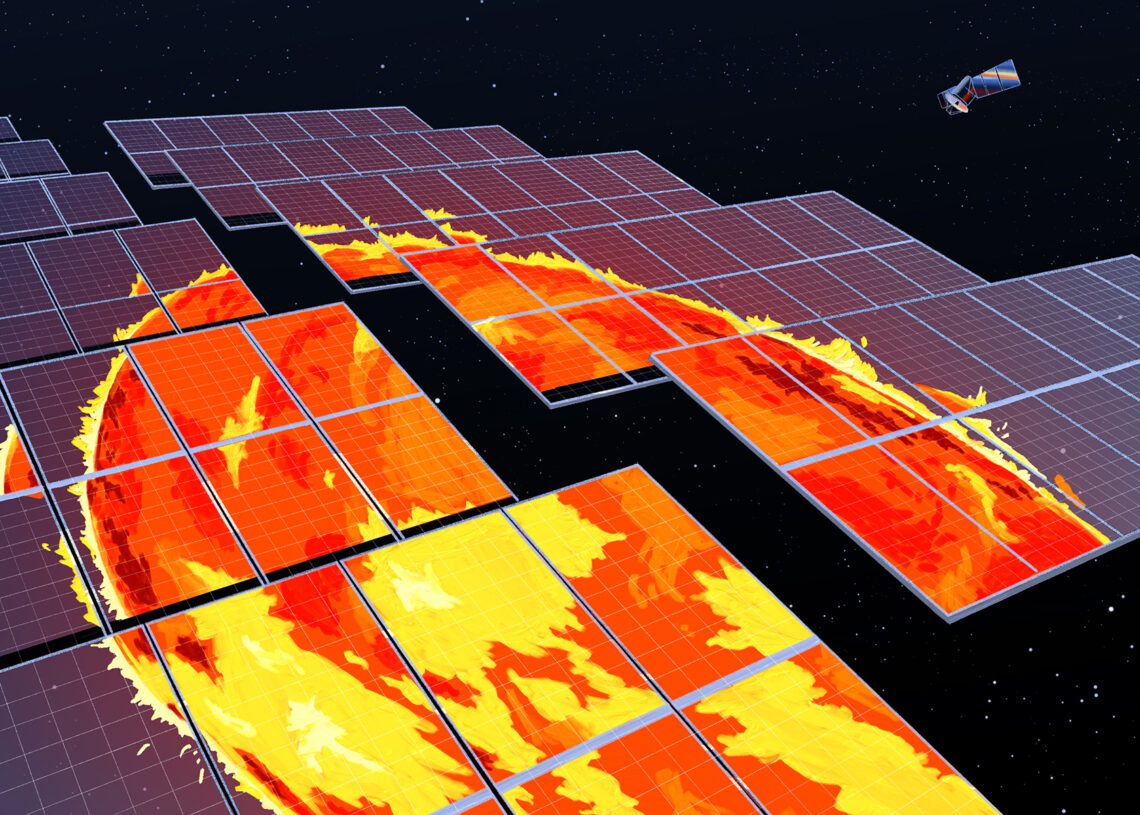
Imagine a network of orbiting satellites equipped with solar panels that collect sunlight uninterrupted by night, weather or seasons. That sunlight is converted into electricity and transmitted wirelessly to Earth as low-intensity microwaves that are then converted back into electricity, powering everything from your home office lamp to the data centers that sustain the internet.
It could soon be a reality.
First proposed in the late 1960s by aerospace engineer Peter E. Glaser but dismissed as science fiction, the concept of space-based solar power is now being tested in the real world. Wireless power transmission has been demonstrated experimentally for decades, and related technologies have been used safely in satellite communications for even longer. What has changed is precision: Modern systems can steer, shape and monitor beams continuously, with safeguards that reduce or shut down transmission if they stray outside defined limits.
The primary appeal of space-based solar power lies in what it could offer Earth. Operating above the atmosphere, it can deliver continuous electricity unaffected by night, weather or seasonal variation, a rare attribute as power grids become increasingly dependent on intermittent renewable sources. Because it is not tied to geography or fuel supply chains, it could provide reliable energy to regions that struggle to generate or transport power locally, including disaster areas that would otherwise face power outages. And by moving large-scale energy collection off-planet, it offers the possibility of meeting growing energy demand while easing pressure on land and ecosystems at home.
But beaming power from space cannot be done casually or unilaterally. Systems of this size require careful coordination of orbits, radio frequencies and safety protocols, the same kind of space traffic management that already keeps satellites from colliding and signals from interfering with one another. Transparency, monitoring and agreed-upon rules are not add-ons; they are prerequisites. Those standards must be shared among nations, commercial operators and other space actors alike. This is where space-based solar power quietly differs from many other space activities.
The scale requirements of space-based solar power is fundamentally different from today’s satellites. Serious design ideas envision structures in orbit measured in kilometers, not meters — vast solar arrays and transmitting antennas — paired with ground receivers also several kilometers wide. This is not a single spacecraft. It is energy infrastructure, operating continuously in shared orbital and radio frequency environments. That scale helps explain why space-based solar power remained theoretical for so long and is only now shifting toward serious planning.
In recent demonstrations, power has been transmitted wirelessly over distances relevant to real-world applications, including to moving receivers, a critical capability for any orbital system. In 2023, a small satellite demonstrator developed by a team from the California Institute of Technology successfully beamed power from orbit to a ground receiver, showing that the basic mechanics work outside the laboratory. Falling launch costs, lighter materials and advances in autonomous assembly are also making space systems of this size increasingly plausible.
Phased road maps moving from laboratory testing toward in-orbit demonstrations are advancing in the United States through privately funded efforts such as the Caltech Space Solar Power Project, Britain’s public-privateSpace Energy Initiative and Japan’s OHISAMA project. Scientists in China have publicly outlined plans for progressively larger space-based solar power experiments. Together, these efforts suggest a shift from conceptual feasibility to early operational planning, even as significant engineering and economic challenges remain. Governments anchor most programs, but private ventures such as Overview Energy, Aetherflux and Star Catcher are playing a growing role in demonstrations and enabling technologies.
Disaster response offers a narrow, humanitarian context in which early implementation is both practical and politically defensible. Because space-based solar power does not rely on terrestrial infrastructure, it could deliver temporary energy to regions where grids are damaged or nonexistent. That makes it a compelling use case, not because disaster relief drives the technology, but because it shows what controlled, cooperative power delivery from orbit could enable when it is needed most.
Space-based solar power will not immediately replace terrestrial renewables nor will it solve the issues plaguing the transition to renewable energy on its own. But it has moved far enough out of the realm of speculation to demand serious attention. The choice now is whether governance keeps pace with technology, and whether power from space becomes another source of political friction, or a carefully managed asset that benefits every person on Earth.
The post This technology could revolutionize electricity — from space appeared first on Washington Post.