At least one sign of change is evident on streets of Dhaka, the capital of Bangladesh, even before the votes are cast on Thursday in the first general elections since millions of protesters toppled the country’s authoritarian government in 2024. The once blue and green uniforms of its police officers are now gray and brown.
The swap, made in November, was meant to distance the officers from the brutal crackdown on student protesters that ended in more than 1,400 deaths. Many of those protest leaders are now worried that this costume change may be as far as their movement for democratic reform will get.
“We didn’t want to change the dresses. We want to change the system, the structure,” said Tanjina Tammim Hapsa, an activist at the University of Dhaka.
In a way, the Bangladesh election is a test case for whether student movements in other parts of the world, including the Gen-Z uprising in Nepal in September, the June student protests in Kenya, and many of the protests in Iran in recent months, can bring about lasting change.
When the young men and women of Bangladesh — a small neighbor of India, home to more than 175 million people where the median age is around 25 — took to the streets in July 2024, they were protesting against a system of reserving jobs for the descendants of Bangladesh’s freedom fighters. But their frustration, over the lack of jobs and endemic corruption, erupted into outrage after the prime minister, Sheikh Hasina, ordered the crackdown on protesters. She was forced to quit on Aug. 5, 2024 and fled to India; her party, the Awami League, has been barred from elections.
As an interim government took over, the students laid out their demands: elections to deliver a more inclusive government; a stronger democracy with term limits for the prime minister and a more independent judiciary; accountability for elite corruption and extrajudicial killing; and better economic opportunities for its young population.
But in interviews with dozens of Bangladeshis about the revolution, many said the hope that once united students has unbraided. The leader of an entrenched political party is expected to win the elections and become the next prime minister. An ambitious agenda for reform has been watered down. Many students said they doubt whether the movement will achieve any of its major goals, even after the loss of so many lives.
“Their sacrifice can’t go in vain,” said Majedur Rahman, 25, an applied math student at the University of Dhaka. If this election doesn’t deliver a fair system, Mr. Rahman said, “we will have to stand up again.”
Despite their frustration, some young Bangladeshis are trying to hold on to optimism.
“This is a great opportunity for me to show my right, my capability and my choice,” said Khalid Muhammad Khan Abir, a 23-year-old student who was among the protesters.
But Mr. Abir does not expect much change to come from the existing political parties, which he said are likely to fall into the same pattern of greed, corruption and power grabs that stifled Bangladesh under Ms. Hasina. Referring to those politicians, he said, “When I get power, I feel that I’m the only one, and I can do anything, and my word is the last word.”
Even the National Citizen Party, formed by students on a platform of making political reforms legally enforceable, has made compromises. It struck an alliance with Jamaat-e-Islami, a party dedicated to running the country under Islamic law, upsetting students who wanted their representatives to be more secular and inclusive. The N.C.P. has said that it allied with Jamaat only for the election and disagrees with many of the party’s principles.
Many students say they have put their hopes, instead, on a referendum for political reform that is also on the ballot.
In July, the interim government of Bangladesh, together with dozens of political parties, adopted a consensus document called the July Charter, which contained a collective vision for the country’s future and specific proposals about how to achieve it. On Thursday, Bangladeshis will have the chance to vote, in a legally binding referendum, on whether to adopt those reforms.
The proposals include measures to ensure more political participation for women, creation of a bicameral legislature where the upper house gets seats based on a percentage of the votes they win in the lower house, a structure meant to be a check on parliamentary control.
Bickering and opposition to many of the proposed reforms by the two largest political parties, the Bangladesh Nationalist Party and Jamaat, and many others, led to a watered-down set of proposals. The B.N.P. is expected to win the elections.
That compromise has shrunk the ambitions of the movement.
Dr. Iftekharuzzaman, the executive director of Transparency International in Bangladesh , said that the student movement, like many others around the world, was “aspirational.” For Bangladesh to set a new political course, he said, it must create a solid foundation, by strengthening its institutions and introducing more checks and balances. The July Charter could have provided that foundation, he said, but in its current form, it is already shaky.
“We had an opportunity,” said Dr. Iftekharuzzaman, who uses only one name. “It’s an opportunity lost.”
One of the most important proposals would increase women’s participation in politics. That was especially meaningful because women were highly prominent in the protest movement. The July Charter calls for at least 10 percent of candidates nominated to the proposed Upper House to be women, and it sets a road map for women’s representation in the Lower House, going from 5 percent to 33 percent over several elections.
That produced a sharp rebuke from Jamaat, the religiously conservative bloc that is partnering with the student party for the elections. Last week, a post from the X account of Jamaat’s leader, Shafiqur Rahman, compared the employment of women to prostitution. After the post went viral, Jamaat representatives said that Mr. Rahman’s account had been hacked.
Taposhi Rabeya, a student activist who participated in the protests, said she was shocked by the comments and disheartened that political parties had nominated so few women female candidates for the election. Of the 2,028 candidates, only 81 are women, including independents. Ms. Rabeya said she had hoped for a new kind of politics, where money, muscle and intimidation didn’t determine outcomes. “But our political leaders have not been able to leave those practices behind,” she said.
The journey from the 2024 student revolution to Thursday’s election has been pockmarked with many things that Bangladeshis may want to leave in the past: chaos and riots after the death of a student leader, a resurgence of Islamic extremism, violent confrontations between political parties, attacks on Hindu minorities, and even a fracas over cricket matches involving Bangladesh and India.
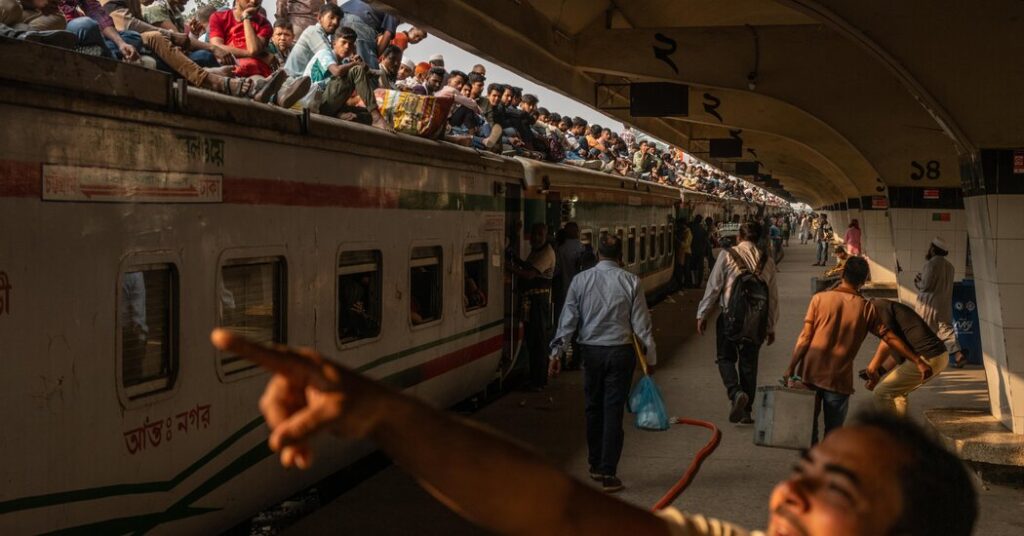
The mood in the country, if not exactly celebratory, was festive with people gathering for the election. The government has declared a two-day national holiday, so schools, colleges and other institutions were closed. The streets of Dhaka began to empty this week, as many Bangladeshis returned to their home districts to vote. At the Kamalapur Railway Station, the city’s main rail hub, the trains were so packed that some passengers sat on the roof of the train.
Political parties campaigned furiously until two days before the election, visiting homes late at night. For days, large campaign posters — on fabric rather than paper — have dotted the streets. The government had insisted on the change to save the environment.
“Voting is a joyful thing,” said Rashid Ahmed, who was on his way to the town of Brahmanbaria to vote. “Even through all this traffic jam, I’m going through the hassle to get home.”
But the government is also primed for the possibility of violence, with nearly a million army, paramilitary and police troops stationed outside polling booths and along streets across the country, officials said. For some Bangladeshis, their presence is an unsettling reminder. More than 1,000 police officers remain in detention or face criminal charges for their roles in the killing of student protesters under Ms. Hasina’s rule.
Many of the officers patrolling Dhaka have switched to their new outfits, but others are yet to receive their sets — a reminder of a country caught between its history and its future.
Jane Alam contributed reporting.
Anupreeta Das covers India and South Asia for The Times. She is based in New Delhi.
The post Students Won a Revolution in Bangladesh. They Want So Much More. appeared first on New York Times.