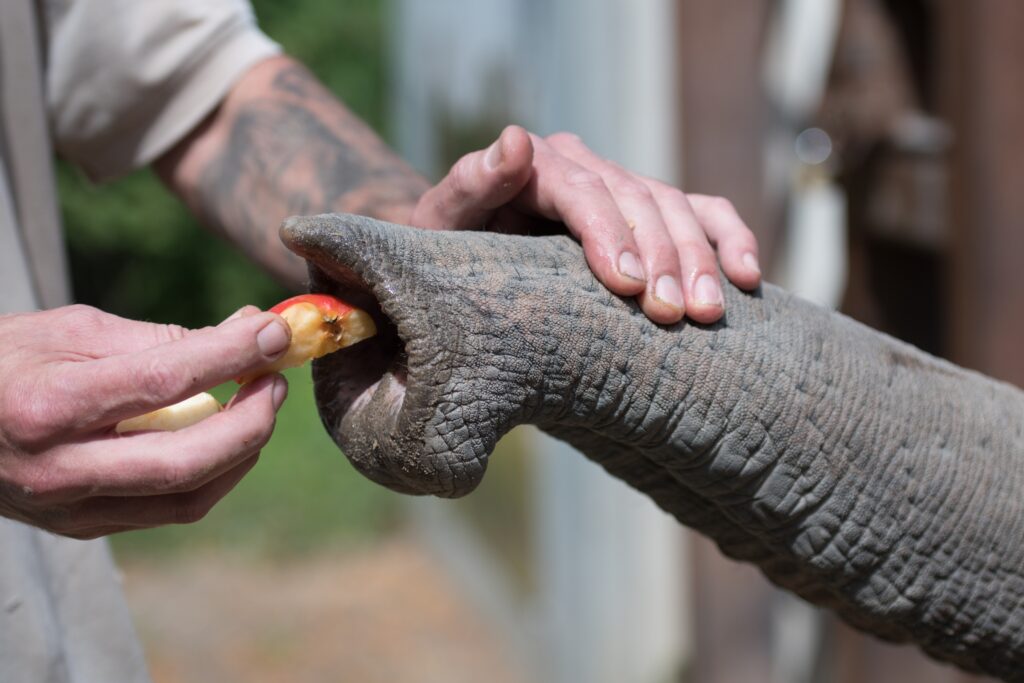
The list of feats Andrew Schulz has witnessed an elephant perform with its trunk is as long as, well, an elephant’s trunk. These powerful proboscises are strong enough to push over 900 pound trees and gentle enough to pick up a tortilla chip without breaking it. They can snuffle along the ground to sense vibrations from far-off herd movements. They can be used to solve puzzles, peel bananas, craft tools, console a fellow pachyderm or a human friend.
Now Schulz has found the secret to the trunks’ extraordinary dexterity: whiskers.
The hundreds of fine hairs that cover an elephant’s trunk are some of the most sophisticated and sensitive whiskers in the animal kingdom, according to new research in the journal Science. Using microscope images, advanced computer models and a 3D-printed “whisker wand,” Schulz and his colleagues show how the structure of elephant whiskers makes their trunks uniquely capable of detecting motion, handling objects and performing complex tasks.
These organs are an example of what scientists call “material intelligence,” said Schulz, a mechanical engineer at the Max Planck Institute for Intelligent Systems in Germany who studies how animals move. Though the whiskers are inert structures — incapable of moving independently or thinking for themselves — their physical characteristics allow them to translate signals from the environment into information that can be conveyed to the brain.
The findings published Thursday offer the deepest-ever analysis of a rarely studied organ, according to co-author Lena Kaufmann, a neurobiologist at Humboldt University in Berlin. Scientists have published thousands of papers on rat and mouse whiskers, but elephants have largely been overlooked.
Yet Kaufmann believes scientists can learn a great deal by studying the diverse strategies that animals have evolved to navigate the world.
“We all have the problem off needing to sense things in our environment, but there’s a multitude of ways you can solve this problem,” she said. “And I think that’s the very fascinating thing.”
All whiskers are made of keratin, the same protein found in hair as well as claws, hooves, horns and fingernails. But unlike ordinary hair, whiskers are connected to cells called mechanoreceptors that can detect when the whisker touches an object or vibrates in a breeze.
Yet each whiskered species uses these hairs in unique ways. Rat whiskers are circular, dense and stiff. Tiny muscles in their follicles allow them to rhythmically brush their whiskers against objects, creating a mental map of their surroundings. Though brittle, new whiskers can quickly regrow to replace any that fall out or break.
The whiskers that adorn Asian elephant trunks cannot move on their own, and they don’t regenerate when some are lost. But their complex structure more than compensates, Schulz said. They are shaped like blades of grass, enabling them to bend easily, and riddled with tiny pores that allow them to absorb force and avoid breakage.
Most surprising, Schulz said, is the “stiffness gradient” the team uncovered. Whereas rat whiskers are uniformly flexible, Asian elephant whiskers are rigid at their base and soft at their tips. This allows them to vibrate at a wider range of frequencies — probably increasing the sensitivity and precision of the signals sent to the mechanoreceptors at their roots.
“They’re like aliens,” Schulz said. “If you try to compare them to any other whisker structure, they’re basically different in every single way.”
The discovery could help engineers develop better touch sensors and other robotic tools, Kaufmann said. But just as important, she said, the findings can help humans understand our fellow creatures, giving us a glimpse into an elephant’s experience of the world.
Given their thick skin and weak eyesight, elephants depend on an acute sense of touch to find food and detect threats. Their whiskered trunks probably also help them communicate with one another, Kaufmann said, enabling the animals to live in complex, multigenerational herds.
“This is very close to my heart,” said Kaufmann, who knows better than most the gentleness of an elephant’s touch. While conducting research at the Berlin Zoo, she recalled, a young Asian elephant named Anchali used her trunk to pull Kaufmann toward herself.
The scientist reached up and pet the animal’s whiskery skin, enveloped in an elephant hug.
The post Scientists have discovered one of elephants’ most sensitive secrets appeared first on Washington Post.