This article is part of Overlooked, a series of obituaries about remarkable people whose deaths, beginning in 1851, went unreported in The Times.
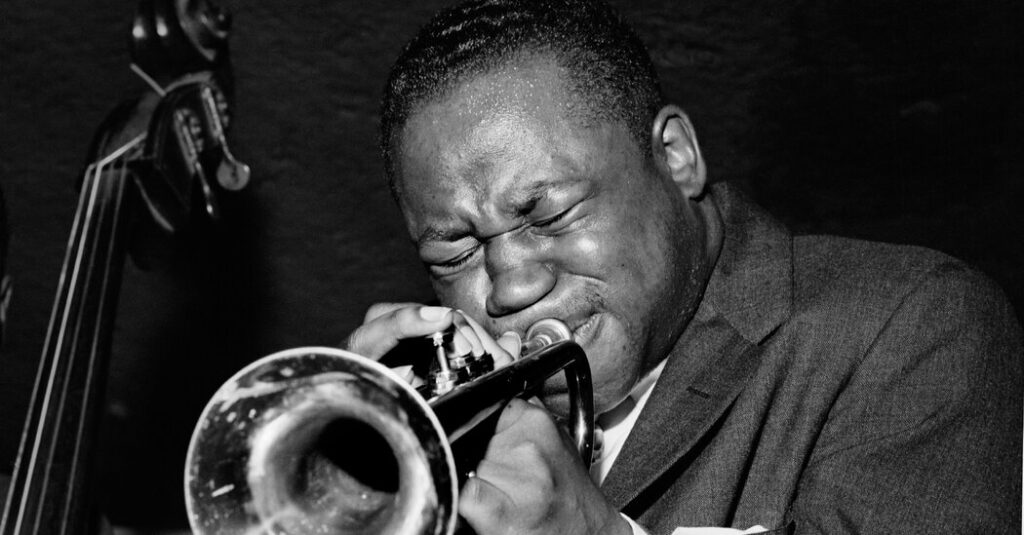
Clifford Brown was 23 but already one of the most promising trumpet players in jazz when he joined forces with the drummer Max Roach in 1954. The Clifford Brown-Max Roach Quintet’s first album, which came to be regarded as a classic in the annals of modern jazz, was recorded that summer and released in December. In less than a year, the quintet would be the talk of the jazz world. In less than two years, Brown would be dead.
He initially drew attention for his flawless technique: He could improvise long, complex melody lines at breakneck tempos without missing a note. But he was always more concerned with expressing himself than with showing off, and his tone was warm and emotionally rich — even at its most rapid-fire, but especially at slower tempos, as showcased on the 1955 album “Clifford Brown With Strings.”
As the journalist, social commentator and music critic Nat Hentoff put it in 2008 at a symposium devoted to Brown’s music: “Fluency and skill is only a small part of his impact. He always told a story.”
When Brown was killed in an automobile accident in 1956 on the Pennsylvania Turnpike while on his way to a gig, his death was not national news; he was a jazz star, but he was still not widely known to the general public. For Brown’s fellow musicians, however, the loss was devastating.
The saxophonist Benny Golson, who had played alongside Brown in ensembles led by Tadd Dameron and Lionel Hampton, heard the news while working with Dizzy Gillespie’s big band. “Of course, no musician walking onstage could believe it,” he remembered in 1968. “Some covered their faces with their hands and said, ‘Oh, no!’” Many were in tears.
Not long after that, Golson composed a heartfelt ballad in Brown’s memory, “I Remember Clifford.” It became a jazz standard, recorded as an instrumental by the likes of Gillespie, Stan Getz and Keith Jarrett and, with lyrics added by the singer Jon Hendricks, by Sarah Vaughan, Carmen McRae and other vocalists.
Seventy years later, Clifford Brown is still remembered — and revered.
The saxophonist Harold Land, who played alongside Brown in the Brown-Roach quintet, said that “every time he picked up the instrument, something beautiful happened.” Gillespie, himself one of the outstanding trumpet players in jazz history, called him “the next major voice in the line of trumpeters.” Three generations have acknowledged their debt to him, among them Wynton Marsalis, who has said that he strives “to play with clarity and directness, like Clifford Brown.”
It was not just Brown’s playing that impressed his fellow musicians; it was also Clifford Brown the person. They spoke of his discipline: “He practiced all the time,” Roach once recalled. “As simple as that. He practiced, and just as important, he listened.” They described his character: Humble and soft-spoken, he didn’t do drugs, rarely drank alcohol, and, according to Roach, had only one vice — betting on the horses.
Clifford Benjamin Brown, the youngest of eight children, was born in Wilmington, Del., on Oct. 30, 1930. His father, Joe, held jobs including firefighter, janitor and, eventually, deputy sheriff. His mother, Estella (Hackett) Brown, managed the household and, for a time, ran an employment agency from the family’s home.
Joe Brown collected musical instruments as a hobby and, his son recalled in an interview with DownBeat magazine in 1954, “It was the trumpet that fascinated me.” When Clifford was 13, his father bought him a trumpet of his own — but, he said, “only because of that fascination with the horn itself. Otherwise I had no noticeable interest in music as such at that time.”
That would come soon enough. While still in junior high school, he began taking lessons with a local trumpeter and music teacher named Robert Lowery. Interviewed by Nick Catalano for his book “Clifford Brown: The Life and Art of the Legendary Jazz Trumpeter” (2000), Lowery remembered his student as a fast learner who was “determined to succeed.”
As a teenager, Clifford began playing at jam sessions and had the occasional paying gig. After graduating from Howard High School in 1948, he attended Delaware State College (now University) for one semester before transferring to another historically Black institution, Maryland State College (now the University of Maryland Eastern Shore). He played in the college’s 14-piece jazz band, which developed a strong regional reputation for innovative arrangements and excellent musicianship.
A pivotal moment in his career came when he filled in for an absent member of Gillespie’s trumpet section at a concert in Wilmington in 1949; Gillespie was impressed by his playing. The next year, Brown was hospitalized after being seriously injured in a car accident — an episode that, in retrospect, seems like an eerie premonition of his untimely death — and was unable to play for a year. Gillespie visited him and encouraged him not to give up.
In the spring of 1951, fully recovered, Brown worked for a week at a Philadelphia nightclub with the saxophonist Charlie Parker, who, like Gillespie, was a pioneer of the modern style known as bebop. He later said Parker “helped my morale a great deal” by praising his playing.
Brown made his first records in 1952 as a member of Chris Powell and the Five Blue Flames, a rhythm-and-blues group, and recorded his first album as a leader in 1953. The next year was filled with milestones in his life and his career.
He married LaRue Anderson, whom he had met when she was studying music at the University of Southern California and interviewed him for a thesis she was planning to write about why jazz was not a serious art form. (He persuaded her that she was wrong.) He was voted “new star” in the DownBeat critics poll. And the Clifford Brown-Max Roach Quintet released its critically acclaimed debut album, which included two Brown compositions, “Joy Spring” and “Daahoud,” that quickly became staples of the jazz repertoire.
Brown made the most of his brief moment in the spotlight. Between 1954 and 1956, in addition to five albums with the quintet (including one nominally under the leadership of Sonny Rollins, who replaced Land as the quintet’s saxophonist in 1955), he recorded with the singers Vaughan, Dinah Washington and Helen Merrill and, in 1955, with a string orchestra.
Late on the night of June 26, 1956 — which, as it happened, was both LaRue Brown’s birthday and the Browns’ second wedding anniversary — Brown was on his way from Philadelphia to Chicago, where the quintet had an engagement. He was accompanied by Richie Powell, the Brown-Roach group’s pianist, and Powell’s wife, Nancy. Nancy, who was driving, lost control of the car on a rain-slicked road near Bedford, Pa., shortly after 1 a.m. on June 27. All three were killed.
Clifford Brown’s reputation has grown since his death, and his legacy has been enhanced with the release of previously unissued recordings and the discovery of a 1955 performance on a Detroit television show hosted by the comedian Soupy Sales — the only known video footage of Brown in action.
Brown is also the subject of a documentary, “Brownie Speaks” (2014), directed by Don Glanden.
When Willis Conover of Voice of America interviewed Brown in December 1955, he closed by predicting, “I know that your already brilliant career will go much, much further.” The broadcast aired in July, a month after Brown’s death.
The post Overlooked No More: Clifford Brown, Trumpeter Whose Brief Life Left a Lasting Mark appeared first on New York Times.