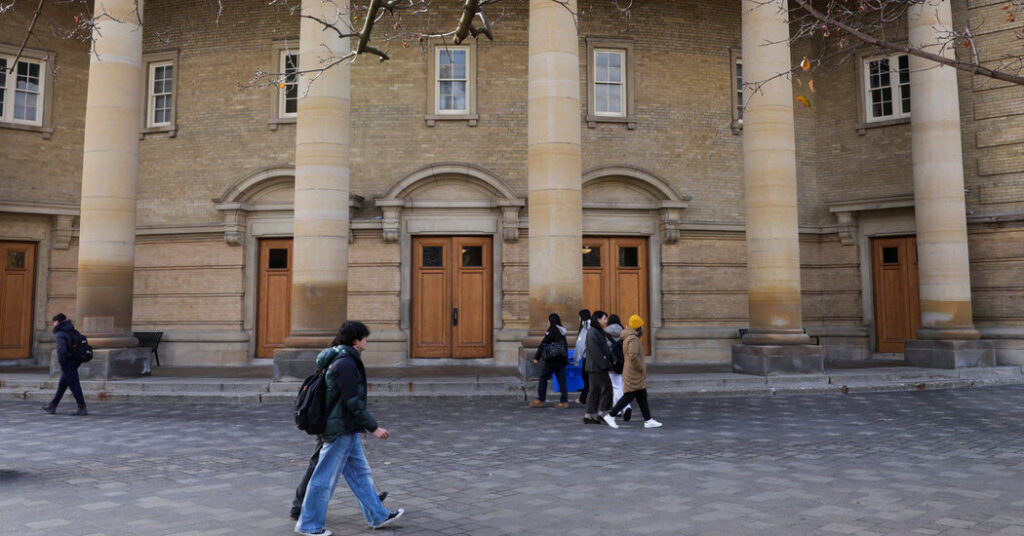
Ontario will allow public colleges and universities to raise tuition for the first time since 2019, as part of a broader plan that will boost funding for higher education and put the sector on a more sustainable path, the government said on Thursday.
The conservative government of Premier Doug Ford pitched the new funding model as a way to shore up struggling colleges and universities in the Canadian province and protect the vital role they play in driving the region’s economy. Critics said the tuition increases would squeeze students who are already struggling to afford rent and food.
Tuition rates in Ontario have been frozen since 2019, when the province also cut tuition by 10 percent in an effort to make higher education more affordable. Since then, colleges and universities have complained that the rate freeze, combined with the Canadian government’s cuts to international student visas, have left them with growing budget shortfalls that have threatened programs, research and student services.
In November, the Council of Ontario Universities said that its institutions had made nearly 550 million Canadian dollars in cuts over the last several years, but were still facing a projected $265 million annual deficit this school year and even greater deficits in the years to come.
The new funding model unveiled on Thursday seeks to address those shortfalls. Officials said it would pump an additional $6.4 billion into the higher-eduction sector over four years and raise annual operating funding to $7 billion, the highest level in the province’s history.
“If we have learned anything in the last year of instability across the globe, it is that Ontario must be ready,” Nolan Quinn, Ontario’s minister of colleges and universities, said at a news conference on Thursday. “We cannot sit idly by while external forces decide our future. We must take decisive action to protect what we hold dear and safeguard our own destiny.”
The model will allow publicly funded colleges and universities to raise tuition by up to 2 percent per year for three years and then by up to 2 percent, or the three-year average rate of inflation, whichever is less, in the years following.
Mr. Quinn described the increases as “modest.”
Tuition varies by institution in Ontario. The University of Toronto, which is by far the largest university in Ontario, with about 100,000 students, charges $6,100 to $7,250 in tuition for Canadian undergraduates and $63,570 for foreign undergraduates, according to Universities Canada, which represents institutions of higher education.
On average, officials said, the increases will result in an additional cost of 18 cents per day for college students and 47 cents per day for university students. Low-income students will have the additional fees covered by a program known as the Student Access Guarantee, officials said.
The model also puts new limits on the Ontario Student Assistance Program, a major source of student financial aid, in an effort to strengthen its long-term sustainability. Students will be able to receive a maximum of 25 percent of their funding from the program as grants, and a minimum of 75 percent as loans. The current mix is 85 percent grants and 15 percent loans, the Canadian Broadcast Corporation reported. The program will also stop offering grants to students at private career colleges.
Peggy Sattler, a member of a left-leaning opposition party who focuses on colleges and universities, said the tuition increases and grant cuts “will make it impossible for young people to build a future in Ontario.”
“Young people are already facing record-high unemployment, and are asking whether they can afford rent, groceries, or making a living here in Ontario,” Ms. Sattler said in a statement. “Instead of fixing the affordability crisis, this government is telling them to take on more debt and hope things somehow work out.”
Ricardo Tranjan, the Ontario research director at the nonpartisan Canadian Center for Policy Alternatives, a progressive research group, said that he was glad that the government was seeking to boost the finances of colleges and universities, which have been struggling for years, particularly because of declining international student enrollment.
“Finally, they’re recognizing the problem,” he said in an interview. “Finally, they’re deciding to act on it. Better later than never, I guess.”
But Mr. Trajan said that even though the plan would help colleges and universities, the tuition fees would pinch students. “That increase might be judged relatively small as a trend, and compared to other provinces,” Mr. Tranjan said. “But it’s coming on top of food and rent that is already expensive. It will be a burden on them.”
Michael Levenson covers breaking news for The Times from New York.
The post Ontario Lifts Tuition Freeze at Public Universities appeared first on New York Times.