More than 10,000 nurses who have been on strike for a month will return to work at two major New York City hospital systems after voting to approve a new contract. But more than 4,000 strikers were still holding out for a better deal.
On Wednesday, the nurses’ union, the New York State Nurses Association, announced that members at Montefiore Medical Center and Mount Sinai Hospital, along with two other medical centers in the Mount Sinai system, had ratified the tentative deal, which includes salary increases and modest improvements to nurse staffing levels.
But nurses at NewYork-Presbyterian/Columbia hospital voted against the proposal and said that they were prepared to carry on their strike, which began Jan. 12. Beth Loudin, a neonatal nurse and union leader at NewYork-Presbyterian, said that the proposed deal did not include sufficient protections against layoffs, nor would it put enough new nurses into understaffed units.
“Those are the two things we needed,” said Ms. Loudin, who heads the bargaining committee for the nurses at NewYork-Presbyterian/Columbia.
The New York State Nurses Association was hoping to avoid mixed results that would return some nurses to work while others remained on the picket line. And a rift has emerged in recent days between the statewide union officials and the nurse leaders at NewYork-Presbyterian.
“More than 4,200 nurses remain on an unfair labor practice strike at NewYork-Presbyterian,” the union said in a statement.
The statement said that nurses in the Mount Sinai Health System and at Montefiore voted in favor of the pact “by an overwhelming majority.” Of the nurses who voted at the four hospitals in those health systems, more than 86 percent were in favor of the deal, according to the union.
The lengthy duration of the strike came as a surprise to many, including many of those on the picket line.
When the nurses last walked off the job — in early 2023 — the hospitals quickly agreed to the health care workers’ demands, which focused on staffing levels. That strike lasted three days. But the nurses had more leverage last time. And the hospitals were caught unprepared then, with few executives suspecting that the nurses would walk out.
The dynamics were different this time. The hospital systems spent tens of millions of dollars ahead of the strike, hiring thousands of travel nurses who were paid about $9,000 a week.
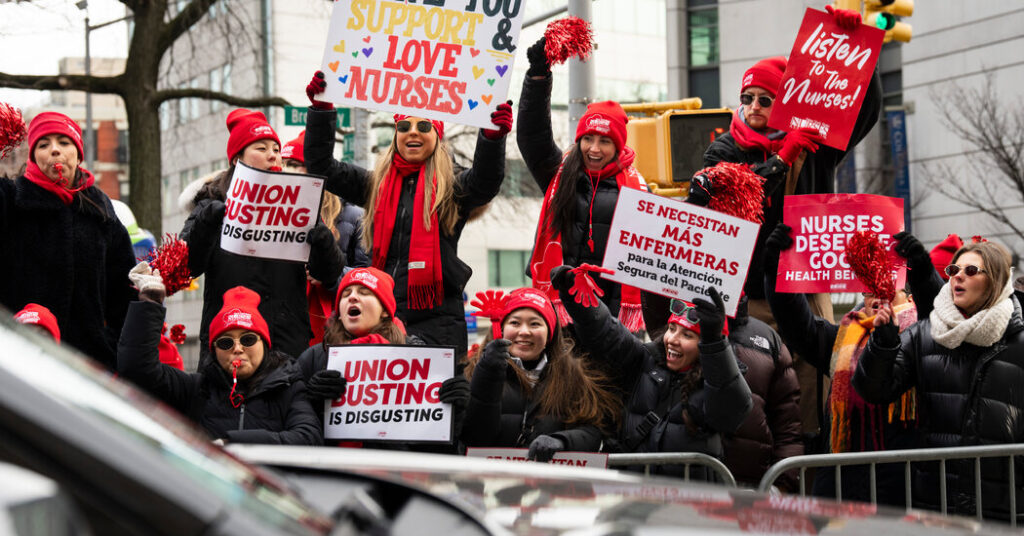
Nurses on the picket line endured bitter cold but maintained a large and lively presence. Holding hands, they have formed a chain that spanned several blocks. They have jogged from one hospital to another. And former patients and their relatives have taken the microphone and extolled the skill, expertise and devotion that they had witnessed from nurses during their hospital stays. Many of the nurses lost their health insurance during the strike.
But at negotiations, conducted at the Javits Convention Center in Manhattan, the nurses’ union and hospitals made little progress for weeks, even as the number of mediators mounted. During breaks in the negotiations, the two sides lobbed accusations at each other, ranging from dishonesty to greed to cowardice.
In the end, a well-known mediator, Martin F. Scheinman, put together a proposal that represented the consensus of the mediators. Mount Sinai and Montefiore, along with the union bargaining committees representing the nurses at both hospital systems, agreed to the proposal. That pact was then presented to the rank-and-file nurses to ratify or reject. (Mr. Scheinman has acted as a mediator between The New York Times and the NewsGuild.)
The bargaining committee at NewYork-Presbyterian/Columbia, however, did not approve the proposal, according to Ms. Loudin. But state union leaders appear to have sidestepped the local bargaining committee and submitted the deal to the rank-and-file nurses at that hospital for a vote, anyway. The union said that the nurses at NewYork-Presbyterian/Columbia deserved a chance to vote on the same deal as the other striking nurses.
“We believe all striking nurses deserve to see the details of their tentative agreements and get the opportunity to vote on whether to ratify a new contract,” Nancy Hagans, president of the New York State Nurses Association, said Tuesday.
After the nurses at NewYork-Presbyterian/Columbia rejected the deal, a hospital spokeswoman invited the union to reconsider. “For now, we remain willing to honor this current proposal for reconsideration,” the spokeswoman, Angela Karafazli, said. She also said that the hospital would welcome back individual nurses who were ready to return to work.
“Next steps are still being determined,” she said. “In parallel, we are inviting our nurses to return to work if they choose.”
The proposal, which covers three years, will deliver raises of 4 percent a year. At NewYork-Presbyterian, that would boost starting pay for a nurse with little experience from $122,252 to $137,557 by late 2028.
Many nurses make far more, after seniority and other pay differentials are factored in. At the three hospital systems affected by the strike, nurses on average make $150,000 or $160,000. The average salary is nudged upward by lumping in several categories of nurses — nurse practitioners, for instance — who have more training and responsibilities than registered nurses.
The salary raises would put average pay closer to $175,000 by late 2028.
The deal also locks in significant gains that the nurses union secured three years ago during the last contract fight: minimum staffing levels that the nurses can enforce.
Nurses have long said that many hospital units across the city are chronically understaffed, leading to inferior care. The 2023 strike resulted in improved nurse-to-patient staffing ratios and payouts if hospitals fell below those minimums. Hospitals agreed to pay extra wages to nurses if hospitals left units insufficiently staffed. That has resulted in significant payouts. Nurses at three hospitals in the Mount Sinai system were awarded more than $6 million from arbitrators since the start of 2024 after providing evidence that units didn’t have enough staff, according to the union.
Hospitals have chafed at these awards, which became a sticking point in negotiations. The deal will keep those gains for the nurses in place, union officials said.
The pact will also require the hospitals to hire more nurses, though not as many as the union hoped.
“Our contracts ensure that our hospitals are safer places — through increased staffing, workplace violence protections, and more,” Ms. Hagans, the union president, said. “This hard-earned victory shows hospitals that they can’t cut corners on patient care. Now it’s time for NewYork-Presbyterian to do the right thing, agree to a fair contract and bring all our nurses back to work.”
At Mount Sinai, the striking nurses will begin returning to work Saturday morning, according to the health system’s chief executive, Dr. Brendan G. Carr.
“The past several weeks have been challenging, emotional, frustrating and exhausting in different ways for all of us,” Dr. Carr wrote in a message to employees. “Moving forward after a strike can bring a wide range of feelings: relief, uncertainty, anxiety or all of the above.”
Joseph Goldstein covers health care in New York for The Times, following years of criminal justice and police reporting.
The post Nurses at 4 N.Y.C. Hospitals Vote to End Strike, but It Continues at One appeared first on New York Times.