Six years ago, the Turkish author and Nobel laureate Orhan Pamuk received the plot summary of a planned television adaptation of one of his most celebrated novels, “The Museum of Innocence.” As he flipped through its pages, he was horrified.
The production company had taken liberties far beyond what Mr. Pamuk considered reasonable in condensing for the screen his 500-page-plus tale of obsessive love in Istanbul in the 1970s and ‘80s, adding plot twists that he felt egregiously diverted his narrative.
So he struck back, suing the producer to reclaim the rights to his story.
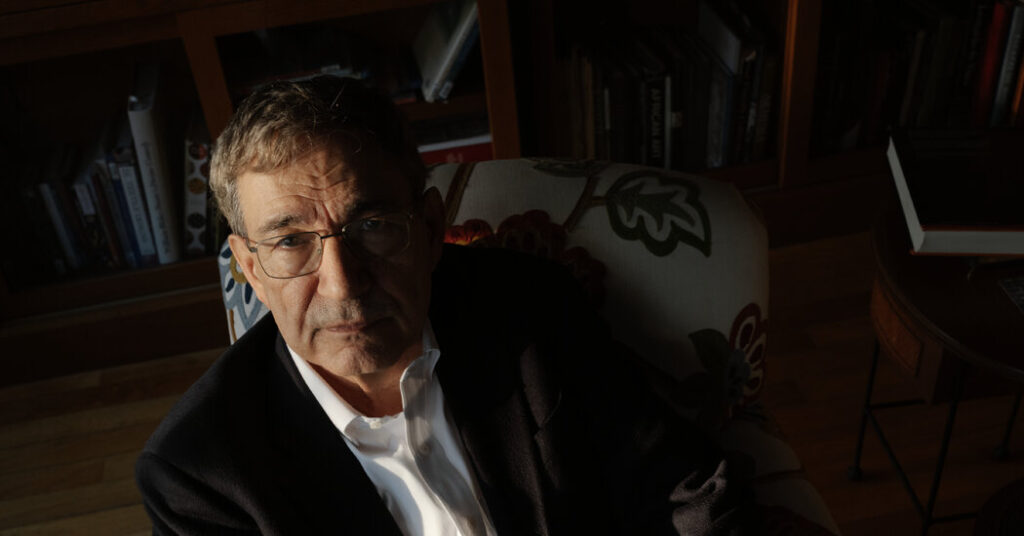
“I had nightmares during that period, paying a lot of money by my standards to the California lawyer and worrying about, what if they shoot it the way they wrote it?” Mr. Pamuk said, speaking in his book-lined office on the top floor of the apartment building that his family built in Istanbul and where he grew up.
He won the suit in 2022 and tried again with a Turkish producer, this time imposing conditions to maintain control of the story. Four years later, he is finally happy with the outcome. On Friday “The Museum of Innocence” will launch as a nine-part series on Netflix.
The streaming premiere marks a late career first for Mr. Pamuk, 73, Turkey’s best-known novelist, whose books of fiction, memoir, essays and photography have been translated into scores of languages. He was awarded the Nobel Prize in Literature in 2006.
The Netflix series further expands his work’s reach, putting his novel on televisions across the world.
“Of course every novelist wants his or her novel to be converted into a film,” he said. “Most of the time, the motivation is either money or popularity, and I carry these vices.”
Mr. Pamuk was born into an affluent, secular family in Nisantasi, a chic Istanbul neighborhood associated with the city’s European-oriented elite.
He dreamed of becoming a painter and dropped out of architecture school before turning to fiction, exploring Turkey’s Ottoman past, its Western aspirations and the tensions between them. His wife is a hospital director; he has one daughter from his first marriage and one granddaughter.
Novels including “The Black Book,” “My Name is Red” and “Snow” raised his international profile. The Nobel committee, in awarding him the world’s top literary prize, wrote that he had “discovered new symbols for the clash and interlacing of cultures.”
Mr. Pamuk has written extensively about Istanbul and his stories feature sites plucked from his memories. A number of his characters lived, worked and got killed within walking distance of his childhood home. In a nearby university building, one character fell in love; another failed her entrance exam.
During a stroll around the area, he bemoaned how the wooden houses of his youth had been replaced by bland apartment buildings, fancy coffee shops and crowded sidewalks.
“It is hard to continue to love this place, this neighborhood, because of how it has changed,” he said.
A corner store once known as Alaaddin’s Shop, which Mr. Pamuk and one of his characters frequented, was now a men’s clothing chain. On the site of Mr. Pamuk’s long-gone secondary school stood a new shopping center.
“It’s a mall, a regular mall,” he said. “Nothing interesting.”
The neighborhood features prominently in “The Museum of Innocence,” published in 2008, which relates in copious detail the story of a bourgeois bachelor, Kemal, who falls hopelessly in love with a younger, poorer sales clerk, Fusun, and spends years scheming to be near her as his life drifts off course.
Kemal and his mother live in an apartment whose balcony overlooks a historic mosque. Both are down the street from Mr. Pamuk’s office, as is the building where Kemal and Fusun meet for trysts.
In the book, Kemal catalogs his obsession by pilfering everyday objects he associates with his beloved — saltshakers, hairpins, coffee cups, shoes, a toothbrush, a half-eaten ice cream cone and 4,213 cigarette butts. After the novel’s climax, he displays these relics in a museum, giving the book its name.
The story is already a multipart franchise. In 2012, Mr. Pamuk opened an actual Museum of Innocence in Istanbul featuring objects from the book. He wrote a museum manifesto and catalog. In 2015, he participated in a related documentary.
Hoping to add a screen adaptation, Mr. Pamuk signed a contract in 2019 with what he described as “a Hollywood production company” that he declined to name. But its vision included major alterations to the story, such as Kemal getting Fusun pregnant, that Mr. Pamuk could not abide.
“Too much change,” he said. “Once you do that, the rest of the book is not my book at all.”
It took him two and a half years, and lots of legal fees, to terminate the contract, he said.
Once he had the rights back, he began talks with a Turkish company, Ay Yapim, about the series.
This time, he controlled the process with a punctiliousness that seems not unlike that of his novel’s main character.
He asked for no advance payment and did not sign a contract before the script was finalized, he said, to ensure that the producer took no undue license with the story.
He ensured that the credits would mention not just his book but also his museum, where some scenes were filmed.
No matter how successful the series was, there would be no second season, he decreed, so the story’s ending would stand.
He met repeatedly with the scriptwriter and the head of the production company, Kerem Catay, reviewed the drafts of each episode and suggested changes.
Once the text was finalized, he and Mr. Catay both signed off on every page of all nine episodes. Mr. Pamuk amended the signed script to the contract to lock in his vision.
“Once the script was produced like this and we were assured that if they don’t shoot this, they’ll end up in Siberia or hang, then I was reassured,” Mr. Pamuk said with a grin.
In an interview, Mr. Catay confirmed Mr. Pamuk’s deep involvement. He described the scripting process as unique and said the series took four years to complete, longer than any other in his 19 years in the business.
“Orhan Bey has high standards,” he said, referring to the author with a Turkish honorific. “It wasn’t easy for a writer, a producer and the writer of the novel to have this going-page-by-page thing.”
Mr. Catay realized after two years of work, he said, that they still had no contract, meaning that Mr. Pamuk could have walked away at any moment, rendering their efforts worthless.
The company built a set based on Nisantasi in the 1970s. It cast a Turkish heartthrob, Selahattin Pasali, as Kemal and the lesser known Eylül Kandemir as Fusun (“We’re hoping that she’ll be famous,” Mr. Pamuk said).
The company also hired Zeynep Gunay Tan, a female director and Mr. Pamuk’s preference.
After the novel was published, Mr. Pamuk said, he had been criticized by Turkish feminists for focusing on the male character’s perspective.
“Although I tried to avoid the common misconceptions or prejudices of Middle Eastern men, unfortunately I am a Middle Eastern man and I accept all feminist criticism completely,” he said.
Having a woman directing, he said, added more of the heroine’s point of view.
Once the series was done, Mr. Pamuk watched all nine episodes, and Mr. Catay called to get his thoughts.
Mr. Catay remembered being nervous about how the novelist might react.
“He was so happy,” Mr. Catay recalled. “He said he liked it.”
Mr. Pamuk hopes the production will be received as a “distinguished film” and draw visitors to his museum, he said. The show was produced in Turkish and dubbed and subtitled in English and other languages.
The series also gave Mr. Pamuk another career milestone: his acting debut. In a few scenes, he plays the famous author Orhan Pamuk, to whom Kemal recounts his ordeal.
Mr. Pamuk, who said he was not particularly looking forward to the launch party and other hoopla, played down his onscreen premier.
“You can’t call it acting because I’m playing myself,” he said.
When asked about Mr. Pamuk’s performance, Mr. Catay said it served its purpose.
“He’s OK,” he said. “But he’s a better writer.”
Safak Timur contributed reporting from Istanbul.
Ben Hubbard is the Istanbul bureau chief, covering Turkey and the surrounding region.
The post Nobel Novelist Orhan Pamuk Finally Gets the Netflix Series He Wanted appeared first on New York Times.