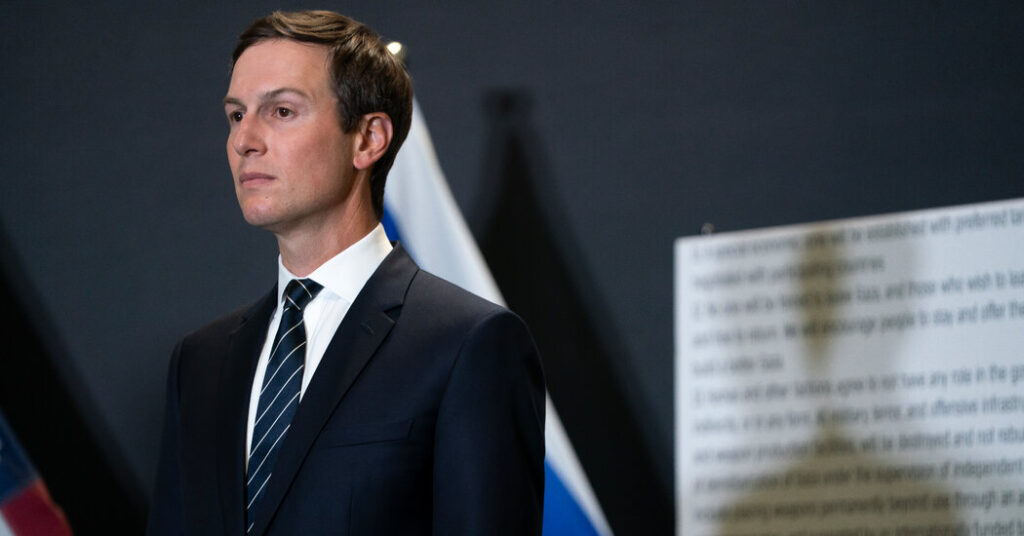
It was a discussion last year between two foreign nationals about Iran, not an unusual topic for American spies to study. But an intercept of that communication, collected by a foreign spy service and given to the United States, has now become a flashpoint within the intelligence community and between the administration and Congress. The reason is a single name that came up in the discussion: Jared Kushner, President Trump’s son-in-law.
The previously unreported mention of Mr. Kushner in the discussion came after members of Congress were briefed last week about a classified report filed by a whistle-blower regarding the intercept, according to people familiar with the material. The whistle-blower has accused Tulsi Gabbard, the director of national intelligence, of limiting who could see the report and of blocking wider distribution among the nation’s spy agencies, people familiar with the complaint said.
The whistle-blower report was drafted last May, while the Trump administration was deliberating about a strike on Iran. At the end of June, the military bombed Iranian nuclear sites on Mr. Trump’s orders.
Mr. Kushner has subsequently helped lead negotiations between the administration and Iran over Iran’s nuclear and ballistic missile programs and its sponsorship of terrorism across the Middle East. He also has business interests in the Middle East and in other parts of the world.
The episode has led to clashes over how to interpret the mention of Mr. Kushner in the discussion and whether Ms. Gabbard was improperly seeking to keep the intelligence from being distributed within the intelligence community.
Mr. Kushner’s name was redacted in the original report from the National Security Agency, but people reading it, including the whistle-blower, were able to determine that the reference was to him. The names of Americans, particularly senior U.S. officials, are usually redacted from accounts of intelligence intercepts, a process called masking.
The foreign nationals were discussing Mr. Kushner, but some officials who have read the underlying intelligence or been briefed on its contents downplayed the significance of the references to him.
The foreign nationals, they said, were commenting on Mr. Kushner’s influence with the Trump administration. At a time last year when Mr. Kushner’s role in Middle East peace talks was less public than it is now, the foreign officials were recorded saying that he was the person to speak to in order to influence the talks.
The intercept also included what officials described as “gossip” or speculation about Mr. Kushner that was not supported by other intelligence. Some senior officials said the information was demonstrably false. While the whistle-blower believed that information should be circulated, the N.S.A.’s general counsel, Ms. Gabbard and the intelligence community’s inspectors general disagreed.
Officials declined to describe the gossip, saying that revealing it would expose the source of the information.
The complaint, the investigation of the complaint and the underlying intelligence all remain classified, officials said. The people interviewed for this story spoke on the condition that their names not be disclosed because of that secrecy. The New York Times spoke to people in both major political parties, as well as people with different opinions of the controversy over the whistle-blower report.
The whistle-blower report was based on a telephone intercept provided to the N. S.A. from a foreign intelligence service. Intercepts are notoriously difficult to interpret. Typically intelligence analysts look to verify them with other forms of intelligence, like information from a human spy or surreptitiously obtained documents.
With the questions around the intelligence, Ms. Gabbard moved to restrict access to the report, according to officials. Ms. Gabbard’s aides have vigorously defended her handling of the complaint in numerous social media posts over the last week since The Wall Street Journal first reported the existence of the whistle-blower complaint. Because the intelligence report mentioned Mr. Kushner, Ms. Gabbard provided the information to Susie Wiles, the White House chief of staff, according to people briefed on the events.
The whistle-blower, an intelligence official whose identity has not been publicly disclosed, said Ms. Gabbard’s actions improperly limited who could see the report. Some people who have reviewed the complaint have questioned whether she was trying to protect an ally of Mr. Trump from scrutiny.
Some officials who either read or were briefed on the intelligence report said that had Ms. Gabbard not moved to restrict access to the report, it would have been quickly forgotten as one of many that recount foreign officials trying to figure out who has influence with Mr. Trump.
Some current and former officials say it can be easy to guess the identity of American officials referred to in intelligence intercepts, even if their names are masked. Because senior officials can be sensitive about top officials or Mr. Trump’s advisers being referred to, even if their names are hidden, Ms. Gabbard may have been acting out of practicality by restricting the data, according to a former official.
Mr. Kushner’s office declined to comment. Officials from the White House and the Office of the Director of National Intelligence declined to discuss the intelligence report.
Ms. Gabbard had previously pulled back and then restricted access to another N.S.A. intercept. That intelligence report involved an intercept of a call between Nicolás Maduro, then the Venezuelan president, and Richard Grenell, Mr. Trump’s envoy. Names of U.S. officials recorded in intelligence intercepts are supposed to be masked, and Ms. Gabbard argued the N.S.A. had failed to properly conceal Mr. Grenell’s identity. Mr. Grenell was negotiating with Mr. Maduro on Mr. Trump’s orders.
The acting intelligence community’s inspector general cleared Ms. Gabbard of wrongdoing after she responded to questions about her actions. That conclusion was later affirmed by the current inspector general, a Trump appointee.
It is not clear when the inspector general cleared Ms. Gabbard. But inspectors general are typically supposed to make a determination about a whistle-blower complaint within two weeks of receiving the complaint.
On Feb. 5, Senator Tom Cotton, Republican of Arkansas and the chairman of the Senate Intelligence Committee, wrote on social media that he agreed with the inspectors general and that the complaint did not contain “credible allegations of waste, fraud, or abuse.”
Some administration critics, who have reviewed the report and have considered the underlying intelligence to be significant, also agreed that Ms. Gabbard did not act improperly by restricting distribution of the report.
While inspectors general are required to notify Congress only about complaints they find credible, some of the administration critics said Ms. Gabbard should have nevertheless alerted congressional intelligence committees about the whistle-blower report or the underlying intelligence months earlier than she did.
Senator Mark Warner of Virginia, the top Democrat on the Intelligence Committee, has been circumspect about the complaint, but was critical of the delays in sending it to lawmakers.
Ms. Gabbard disputed that and defended her handling of the whistle-blower complaint in her own lengthy social media post.
Congressional officials learned about the complaint, but not its contents, when a lawyer for the whistle-blower sent a letter to the intelligence committees in November.
The intelligence committee was expected to provide Congress with a copy of the underlying intelligence report so that oversight committees could review it this week, but it hasn’t been sent to Capitol Hill yet. A heavily redacted copy of the inspector general’s report was provided to Congress. Ms. Gabbard’s office redacted Mr. Kushner’s name, citing executive privilege.
Julian E. Barnes covers the U.S. intelligence agencies and international security matters for The Times. He has written about security issues for more than two decades.
The post Intelligence Dispute Centers on Kushner Reference in Intercepted Communication appeared first on New York Times.