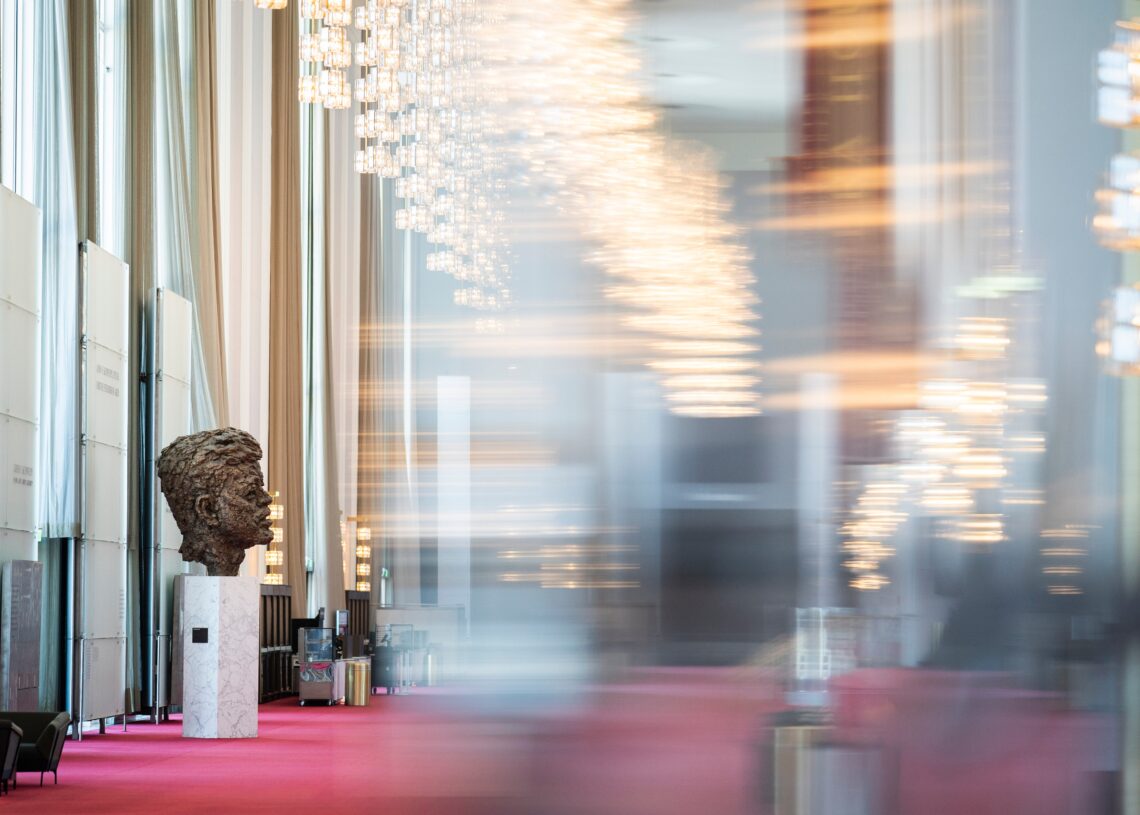
Back in November, Washington National Opera artistic director Francesca Zambello figured out exactly how she would blow up the opera company’s 44-year relationship with the John F. Kennedy Center for the Performing Arts.
She did not warn anyone ahead of time — not her board of trustees or even her closest professional confidant, the opera’s general director, Timothy O’Leary — because Zambello knew what they might say:
Don’t do it, Cesca. Be more cautious.
She just did it, without asking. Between rehearsals one day, Zambello gave a candid interview to the Guardian, divulging the traumatic effect of President Donald Trump’s polarizing takeover of the arts center: empty seats, plunging donations, supporters so upset they were ripping up the opera’s mailed brochures and sending them back to her with angry notes.
“They say things like: ‘I’m never setting foot in there until the “orange menace” is gone,’” Zambello told the London-based news outlet. “Or: ‘Don’t you know history? Don’t you know what Hitler did? I refuse to give you a penny.’” The opera company, she said, might be forced to move.
Her words reached their intended audience.
Richard Grenell, Trump’s handpicked Kennedy Center boss, contacted the opera board on Nov. 8, a Saturday, just hours after the Guardian story appeared: Would they be disciplining Zambello for her outburst? (Opera board members say he explicitly told them she should be removed. Grenell’s team denies that.)
He also informed the board that he wanted to end the center’s contract with the opera company. The affiliation agreement, signed in 2011 and renewed in 2024, requires the Kennedy Center to provide the opera $2.75 million each year and pay for its staff and expenses.
The opera board brushed off Grenell’s first request; it considers Zambello, 69, irreplaceable.
On the second matter, the board’s members were more flexible. They started talking about how to leave the Kennedy Center and dissolve the affiliation agreement. Their final vote came Jan. 9.
“It has nothing to do with the name change,” said attorney Kenneth Feinberg, a longtime opera board member, alluding to the Kennedy Center board’s vote in December to add Trump’s name to the center. “It is strictly dollars and cents, and the Kennedy Center’s inability to understand the economics of how opera works.”
Now, with Trump’s plan to shut down the Kennedy Center for two years of renovations, Zambello’s decision to go off-script with the Guardian seems prescient. While others, including the National Symphony Orchestra, are facing a shutdown thrust upon them with no notice, the opera has a significant head start on planning its post-Kennedy Center future.
“My first thought remains I consider this whole situation just so sad and tragic,” said Daniel Glaser, an opera board member. “But I’m glad we had a plan, and I think we’re now better positioned to weather this move.”
Which is not to say the move will be easy. Within hours of the company’s vote, the Kennedy Center cut off its email and shut down its website. And the company is leaving behind the best opera house in town — a 2,364-seat space that since 1971 has played host to Renée Fleming, Plácido Domingo and Denyce Graves. The opera will also lose the Kennedy Center’s annual contribution to its budget and is in negotiations over roughly $20 million of endowment funds, which the Kennedy Center has not yet agreed to release.
But the Washington National Opera faces bigger questions. Will its audience, a good chunk of whom stopped coming to performances last year, follow it to alternative spaces in the District that are less equipped for opera? Next month, the company will offer productions of “Treemonisha,” featuring the music of ragtime pianist Scott Joplin, and “The Crucible” at George Washington University’s Lisner Auditorium. Other events will be announced later.
“You cannot be an itinerant company without a home,” said Esther Nelson, the former general director of Boston Lyric Opera and the Glimmerglass Festival in Cooperstown, New York. “You can do things outside your home, but eventually you need a home to be financially stable.”
The Jan. 9 announcement stunned opera colleagues, ticket buyers and subscribers, but the roots of the move can be traced back decades. In 2011, the Washington National Opera was on the cusp of economic extinction when it signed the deal that effectively made it part of the Kennedy Center.
The affiliation agreement came after years of turmoil and a near-bankruptcy. Former company officials pin blame on Plácido Domingo, the swaggering superstar tenor who became artistic director in 1996 and then general director in 2003. During his tenure, the WNO’s programming grew more ambitious, adding stars such as José Carreras and Fleming to the fold. He also oversaw its renaming: Originally the Washington Opera, it became the Washington National Opera in 2004.
But Domingo did not keep his budget in check.
“Washington Opera was a nice, smallish regional opera company for many, many years until they hired Plácido,” said Michael Mael, the executive director from 2011 to 2017. “Plácido expected the company to perform on par with the Metropolitan Opera, and that’s expensive.”
Mark Weinstein, Mael’s predecessor, had worked with the beloved soprano Beverly Sills when she served as the general director of the New York City Opera in the 1980s.
“Both of them are self-centered individuals, but Beverly understood that if the company did well, it would reflect well on her,” he said. “With Domingo, it was always the opposite. It was, ‘What can these companies do for me?’ Money didn’t matter to Plácido because he always felt there was more money out there.”
Soon after the arrival of Domingo — a commanding presence and donor magnet once compared by a swooning critic to “a hero from Gothic Spain” — the opera was running as much as a $10 million deficit some years, drawing from its shrinking endowment funds to offset it, Weinstein said. When Weinstein tried to make spending cuts, he said he encountered resistance from Jane Cafritz, then the board chair.
“Cafritz called me in and said I was a constraint to Domingo, and Domingo never really wanted me there, and then Jane said, ‘I want Domingo, and he wants you out, so you’re out,’” Weinstein recalls.
(Cafritz, who remains a member of the WNO board, did not return phone calls. Through an opera representative, she disputed Weinstein’s account but declined to give an interview. Domingo did not respond to a request for comment.)
By 2011, when Domingo stepped down from his WNO role, the situation was dire.
Mael, who had replaced Weinstein, found an ally in then-Kennedy Center President Michael Kaiser, who was not only an opera appreciator but a former member of the company’s board.
Kaiser viewed the Washington National Opera as an important part of the Kennedy Center’s mission as a nonprofit organization.
“One, it’s hard to imagine the national cultural center in Washington, D.C., without an opera in it,” he explains. “And number two … you don’t want the Opera House to be empty for 10, 15 weeks a year. You don’t want unused real estate.”
The affiliation agreement effectively turned the WNO, once a totally independent organization, into a branch of the Kennedy Center. Its business operations moved to the center’s payroll, including its executives, publicists and fundraisers. The opera’s income went back to the Kennedy Center. The opera had to get approval from the Kennedy Center to move forward on programming, but its board had the authority to make “final artistic decisions for each Season, including casting, conductors, directors, scenic design and music,” according to the affiliation agreement.
Theoretically, Kaiser could fire the WNO’s artistic director. But at the time, opera company officials had no cause for concern. The National Symphony Orchestra, also under the Kennedy Center’s wing, required a far greater subsidy and had operated with a fair amount of artistic freedom for years.
“It really did save the opera,” said O’Leary, the current general director. It “was a period where a lot of organizations completely dissolved. Museums, symphonies, the Baltimore Opera Company. It really was like the Kennedy Center will provide the financial backstop for the opera.”
Now, after the Kennedy Center’s dramatic shifts under Trump, Kaiser looks back to a fork in the road that could have changed everything. Around 2007, he examined the governance of the Kennedy Center and decided it made no sense for the president to have the authority to appoint its board.
The issue wasn’t political. In the past, Republican and Democratic leaders viewed the institution as nonpartisan and kept the board balanced between parties.
But Kaiser theorized the Kennedy Center could raise more money if it cultivated its own board members, with an eye to their resources and networking abilities.
“It had nothing to do with whether a president was going to fire board members or not,” said Kaiser. “That’s not why I was concerned.”
However, a crisis at the Smithsonian Institution over the spending of then-Secretary Lawrence M. Small changed his mind, and Kaiser resolved that it wasn’t the right time to go to Congress asking for more autonomy.
“And what no one realized, certainly not myself, was that the legislation [creating the Kennedy Center] did not prohibit the president from removing board members,” said Kaiser. “He had free rein to add or subtract at will.”
Which is exactly what Trump did after taking office. In February 2025, he replaced all of Joe Biden’s appointees on the Kennedy Center board with his own slate that included White House Chief of Staff Susie Wiles, second lady Usha Vance and White House Presidential Personnel Office Director Sergio Gor. That new board then voted Trump chairman of the Kennedy Center and fired the center’s president, Deborah Rutter, a respected arts administrator who had replaced Kaiser in 2014. Grenell, a longtime Republican Party figure who had served as U.S. ambassador to Germany and spokesman for the U.S. delegation to the United Nations, took over. Grenell then fired scores of Kennedy Center employees, attacked the previous leadership and laid out a shift in philosophy.
Grenell, who has declined multiple requests to speak with The Washington Post over the past year, told Fox News Digital that the Kennedy Center had no money in reserve and was taking “tens of millions of dollars in public funds.”
“We must have programs that sell tickets,” he said. “We can’t afford to pay for content that doesn’t at least pay for itself right now.”
Early on, the opera realized it had a problem.
The Kennedy Center’s new leaders, who had little or no experience in nonprofit arts institutions, either did not understand or agree with the economic reality for operas, symphonies and other fine arts institutions around the country: They never cover the cost of a production solely through ticket sales. They almost always lean on support from donors, corporations and other sponsors.
Those funding sources aren’t often in place yet at the point when artistic directors need to sign top-notch talent — typically three to five years in advance. And yet Grenell, first in meetings last spring and later in his frequent social media commentary, made it clear that he viewed the company as a financial drain on the Kennedy Center. If they wanted to schedule any future production, he told them, they had to show him how it would break even.
“There’s no nonprofit performing arts company in the country that can possibly operate without other sources of revenue or funding to compliment ticket sale income, and it’s impossible to know in advance that you have all of those in place,” said Peter Gelb, the longtime general manager of the Metropolitan Opera in New York City. “If the Met operated that way, we wouldn’t be able to perform at all.”
Last summer, O’Leary started to realize how challenging it would be to plan the opera’s seasons. Grenell wanted revenue projections at a time when the Trump-driven changes at the Kennedy Center were making it harder to even approach the previous year’s figures. Trump’s takeover had alienated a chunk of the opera’s audience. That became more acute when his name was put on the exterior of the building in December. During Grenell’s first year, the number of WNO staffers paid for by the Kennedy Center fell from 56 to 36. The entire development department left, according to company leaders.
By November, Zambello thought the relationship with the Kennedy Center was beyond repair.
Not everyone on the opera board agreed. And some feared the consequence of leaving the company’s home.
That’s when she decided to go rogue.
Zambello chose the Guardian as her platform for raising the alarm, reasoning that it would deliver maximum impact through its international audience.
“I was concerned that many people who I spoke with — audience members, donors — they did not know our situation,” Zambello said now. “And it’s my job to tell the truth.”
Glaser, a WNO board member of several years, admits he was surprised to see the comments in the Guardian. He wouldn’t have chosen that route. It wasn’t his style. But Zambello’s decision marked a turning point, and after that, Glaser knew there was no way to move forward with the Kennedy Center:
“It was very, very clear that we reached the point of no return.”
When Deborah Borda, the former president and CEO of the Los Angeles Philharmonic and the New York Philharmonic, learned about the challenges for the Washington National Opera, she concurred that it was the right choice.
“That’s a fascinating thing, because that is a form of leadership where the leader makes a decision and brings about a crisis,” Borda said. “So there has to be action.”
That action became official last month with the opera board’s vote. Three members who voted no resigned afterward: Anne Kline Pohanka, Eric J. Kadel and Molly Wilkinson. But the board’s executive committee was unanimous. The remaining leaders were ready to move forward, outside the Kennedy Center.
In the aftermath, Grenell insisted in a social media post that he had started the process to end the partnership, and technically, he wasn’t wrong.
But it had been Zambello, with her controversial interview, who set it all in motion.
She knows what it’s like for an opera company to pull up stakes. In the ’90s, when San Francisco’s historic War Memorial Opera House underwent renovations for earthquake damage, she reenvisioned Borodin’s “Prince Igor” for the sprawling arena that became the city opera’s temporary quarters. In Houston in 2018, she staged “West Side Story” in a cozy space dubbed the “Resilience Theatre” that was quickly assembled within a convention center after the Houston Grand Opera’s downtown home was flooded by Hurricane Harvey. And in 2021, Zambello created an outdoor season at the Glimmerglass Festival in Cooperstown, N.Y., after having to cancel the previous season due to the coronavirus pandemic.
Just last fall, a small fire in the Kennedy Center forced the WNO to stage its final production of Verdi’s “Macbeth” at George Washington University’s Lisner Auditorium. O’Leary knew it would be a suitable landing spot if the opera needed to move quickly. In March, the WNO returns there to stage “Treemonisha” and “The Crucible.”
“To be honest, that was an illustration of the fact that it was still a great venue for us,” said O’Leary. “It’s where we began 70 years ago, and it was also an illustration of the kind of tenacity and resilience and esprit de corps of the company. This show-must-go-on mentality. We were not going to cancel the production; we wanted to make sure we delivered the show to the audience, and we did.”
Aaron Schaffer contributed to this report.
The post Inside the Kennedy Center’s scorched-earth Washington National Opera split appeared first on Washington Post.