Shivering swimmers emerging from a pool at the Y.M.C.A. found themselves in frigid changing rooms. Bankruptcy court closed early because the federal building had no heat. Municipal employees sat at their City Hall desks in puffer jackets. A sign on a popular restaurant said it would remain closed until it could count on enough heat to keep customers comfortable.
As temperatures fell to minus 13 degrees on Monday morning, it was another day of discomfort for many people in downtown Youngstown, Ohio, where a failing utility company and crumbling heating infrastructure have left more than two dozen buildings with little or no heat during the bitter cold that has gripped the state and much of the country over the past month.
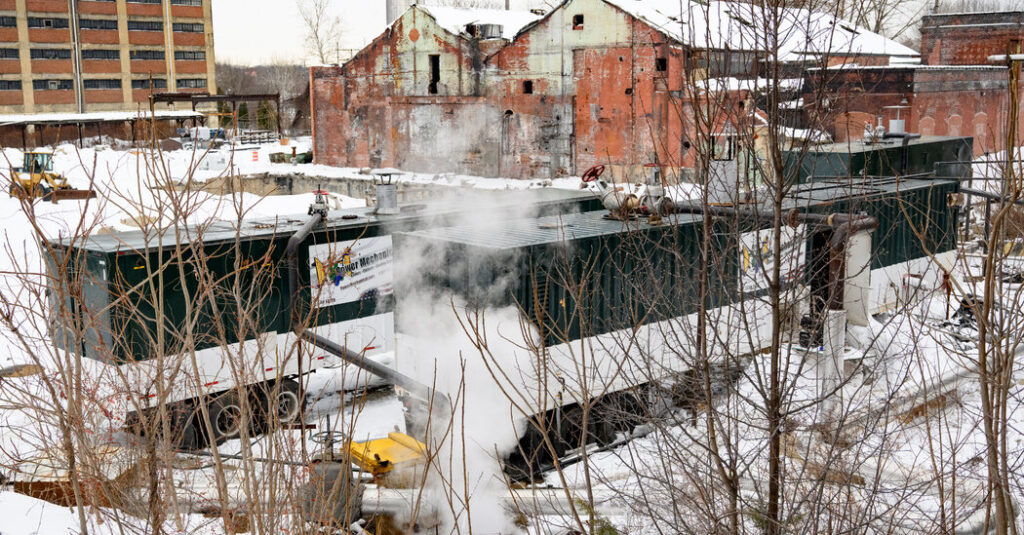
Just a few days ago, two of the three mobile boilers that have been temporarily serving some of the biggest downtown buildings failed. Late Tuesday, the third broke down, the manager of the system told business leaders and city officials.
When City Hall opened on Wednesday morning, there was no heat. By Thursday morning, all three boilers had been repaired and heat returned to at least parts of downtown.
The city’s mayor, Derrick McDowell, who took office last month, said it was intolerable to expect Youngstown, which is a customer of the utility company that is supervised by the state, to rely indefinitely on temporary boilers for 28 buildings.
“I can’t fan the flames of entrepreneurial spirit when buildings are fluctuating between 40 and 60 degrees,” said Mr. McDowell, who is traveling to the state capitol building in Columbus on Thursday to ask for help. “This is literally an economic emergency.”
Calls for assistance from the state have largely proved fruitless.
Youngstown officials are seeking a short-term fix to ensure that there is heat through the rest of winter and help for a long-term solution. They estimate that it would cost $10 million to $30 million — a big-ticket item for a city with a $222 million budget.
Lauren McNally, who represents a district that includes Youngstown in the state legislature, said she had achieved little traction with Gov. Mike DeWine or the Public Utilities Commission of Ohio, which oversees utilities in the state and whose previous chairman was a central figure in a bribery scandal.
Asked why the governor, who nearly three weeks ago declared a weather-related state of emergency, had not taken any action to aid Youngstown, Dan Tierney, a spokesman for Governor DeWine, pointed to what he called an archaic system. “There is not much precedence in modern times for these types of situations,” he said. Mr. Tierney added that the governor has followed the law by ensuring that a receiver has been appointed to run the utility and that any capital outlay would have to come from the state legislature.
On Wednesday night, the state attorney general asked an Ohio Court of Common Pleas to replace the receiver, Reg Martin, who had been criticized by Youngstown leaders for not acting decisively to keep heat flowing since he took over the company, SOBE Thermal Energy Systems, in September. The New York Times had inquired earlier Wednesday with the governor’s office and the commission about Mr. Martin’s performance.
Matt Schilling, a spokesman for the commission, had defended Mr. Martin’s performance on Wednesday, emphasizing that Mr. Martin’s previous experience with an antiquated system contributed to his reappointment. “You can’t just draw names out of a hat and say ‘Go run this thing,’” Mr. Schilling said.
The steam-powered system, built in the late 19th century, is a relic of the industrial age and is still present in the Northeast, most notably in Manhattan. Youngstown’s system works by forcing steam along pipes from one end of downtown to the other. Buildings closer to the boilers get more pressure and those farther away get less.
The failure of the heating system is the latest blow to efforts to rejuvenate downtown, whose hollowing out began in the late 1970s when the closure of the steel mills set off an industrial exodus that decimated the city’s tax base. The city’s population, at 60,068 in the most recent census in 2020, has declined 65 percent since 1960.
More recently, the coronavirus pandemic rocked central Youngstown as it did downtowns across the country, with office occupancy rates dwindling as more people worked from home. That was followed by a beautification project that left streets torn up for two years and a natural gas explosion that forced the demolition of a notable bank building.
The cold temperatures and the broken heating system have led to ruptured pipes in two architectural masterpieces, the 17-story Metropolitan Tower and the 13-story Mahoning National Bank Building, along with the Y.M.C.A, which draws about 3,500 visitors each week.
“People are done believing in what we’re believing, which is the revitalization,” said Dominic Marchionda, a property owner who says he has put up some residents in his buildings at hotels because they have been without heat. “The whole theme we created down there was to live, work and play — they’re supposed to be able to shower, too.”
Lindsay Plaskett Fleuriet’s downtown boutique is not on the steam system, but friends in neighboring shops are. “People say, ‘Oh, well, it’s just Youngstown,’ but people have been saying that for too long,” said Ms. Plaskett Fleuriet, who recently returned to Youngstown after living in Europe. “It makes me wonder if we are a city.”
The court-appointed receiver, Mr. Martin, has frustrated city officials and business leaders by opting for what they say are half measures. He has rented smaller boilers and preferred to use a $750,000 settlement from a natural gas explosion to settle the debts of SOBE Thermal Energy Systems, which operated the system, rather than purchase new equipment.
That Mr. Martin, who shepherded the sale to SOBE in his prior stint as receiver, had been put in charge again only heightened frustrations. Mr. Martin did not respond to a phone message seeking comment.
Mr. Martin was appointed in September, shortly before the system’s boiler was repossessed and shortly after the commission learned that SOBE was deeply in debt and the subject of two lawsuits, including one that accused the company president, David Ferro, of bouncing a $400,000 check.
The heating fiasco, though, has been nearly a decade in the making.
The longtime operator of the system, Youngstown Thermal, which bought it from Ohio Edison in 1980, was on the brink of insolvency when it went into receivership in 2017. It had recently lost its largest customer, Youngstown State University, which opted out of the system and built its own boilers. Other customers have trickled away since then.
After SOBE managed the utility system for two years under the direction of Mr. Martin, the state commission recommended it be able to purchase it in 2021. It praised SOBE for investing in more efficient equipment and repairing leaks. It also said the new company had sufficient cash flow to support existing rates.
That assessment did not hold up for long.
City leaders resisted SOBE’s plan to fuel boilers by burning tires because of environmental concerns. SOBE reported a $542,000 loss in 2023, which signaled financial trouble. But the commission did not act until late August, by which time SOBE was in dire financial straits.
Jenifer French, the chair of the utility commission, did not respond to an emailed list of questions.
Ms. McNally, the state legislator, said the commission “chose not to pay attention to multiple red flags.”
Mr. Schilling, the spokesman for the commission, said it was aware of SOBE’s financial troubles two years ago, but believed in the company’s plan. “Now, we know it hasn’t materialized,” he said.
On Monday morning, Shane Brabant, a facilities director at the Central Y.M.C.A., was in the building’s catacombs, checking the steam pressure, which was more than 75 percent below normal.
Two steam lines at the Central Y.M.C.A. froze and cracked last month, knocking the saunas, which are popular in winter, out of commission. The gymnasium was down to 40 degrees. The deep pool, which is usually at about 87 degrees, had dropped below 80. Mr. Brabant was looking for signs of ice on interior walls.
“We had talked about our own steam plant,” he said. “But it was going to cost $824,000 — and that was in 2017.”
A few blocks away, there were similar stories to tell at City Hall. Two weeks ago, amid a particularly cold snap, temperatures inside the building had dropped as low as 31 degrees. But Kyle Miasek, the city’s finance director, could not send everyone home.
Mr. Miasek’s staff had to complete an essential task by Thursday morning of that week: processing payroll for the city’s roughly 680 full-time and 50 or so part-time employees. If not, people would miss a paycheck.
After a long two days in freezing conditions, payroll checks went out. Then on Friday, city managers prepared for the weekend by shutting off the water, opening the faucets and flushing all of the toilets to keep pipes from rupturing. That meant the operators at the 911 call center on the sixth floor had to go next door to the police station to use the bathroom over the weekend.
On Wednesday, as another payroll loomed, the heat was out again.
“What’s most outrageous is that in today’s day and age, we’re in a seven-story building that is relying on a public utility and we have no heat,” Mr. Miasek said. “Nobody seems to care.”
The post In Ohio City, Officials Take Heat Over Residents’ Lack of It appeared first on New York Times.