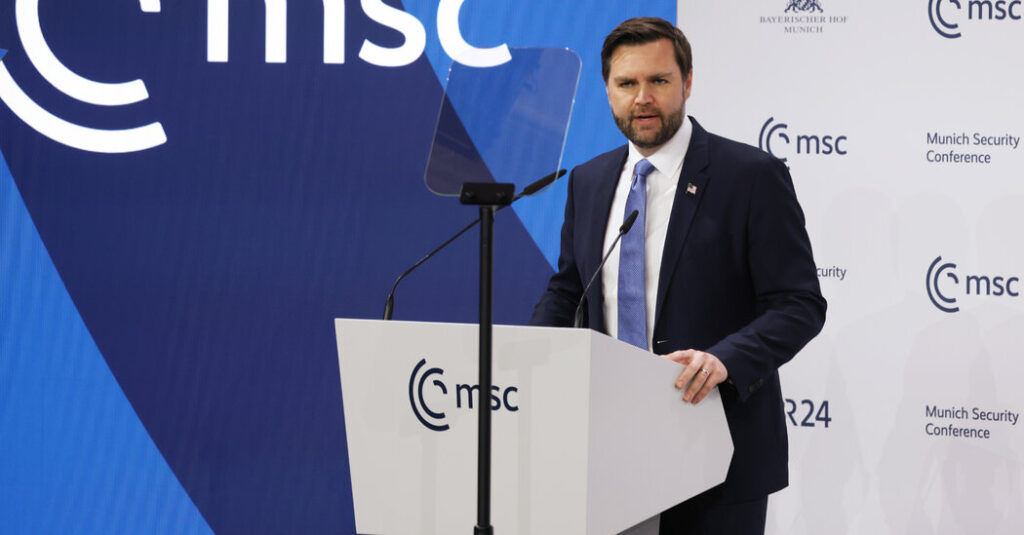
When Vice President JD Vance told the Munich Security Conference last year that America’s European allies were destroying themselves with immigration and unfairly barring the far-right from power, it was a shock to the trans-Atlantic alliance.
There was much more to come.
In the year that followed, President Trump imposed tariffs on European goods. He pushed to end the war in Ukraine on terms largely favorable to President Vladimir V. Putin of Russia and threatened to pry Greenland from Denmark by any means necessary. He mocked European leaders in a bullying speech in Switzerland, declaring Europe would be nothing without the United States.
It has been a dizzying unraveling of the friendship that bound the West together for three-quarters of a century, since World War II. That has left European leaders more wary — and in some cases, more defiant — toward America, as they prepare to meet again in Munich, starting Friday, for Europe’s largest annual gathering of politicians and security officials.
Diplomats and heads of state across the continent say they no longer expect relations with America to revert to a pre-Trump normal, even after Mr. Trump leaves office. They have accelerated efforts to reduce their military and economic dependence on the United States, even as they continue to court the president with flattery in an effort to maintain influence with him on Ukraine and other global issues.
“Trans-Atlantic relations have changed, and no one in this room says this with more regret than I do,” Chancellor Friedrich Merz of Germany, who will open the Munich conference with a speech, said last week. “But nostalgia and reminiscing about bygone better times won’t help us.”
The question on many Europeans’ minds is whether they can ever really trust the United States again — and what they need to do if they cannot.
“Of course, we’ve had a serious loss of trust, no doubt about it,” Wolfgang Ischinger, the chairman of the security conference, said in an interview. “Of course, trust can be rebuilt. But we all know losing trust is easier than rebuilding it.”
In a report before the gathering, staff at the security conference called Mr. Trump a “wrecking ball” and one of the “demolition men” destroying the norms and institutions of the international order. Last month, Prime Minister Mette Frederiksen of Denmark questioned how long America would remain a European ally.
Administration officials do not see it that way. They say Mr. Trump is pushing Europe to be a stronger, more self-sufficient partner, after decades of relying on American troops and nuclear weapons to ensure their national security.
Matthew Whitaker, the American ambassador to NATO, suggested in Berlin this week that the administration viewed Europe as a child that had grown up and needed to find a job.
“We’re not asking for European autonomy,” he said. “We’re asking for European strength.”
Europeans, though, are talking about Mr. Trump in terms that are more resigned and more urgent than a year ago.
At the time, when Mr. Vance stunned the Munich crowd, which had been expecting to hear about Mr. Trump’s plan to swiftly end the war in Ukraine, European leaders tried to rebut him. “This is unacceptable!” Boris Pistorius, Germany’s defense minister, shouted from the audience as Mr. Vance spoke. He later singled out the vice president from the Munich stage.
“If I understood him correctly, he is comparing conditions in parts of Europe with those in authoritarian regimes,” Mr. Pistorius said. “This is not the Europe and not the democracy in which I live.”
Weeks later, Europeans watched as Mr. Trump and Mr. Vance berated President Volodymyr Zelensky of Ukraine in the Oval Office. In December, they read the White House’s updated National Security Strategy, which warned that Europe faced “civilizational erasure,” echoing language from far-right European political parties.
Nathalie Tocci, the director of the Institute of International Affairs, a research group in Rome, said those events and Mr. Vance’s Munich speech were clarifying.
“Those three moments indicated that we’re not in a ballgame of disentanglement, disengagement, detachment, or even abandonment,” she said, “but we’re really in a scenario of betrayal.”
Europeans have questioned Mr. Trump’s strategy of scorning Europe when America needs their support to compete against Russia and China. Jan Techau, a former German defense official and an analyst at the Eurasia Group, said, “It’s just absolute folly to throw away an empire and to throw away your best allies, to alienate them at a time when you need them.”
Europe’s leaders have often sought to mollify Mr. Trump by flattering his ego and giving him small wins.
They pledged to increase military spending within NATO, one of Mr. Trump’s longtime goals. They called Mr. Trump the only leader in the world who could broker peace in Ukraine — in an effort to steer him away from Mr. Putin’s influence.
They cut a hasty trade deal to limit the damage from Mr. Trump’s threatened tariffs. Last month, they promised to bolster NATO’s defense of the Arctic in an apparent handshake deal to stall Mr. Trump’s attempts to take Greenland from Denmark, a NATO ally.
The Greenland crisis seems to have brought Europe to the acceptance phase of its grief, understanding that the traditional reliance and dependence on the United States is no longer possible or even strategically wise, said Ivo H. Daalder, a former American ambassador to NATO.
“Europe cannot trust America today and cannot trust America tomorrow, unless and until the U.S. engages in behavior designed to regain that trust,” Mr. Daalder said. “And it’s possible, if not probable, that Europe will never trust us again. The nature of the relationship between the U.S. and Europe will never go back to where it was.”
The European public appears to think in similar terms.
The latest Cluster17 survey of 7,498 people from seven European countries, conducted in January for Le Grand Continent, a French journal, was startling. A large majority backed sending European troops to defend Greenland, if tensions there escalate. Fifty-one percent said Mr. Trump was an enemy of Europe; only 8 percent called him a friend.
Most European leaders still say the trans-Atlantic alliance needs preserving. German officials suggested this week that Mr. Merz would use his Munich speech to build out a new vision for Europe’s role in the partnership — one that rests on increased military spending; stronger economic growth; and deepened ties with other partners, like India, Africa and swaths of the Middle East.
Mr. Ischinger, the chairman of the Munich conference, said he hoped it would begin two processes: repairing the U.S.-Europe relationship and pushing Europe to act concretely to reduce its dependencies on America.
Secretary of State Marco Rubio, the highest-ranking American official set to attend the conference, is scheduled to speak on Saturday morning. Officials across Europe were not certain this week what he would say. It was not clear if Mr. Rubio planned to meet at the conference with representatives from the far-right Alternative for Germany party, or AfD, who were invited after being frozen out of recent conferences.
Several European officials said privately they did not expect a shock from the more emollient Mr. Rubio on par with Mr. Vance last year. But these days, they could not rule it out.
Mr. Rubio is scheduled to travel from Munich to Hungary and Slovakia, two countries led by populist parties that are sharply critical of the European Union and close to Russia.
Steven Erlanger is the chief diplomatic correspondent in Europe and is based in Berlin. He has reported from over 120 countries, including Thailand, France, Israel, Germany and the former Soviet Union.
The post In Munich, Europe’s Leaders Wonder if They Can Ever Trust America Again appeared first on New York Times.