“The land of liberty had no room for a colored sculptor,” Edmonia Lewis told The New York Times almost 150 years ago.
That was in 1878, when, as an expatriate since 1866, she had been working out of a studio in Rome. A Black and Indigenous woman of humble origins, born and raised near Albany, N.Y., Lewis had achieved improbable mobility and international fame for her neoclassical marble sculptures that ennobled emancipated African Americans, abolitionist leaders, Native American characters from literature and powerful historical women like Cleopatra.
Comfortable promoting her own talent, Lewis crossed the Atlantic at least eight times to showcase her artwork in the United States. In 1873 she exhibited in San Francisco at the invitation of the mayor; more that 1,600 people cutting across race and class came to view five of her sculptures including a bust of Abraham Lincoln. She crafted her story in “How Edmonia Lewis Became an Artist,” a pamphlet distributed to the press that concluded with the line: “God’s gift to Edmonia Lewis is unconquerable energy, as well as genius.”
But by her death in 1907, at about age 63, her fortunes had waned. Lewis was buried in a pauper’s grave in London.
Perpetually forgotten and rediscovered over the decades, Lewis’s story is now being excavated again from the patchy historical record. New museum shows, recent scholarship and artists working in her lineage have juggled fact and speculation to keep her flame alive.
“I feel like Edmonia Lewis found me and kept leading me to illuminate her story,” said Jennifer DeVere Brody, a Stanford University professor who organized “Edmonia Lewis: Indelible Impressions” on campus last fall. Brody’s book “Moving Stones,” to be published in June, is the basis for her new course exploring Lewis through a Black, feminist and queer lens. Brody draws a direct line from Lewis to contemporary artists such as Simone Leigh, Mickalene Thomas and Faith Ringgold (who seated Lewis beside herself in her 1994 quilt “Le Café des Artistes”).
“Lewis becomes the lodestone for ever-emergent webs of interrelation,” Brody said in an interview.
The artist’s first retrospective, “Edmonia Lewis: Said in Stone,” a decade in the making, opens on Feb. 14 at the Peabody Essex Museum in Salem, Mass. It brings together 30 sculptures, almost half of Lewis’s known output, along with works by her contemporaries and traces Lewis’s influence through artworks from the 20th century to today.
“There are so few places where her words survive, she left no studio behind and her work has really scattered,” said Jeffrey Richmond-Moll, the Peabody Essex’s curator of American art, who organized the show with Shawnya Harris, curator of African American and African diasporic art at the Georgia Museum of Art in Athens, where the retrospective will travel in August.
They spent years tracking down long-lost works, such as Lewis’s unsigned 1864 plaster bust of the Union Army hero Robert Gould Shaw, leader of one of the first Civil War regiments of African Americans enlisted in the North. The bust was discovered in the collection of the Massachusetts National Guard Museum and Archives, which was unaware it was by Lewis.
Richmond-Moll and Harris scoured the archives of Lewis’s patrons and friends for references to her. Previously unpublished letters of Florence Freeman, part of an American circle of female sculptors in Rome — including Emma Stebbins and Harriet Hosmer, whom Lewis befriended — provide a beautifully human picture of Lewis hosting meals in her little apartment and playing guitar.
In 1868, Lewis sent “Forever Free,” her marble celebrating Black liberation — a man and woman with broken shackles — from Rome to Boston, “collect,” without a buyer. Her contact, surprised to be saddled with the shipping costs, consigned it to a gallery. (The sculpture anchors the first room of the Peabody Essex exhibition.) “She was like, ‘I want people to see this work, I’m just going to do it on spec,’” Harris said. “Who does that? She must have been quite memorable as a personality.”
After a “rather rough journey” back from America in 1876 when Lewis received no commissions nor sold anything, Freeman described her friend as seeming “quite cheerful and content though and glad to get back, saying ‘never mind, we will have some doughnuts all the same.’”
The retrospective was informed by two scholarly convenings in 2024, one drawing Native American advisers and artists to shed light on Lewis’s Indigenous identity, though the names of her parents are still not verified.
Scholars believe that Lewis was born in 1844 in Greenbush, N.Y., and that her father was a free Afro-Caribbean man, and her mother of Mississauga descent (an Anishinaabe nation in present-day Ontario, Canada). “My mother was famous for inventing new patterns for embroidery; and perhaps the same thing is coming out of me in a more civilized form,” Lewis said in an 1864 interview for The Weekly Anglo-African.
By age 9, likely orphaned, Lewis was being raised by maternal aunts near Niagara Falls. “They were very skilled craftspeople working in basketry and weaving, and were her first instructors in how to create form and structure,” said Bonnie Devine, an artist in Toronto and a member of the Serpent River First Nation in Ontario, who participated in the Peabody Essex Museum’s Native American convening. Devine made a new diptych, a photograph and painting with text about the migrations of the Anishinaabe people throughout the Great Lakes, called “Writing Home, Letter to Sandy.”
Devine sees Lewis bringing that Anishinaabe tradition forward by working in marble in Rome. “It’s quite a long departure,” Devine said. “Yet I see in it the spark of that intense determination to survive.”
Lewis traveled with her aunts to sell their wares at tourist markets in Niagara Falls, Watkins Glen and Genesee Falls. “That helps us to understand, at a very young age, she was attuned to the dynamics of making work for a market and the mobility of Native nations,” Richmond-Moll said.
Her half brother, Samuel Lewis, born to the same father 12 years before her, in Bermuda, is an important part of her story, and her ability to pursue an artistic career.
Samuel traveled as a performer with the circus after their father’s death, sending money for his sister’s education — at New York Central College in McGrawville and then Oberlin College in Ohio. At Oberlin, she received encouragement from the abolitionist Frederick Douglass and studied classical motifs in her art classes but her experience was also harrowing (she was accused of poisoning two housemates, beaten by a white mob and later exonerated after a public trial).
Douglass had advised Lewis to “seek the east,” and Samuel partly funded her move to Boston — where she set up a studio from 1863 to 1865 and cultivated supporters among antislavery circles — and then contributed to her passage to Rome.
A two-part exhibition, “Chisel & Razor: The Artistic Legacies of Edmonia & Samuel Lewis,” opens on June 19 at Tinworks Art in Bozeman, Mont., where Samuel was one of the entrepreneurial founding fathers of the frontier city and set up its first barbershop.
“Samuel offers a new point of departure for thinking about Edmonia and her origins, which are so mysterious still,” said Melissa Ragain, the exhibition’s curator and a professor at Montana State University. She is putting work by almost a dozen contemporary artists, including Sanford Biggers and Sonya Clark, in conversation with the life stories of the Lewis siblings.
“Both of them did a lot of self-mythologizing and had similar strategies in how they navigated the world as public figures,” Ragain said.
The title of the show comes from an 1867 ad for Samuel’s shop in Bozeman, in which he touts his kinship to Edmonia: “The work of the sister and that of the brother, may be said to be one and the same, with this slight exception — that in cutting a shapely ‘phiz’ [face], one has a knack in using the chisel while the other deftly applies the razor.”
No actual letters between the siblings have surfaced, nor is it believed that Samuel and Edmonia ever met again after their youth. “There is a kind of intimacy that’s missing in this story,” Ragain said. “That’s the space a lot of contemporary artists are interested in entering and understanding what that private world felt like.”
In a new commission, Edgar Arceneaux,an interdisciplinary artist in Los Angeles,is staging a live performance piece at Tinworks for its opening weekend, and editing it into a video for the run of the show.
“I felt there was a certain longing that existed between brother and sister as they were both living their own extraordinary lives,” Arceneaux said.
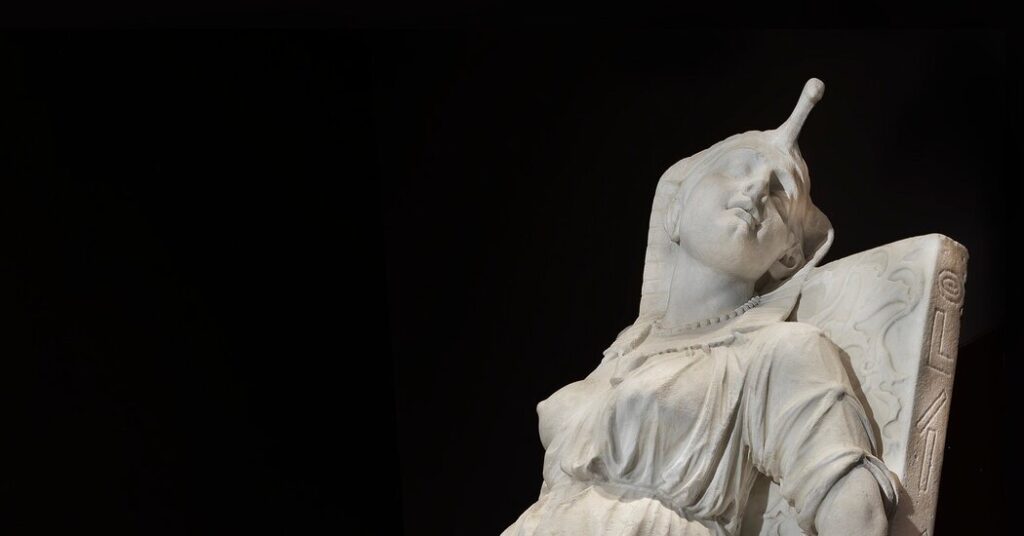
Auriea Harvey, an African American sculptor living in Rome, uses Lewis’s monumental sculpture “The Death of Cleopatra,” as a departure point for her commission opening at Tinworks on Oct. 1.
Weighing almost three tons and seen by nearly 10 million people at the 1876 Centennial Exposition in Philadelphia, the Cleopatra marble depicts the Egyptian queen at the moment of her death, transcendent on her throne. (The work is now in the collection of the Smithsonian American Art Museum.)
Harvey, for her monumental sculptural tableau “Edmonia Triumphalis,” is enthroning her own representation of Lewis on a ceremonial barge arriving in Montana to see her brother. “I wanted to make it her triumphal return, like she’s bringing everything she learned with her,” said Harvey.
Lewis, who never married, had relocated to Paris by 1893, then moved to London in 1901; there are no records of any work made in these years. She died soon after.
More than a century later, Gisela Torres, an artist of Afro-Cuban heritage working in London, read a 2018 article in the art journal Hyperallergic about the discovery of Lewis’s previously unmarked grave in a cemetery where Torres frequently walked.
“I got goose pimples,” Torres said. “I became obsessed.”
She started tracing Lewis’s footsteps in Italy and making ghostly self-portraits there with expired Polaroid film that she printed on fragments of marble, part of a continuing project called “Looking for Edmonia (Self-Portrait),” examples of which are included in the Peabody Essex retrospective.
“The project is about this woman that existed and I feel like I carry her and she carries me,” Torres said. “I have to thank her.”
Feb. 14 through June 7. Peabody Essex Museum, 161 Essex Street, Salem, Mass.; 978-745-9500, pem.org.
Chisel & Razor: The Artistic Legacies of Edmonia & Samuel Lewis.
June 19 through April 4, 2027. Tinworks, 719 North Ida Avenue, Bozeman, Mont.; 406-551-2024, tinworksart.org.
The post Improbably Famous, Then Perpetually Forgotten. Now, the Renaissance of Edmonia Lewis appeared first on New York Times.