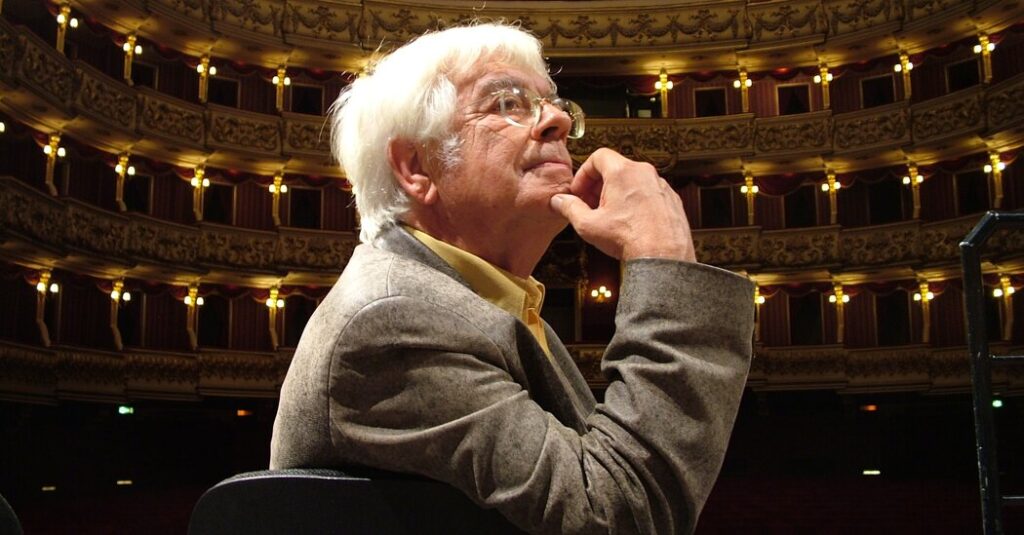
Helmuth Rilling, an eloquent, widely esteemed German musician who evangelized for the music of Johann Sebastian Bach and was the first conductor to record all of that composer’s sacred cantatas, died on Wednesday in Warmbronn, Germany. He was 92.
His death was announced by the International Bach Academy Stuttgart, which he founded in 1981.
Mr. Rilling, who worked mostly with the chorus and orchestra that he founded, the Gächinger Kantorei and Bach-Collegium Stuttgart, was initially “a Bach lover, not a Bach scholar,” he said. His cycle of the nearly 200 surviving sacred cantatas, which engaged him from 1969 to 1985 and employed singers of the stature of Arleen Auger and Dietrich Fischer-Dieskau, began as an act of devotion more than an effort at encyclopedism.
“As an active church musician, I’d performed some of the cantatas liturgically and was struck by just how good they were, and yet there were perhaps only 15 or so discs available,” he told BBC Music Magazine in 2010.
“The Passions and B minor Mass were well represented of course; I wanted to make the cantatas better known,” he continued. “Having recorded 30 or 40 of them and becoming more and more excited that we were exploring really great music, one day I thought, well, why don’t we do them all?”
His Bach came to stand out not just for its omnivorous range — he recorded the vocal, orchestral and other works, from the magisterial “St. Matthew Passion” down to the merest chorale settings — but also for its steadfast, smooth and, to some, increasingly anachronistic style.
Mr. Rilling also helped found the Oregon Bach Festival in 1970 and served as its artistic director until 2013. He emerged near the end of a line of musicians — exemplified by his near-contemporary, Karl Richter — who had once pursued an innovative, more consciously objective approach to Bach than their Romantically-inclined colleagues.
But just months after Mr. Rilling started his cantata survey, the early-music pioneers Nikolaus Harnoncourt and Gustav Leonhardt began a crusading set of their own — using period instruments, basing their work on the latest musicological research and laying the groundwork for the eventual triumph of the historically-informed performance movement in Baroque and other music.
“The musical climate has shifted around the German Bach specialist Helmuth Rilling,” the critic James R. Oestreich reflected in The New York Times in 1994, “to the extent that his interpretations, at one time fairly advanced, are now considered stodgy and old-fashioned in doctrinaire circles.”
Confronted with this fresh radicalism, Mr. Rilling proved no reactionary; while remaining true to the Bach he had grown up with, he preached tolerance as musicians on both sides of the debate grew intransigent. Personally, he stuck with modern instruments, tinkering at the edges of traditions without abandoning them wholesale. If his synthesis of his inheritance and the newest trends could seem staid, at its best it struck many listeners as distinguished.
“Ideas about interpretation are constantly on the move,” the critic Nicholas Anderson wrote in Gramophone in 1995, “but great artistry remains great artistry and in Rilling’s cantata survey there are singers and players whose performances should certainly survive the passage of time.”
For Mr. Rilling, in any case, finding authenticity through academic inquiry mattered less than expressing an authentic emotional message, whether religious or otherwise.
“How can we explain why we are so much touched by Bach’s music?” he wondered in a radio interview in 2004. “I think very often this is because he is dealing with things, with themes, with problems, which existed at his time and still exist today. These are just general human situations like sadness or sorrow or having to deal with death — having to overcome things that are hard to understand.”
Helmuth Rilling was born on May 29, 1933, in Stuttgart, Germany. His mother, Hildegard (Plieninger) Rilling, died 10 days after giving birth to him. His father, Eugen, was a music teacher, and remarried in 1936. As the largest space in the family’s apartment was reserved for music, Helmuth and his four younger stepsiblings bunked in a single room.
Religious from childhood, Mr. Rilling learned to sing and play piano at a church boarding school in Bad Urach, and took lessons from the local seminary organist. He entered the Stuttgart Hochschule für Musik in 1952, studying organ and violin, and at the end of 1953 went with school friends to spend a week singing in the town of Gächingen.
Just 20 or so strong, the students gave a small concert — featuring Buxtehude, Schütz and new music, but no Bach — on Jan. 3, 1954, then performed back in Stuttgart a couple of weeks later. The Gächinger Kantorei choir was thus born; the Bach-Collegium Stuttgart was formed to accompany it in 1965. Mr. Rilling remained the conductor of both until 2013.
It was as a liturgical musician that Mr. Rilling became an authority in Bach. After graduating from conservatory in 1955, he traveled to Italy, training with the organist Fernando Germani in Siena and at the Accademia Nazionale di Santa Cecilia in Rome, then returned to Stuttgart as cantor of the Gedächtniskirche church in 1957. He held that post until 1998.
The church had just been rebuilt, its tower alone having survived Allied bombs, and Mr. Rilling founded its choir. He programmed Bach’s cantatas in special services from 1965, and ended up recording them in the same nave.
“We have performed, not all of the cantatas, but I believe over 100 of them, in church as a part of the service, with the congregation singing the chorales,” Mr. Rilling told The Times in 1987. “The importance of this for the choir and for me is indescribable: to perform this music for, and with, people who are receiving it in its true context, understanding the words and the intent.”
Mr. Rilling, who also held conducting and teaching positions in Frankfurt, married Martina Greiner, a soprano, in 1967. She survives him, as do two daughters, Sara Maria Rilling, a violist, and Rahel Maria Rilling, a violinist.
It was always slightly inaccurate to describe Mr. Rilling purely as a Bach specialist, even if he thought he had led “at least 100, maybe 300” performances of the “St. Matthew Passion,” and held workshops on the composer in countries worldwide under the auspices of the International Bach Academy Stuttgart.
He recorded other classical works and promoted contemporary composers, too. Liszt’s “Christus,” Franck’s “Les Béatitudes” and Honegger’s “Jean d’Arc au Bûcher” were among his more adventurous releases on the Hänssler label. For the 250th anniversary of Bach’s death in 2000, he commissioned and premiered settings of the Passion story by the composers Wolfgang Rihm, Sofia Gubaidulina, Osvaldo Golijov and Tan Dun.
His Oregon Bach Festival recording of Krzysztof Penderecki’s “Credo” (another of Mr. Rilling’s commissions) won the Grammy for best choral performance in 2000. Among the other nominees was his account of Bach’s “Christmas Oratorio.”
No amount of advocacy for new music, however, could erode the central element of Mr. Rilling’s reputation.
“Do you like being a Bach specialist?” the Chicago broadcaster Bruce Duffie asked in 2000.
“Sure,” Mr. Rilling replied. “This is an honor.”
Ash Wu contributed reporting.
The post Helmuth Rilling, Who Recorded Huge Swaths of Bach, Dies at 92 appeared first on New York Times.