GUATEMALA CITY — Guatemala began electing magistrates to its highest court Thursday, in a weekslong process that will again test the strength of its democratic institutions.
Guatemala’s Constitutional Court has been at the center of the country’s battle against corruption in recent years, ruling in high-profile cases on the future of an international anti-corruption commission and the release of a former president charged with corruption.
The Constitutional Court comprises five magistrates, and the president, Supreme Court of Justice, Congress, University of San Carlos and the country’s bar association each select one. Almost all of the current magistrates are hoping to be reelected.
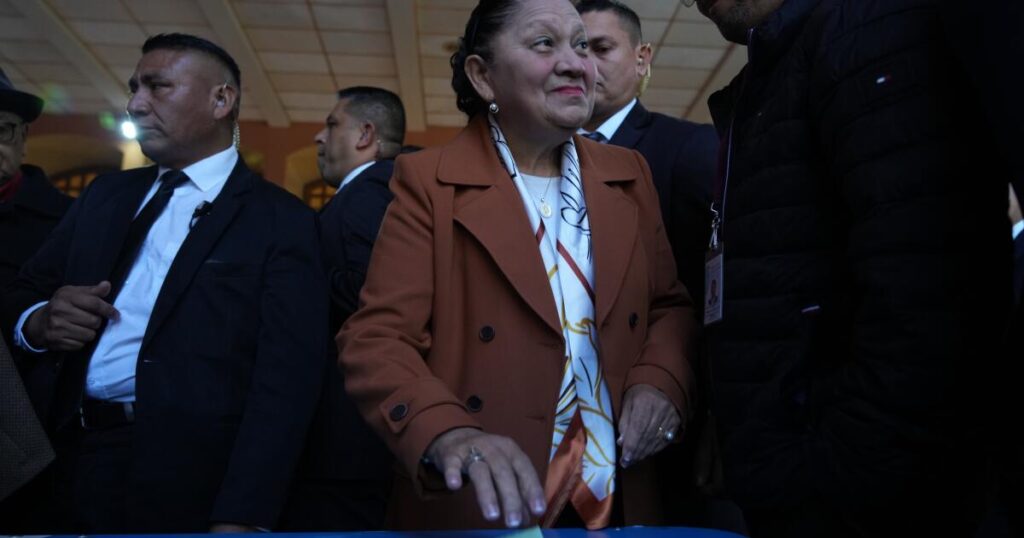
On Thursday, the bar association was holding its election to pick its magistrate and alternate, the first for the new Constitutional Court. The other institutions will pick their representatives in the coming weeks.
A new attorney general will also be elected in the coming months to replace Guatemala’s outgoing top prosecutor Consuelo Porras, sanctioned by the United States and European Union for undermining democracy.
Guatemalan President Bernardo Arévalo called the process “important and critical for democracy,” in an interview with The Associated Press last month.
“The democratic development of the country is on the line, the possibility of having democratic institutions where a culture of respect for the rule of law is built,” he said.
Guatemala’s top court
The Constitutional Court is Guatemala’s highest and its decisions cannot be appealed.
At the Constitutional Court, all 10 positions — five magistrates and five alternates — will be elected.
The high court’s importance is undisputed and that has drawn corruption into the selection previously.
When former President Jimmy Morales terminated the mandate of an anti-corruption commission known as the CICIG in 2019, the Constitutional Court acted as a key democratic safeguard and ruled his decision unconstitutional.
But the court took a turn when new magistrates were elected in 2021.
Human rights lawyer Rafael Maldonado said that “the last five years there has been a Constitutional Court made up of dark characters who have stopped any advance there could be in Guatemala.”
For example, the court in April 2024 upheld the release from prison of former President Otto Pérez Molina (2012-2015), who had been convicted in two separate cases of corruption.
Five judges and their backups will also be elected to the Supreme Electoral Tribunal. In non-justice positions, a new federal comptroller will be elected, as will a rector for the University of San Carlos of Guatemala.
The elections are being closely watched because of the impact they can have on Guatemala’s justice system. The Organization of American States, a regional body, created a Special Mission for the Strengthening of Democratic Institutions in Guatemala to monitor the nomination processes and the European Union sent its own observation group.
Maldonado said the elections will determine “the consolidation of access to justice.”
Political analyst Renzo Rosal said the elections will “put democracy to the test.”
“It is the perfect laboratory to see how the institutions are steered toward greater cooptation, control and loss of independence, which has a direct affect on the citizenry,” he said.
A new top prosecutor
Under Attorney General Consuelo Porras, Guatemala’s Public Ministry has been criticized for undermining corruption investigations and carrying out political prosecutions against former prosecutors, judges and journalists who reported corruption.
Porras’ office also played a key role in barring top anti-corruption candidates from running in the 2023 elections. It then pursued Arévalo’s political party in what many saw as an attempt to keep him from taking office after his surprising victory in a tumultuous election.
Arévalo requested her resignation, but she refused. He does not have the power to remove her before her eight-year run in the role ends in May. She is seeking election as a magistrate to the Constitutional Court.
The constitution says the president gets to select the attorney general every four years from a slate of six candidates proposed by a nominating committee made up of the president of the Supreme Court, the deans of the country’s law schools, the president of the board of the bar association and the president of the bar association’s honor tribunal.
Porras was first selected by President Morales in 2018 and then reelected by his successor President Alejandro Giammattei. She was accused of protecting both former leaders from investigation for corruption, something she has denied.
Pérez writes for the Associated Press.
The post Guatemala begins high-stakes top court magistrate elections, a fresh test for democracy appeared first on Los Angeles Times.