If clergy are usually more priest or more prophet, Rabbi Darby Leigh saw himself as priest. Someone whose main calling was pastoral, helping teens prepare for bar mitzvahs, comforting congregants in hospice, bearing witness to intimate moments.
Then came Minneapolis.
The massive ICE crackdown there — with its stories of federal law enforcement shooting U.S. citizens, separating families and deporting undocumented people, even those trying to go through legal channels — led Leigh to feel called in a new way, to go to Minnesota and join the opposition. He didn’t end up doing it. But some of his congregants began pushing: What are we doing? How are we defending democratic norms?
“Historically, I had the idea I was leading the way to a better future. I was a kind of ‘active,’” he said. “But in the moment we’re in, I’m coming to a new realization. They say faith leaders’ job is to comfort the afflicted and afflict the comfortable. This moment needs all of us to say: I’m willing to be a bit more uncomfortable.”
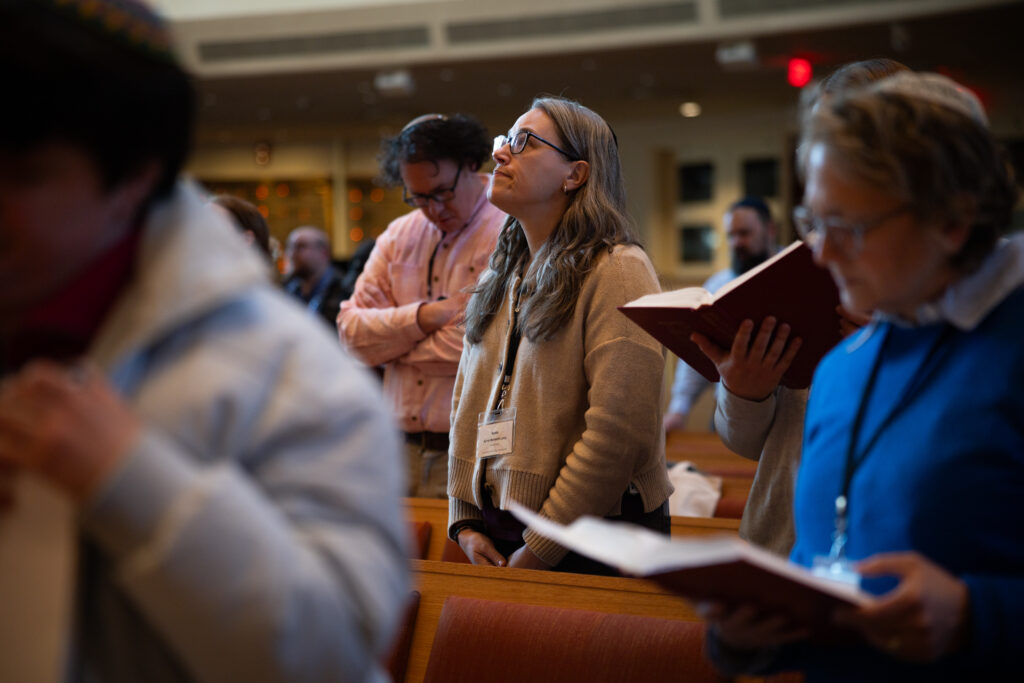
That call to become more visible, more confrontational, more activist brought Leigh this week from his Concord, Massachusetts, synagogue to a three-day training at the D.C. synagogue Adas Israel. There, he and more than 140 rabbis and cantors from around the country heard lectures about the historic role of clergy in opposing authoritarianism, studied concrete organizing tools such as boycotts and walkouts, and how to build relationships with local sheriffs. And they prayed.
They broke into groups to discuss what, specifically, they would do if U.S. Immigration and Customs Enforcement came to their community. With reports that Massachusetts is preparing for a potential ICE surge, for Leigh the exercises didn’t feel purely hypothetical.
While religious leaders have always played roles in advocacy movements, polls show their moral authority has weakened in recent decades. The intensity of the U.S. political climate — and the debate over President Donald Trump’s immigration policy, in particular — has pushed clergy from various faiths into more public roles.
Last month, Catholic bishops said America’s moral standing is being thrown into question by its use or threats of military force. In October, a Chicago priest protesting outside an ICE facility was struck in the head with a pepper ball and sprayed in the face. In North Carolina this week, Bishop William J. Barber II, a prominent progressive pastor, is leading a three-day, 50-mile march to push for better wages and immigrant rights.
The Jewish clergy gathering in D.C. was organized by T’ruah, a progressive group that trains clergy and advocates on human rights issues. An event of some kind was planned when Trump was reelected, but the content and a focus on ICE and authoritarianism came together more recently, Rabbi Jill Jacobs, the chief executive of T’ruah, told The Washington Post.
“Our collective moral voices are more important than ever,” Jacobs told the group as the event opened Monday night. “When political leadership assaults us day in and day out with lies, with cruel policies and with a degradation of human dignity, religious moral voices are the ones that can stand up to insist on what is true and what is just.”
Speakers told the clergy this week to be prepared for difficult decisions about how to respond to an ICE surge. Michaela Brown, a Minneapolis rabbi, said she wanted to share lessons from her experience, “so that you, too, can meet the moments that will inevitably present themselves to you in due time.”
Among Brown’s lessons: Make sure you and your congregants know your neighbors. Be aware of what skills you have and do not have. If you’re not experienced in de-escalation techniques, avoid getting involved in volatile protests. Work to widen your circle of allies — whether that means other Jews you previously broke with over Israel, for example, or Christians whom you might disagree with on abortion or trans rights.
“Our goal is to turn enemies into allies, not to crush them,” Rabbi Sharon Kleinbaum, a prominent New York human rights activist, told the gathering.
At times during the conference, Leigh felt daunted. In one breakout session, he and other clergy around a round table were asked how they would respond if voting locations became federally managed. Trump has repeatedly called for this in recent weeks.
“As faith leaders, how can we stop that? Like a federal takeover of elections, or Trump second-guessing voting,” Leigh said to his group. “What’s a faith leader’s role in that?”
It’s not like Leigh, 53, hasn’t been active — in a different way. Born deaf, he has co-written several books on spiritual and religious support for people with disabilities. He went to the Women’s March in Boston in 2016. He has spoken to his congregation about LGBTQ+ rights and women’s rights.
During the conference, Leigh said he was buoyed by the tools he was learning about: Focus on relationship-building with other faith groups that have already been working on things like creating a food distribution system in case people are stranded in their homes by an ICE surge. Don’t be overwhelmed into inertia.
Shoshana Perry, 66, a rabbi of a 200-family synagogue in Massachusetts near the border with New Hampshire, also came to the conference looking to expand her activism. She has frequently attended a small vigil outside an ICE facility in Burlington, Massachusetts, spoken on climate action and helped migrants settle in her area. But her work in recent months, she said, is “the most physically activist I’ve ever been.”
She knows that views about immigration vary in her congregation, and came to D.C. to hear about strategies for how to balance the political and the pastoral.
“How do I engage with congregants who may not see this the way I do? Do they feel you’re not still their rabbi? Am I willing to risk those relationships?” she told The Post between sessions. “People say rabbis shouldn’t be political. The Torah is filled with politics. Judaism has never been apolitical. It’s always been spiritual, pastoral and political.”
On Tuesday evening, Leigh said he was gaining confidence that he would be more prepared to lead his congregation if ICE came in force to the Boston area. But he was nervous about the final event of the conference — a protest planned for Wednesday afternoon outside ICE’s headquarters in D.C. Joining the T’ruah clergy would be people from 60 other Jewish co-sponsoring organizations.
Leigh had initially decided not to go to the protest, daunted by the possibility of being in a big crowd, unable to hear directions and surrounded by people wearing masks that might prevent him from lip-reading. But after going through the training, he changed his mind.
“I felt, at what point am I going to say everyone is taking a risk. My risk is a bit different. But at what point am I going to stand up?” he told The Post. “I think I’m called to show up more. We all are. If we care about democracy, Judaism, humanity, the way our neighbors are being treated, we are all being asked not to be bystanders. This is a practice-what-you-preach moment.”
By Wednesday afternoon, Leigh was standing outside ICE headquarters in Southwest Washington, near L’Enfant Plaza, surrounded by hundreds of other protesters. He wore a baseball cap and held a sign. “I do not consent,” read one side, in purple lettering. “Pharoah doesn’t win,” read the other side, in red.
All around him, rabbis in prayer shawls and winter coats were holding signs, blowing shofars and chanting prayers. Someone started a chant from Hebrew scripture that commands Jews not to stand by when their neighbor is in danger.
“Shame!” one of the speakers said. Someone playing a drum began a beat as the crowd started to chant: “Shame! Shame!” An interpreter conveyed the word to him.
Leigh shot up his hand and began to chant.
The post For these clergy, Trump’s immigration blitz became a call to action appeared first on Washington Post.