Mothers of young children surged into the work force during the Covid-19 pandemic, propelled by a tight labor market, federal child care subsidies and the sudden abundance of remote jobs.
Years later, they are still on the job. The share of women with children under 5 who are working or looking for work peaked at nearly 71 percent in September 2023 and continues to float above prepandemic levels, according to an analysis of government data from the Hamilton Project, an economic policy research group at the Brookings Institution.
The growth is partly because more employers have flexible office policies, an enduring legacy of the pandemic era. More jobs are at least partly remote, so parents — especially mothers who often shoulder most of their families’ child care duties — can better balance their responsibilities as employees and caregivers. This is particularly true for highly educated women in white-collar jobs.
There is probably also a bleaker catalyst for the elevated labor force participation among mothers with young children, some economists believe: More women feel they must earn a paycheck to afford family life.
“It’s not something to be proud of,” said Kathryn Anne Edwards, a labor economist and policy consultant. “If anything, it just reflects that they might be more desperate for money.”
For families across the country, the cost of living has become an escalating challenge. Grocery prices have increased more than 25 percent over the past five years. Many Americans are straining to pay for health care, education and housing. Child care prices in most states have increased more than twice as fast as prices overall, according to the Century Foundation, a left-leaning think tank.
The financial pressure may be compelling more mothers of young children, who generally work less than other women in their prime working years, to enter and remain in the labor force. Hiring in January was stronger than expected, the Labor Department reported on Wednesday.
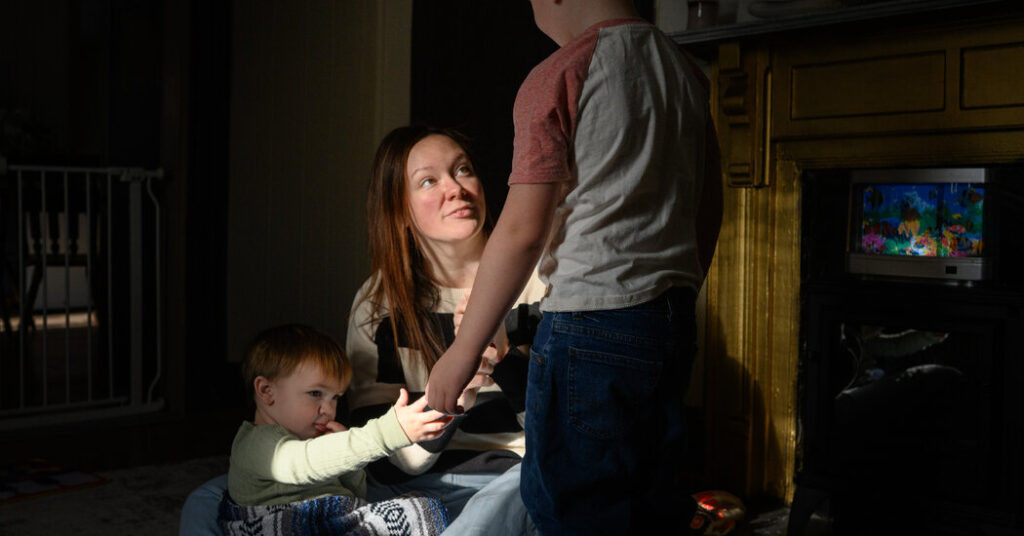
Kelsey Whitlatch, a mother of two in Moundsville, W.Va., left her job as a hair stylist in October 2023, a month before her second son was born. A year later, she got a job at a day care, but it closed soon after.
Ms. Whitlatch, 28, said she considered not working to focus on her children, who are now 5 and 2. But her husband, a bridge inspector for the state, does not make enough money to support their family on his own, especially with the rising costs of groceries and utilities.
During months when she wasn’t working, her family relied on food stamps and struggled to pay bills. She fell so behind on payments for her car that she worried it would be repossessed.
“We were going under so bad,” she said.
She now brings home about $400 a week taking care of a handful of children along with another mother who had worked at the day care. She also has a home bakery business, Sugar Mommas Cottage Home Bakery, that sells cookies and elaborately frosted cakes.
“Everyday I’m grateful — I know we could definitely be way worse,” she said. “I’m glad we’re at least sustaining, to some extent.”
Mothers of young children have a lower labor force participation rate compared with other women for many reasons, including a lack of affordable child care and care giving duties that are in tension with work schedules. Women who drop out of the labor force tend to do so around the time when their children are born, and rejoin when their children are older and parenting responsibilities are less consuming. The labor force participation rate for mothers with children ages 5 to 12 was about 77 percent at the end of last year.
But being a stay-at-home mother for any amount of time is possible only if a family can live on one income. That arrangement appears increasingly out of reach. More than 70 percent of Americans last year said that raising children was unaffordable, according to the American Family Survey, an annual poll of 3,000 Americans.
“What is noticeable is just how widespread this concern is,” said Chris Karpowitz, a political science professor at Brigham Young University and one of the survey’s authors. “Americans of all stripes are worried about the cost of raising kids.”
Poorer families are getting squeezed even harder by slower wage growth, persistent inflation and rising child care costs, said Corinne Low, an economist at the University of Pennsylvania and the author of “Having It All: What Data Tells Us About Women’s Lives and Getting the Most Out of Yours.” That, coupled with a downshift in hiring, has made many families more reliant on second “flex” earners to pick up the slack.
“One of the things that means is families might not be able to afford not having mom in the labor market,” she said.
Other factors keeping more women with young children in the labor force include a change in employers’ expectations about where work is done. White-collar professions are often more conducive to remote-work arrangements, and many companies have become less strict about in-person work. That has allowed some women to set office schedules that align more with child care hours.
Women have also benefited from a boom in the health care industry, which has powered employment growth. More than 40 percent of the 2.8 million jobs created from November 2023 to November 2025 were held by women in health care and social assistance, according to an Indeed Hiring Lab analysis of government data. Roles such as nursing, though often in person, have set shifts that allow mothers to more reliably anticipate their child care needs, Ms. Low said.
“It works for women because it is structured and it is predictable and it has strong boundaries,” she said.
Efforts are underway in New Mexico, New York City and elsewhere to make child care more accessible, which could bolster the labor force participation rate for mothers with young children.
Yet a shortage in affordable child care is a prevailing obstacle. Pandemic-era child care subsidies have expired. The federal government is trying to freeze roughly $10 billion in funding for child care and social services destined for New York, California, Minnesota, Illinois and Colorado, which are all led by Democrats. And evidence is emerging that the Trump administration’s immigration crackdown is shrinking the supply of child care workers, worsening the problem.
Cameron Hulin, 28, lives in Youngsville, La., and has a 3-year-old daughter. She and her husband, an electrician, have cut down their expenses but are still struggling to pay roughly $550 a month to send their daughter to preschool. They have been trying to sell their house and downsize, but have not had any luck.
With another baby on the way, Ms. Hulin and her husband decided it made more sense for her to become a stay-at-home mother rather than pay for child care for two children. She plans to leave her job in child advocacy at a nonprofit in May, when her daughter’s program ends for the summer.
“It’s hard stepping away from something I enjoy,” she said. But, she added, “My purpose is going to be fulfilled still, being there with my kids.”
Sydney Ember is a Times business reporter, covering the U.S. economy and the labor market.
The post Flexibility and Rising Costs Are Keeping Mothers at Work appeared first on New York Times.