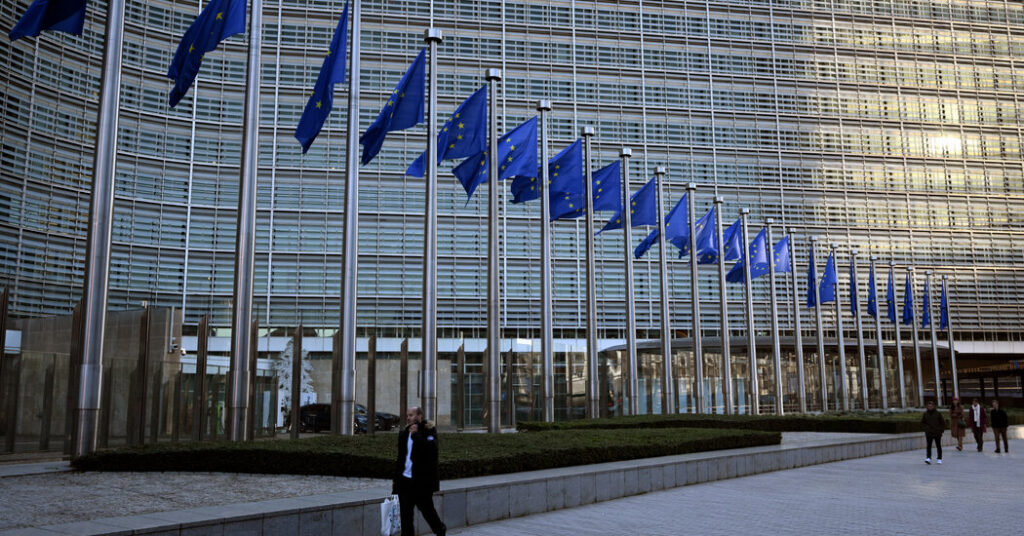
President Trump’s seizure of Venezuela’s oil and his on-again, off-again vows to acquire Greenland, by force if necessary, have underscored the new threat that Washington poses to nations’ sovereignty.
The land and resource grabs have alarmed even once-close allies, compelling them to consider other, less obvious risks. The most pointed stems from American dominance over the global financial networks and technology systems that undergird nearly every purchase or exchange of information made by citizens, businesses and governments.
Allies are concerned for their financial independence and the security of confidential national data.
The risks may be harder to visualize than crashing through a nation’s border and carting off its valuable crude. But they have revived efforts, particularly in Europe, to strengthen control over these critical, though unseen, sources of autonomy and power.
European leaders have stepped up their push to reduce reliance on big American tech firms like Amazon, Google and Microsoft for cloud computing, and on financial services titans like Mastercard and Visa for payment systems.
The move to secure what are being labeled monetary sovereignty and digital sovereignty is part of a broader effort to reduce Europe’s dependence on American weapons, trade, technology and more.
At a summit in Belgium this week, President Emmanuel Macron of France warned that the reliance makes the continent more vulnerable to economic and political coercion from the White House, and he urged other European leaders to seize “the Greenland moment” to do something about it.
Economists and bankers have also been urging lawmakers to approve the creation of a digital euro — the online version of cash — to lessen dependence on American financial service companies and networks.
“Trump was elected and everyone started getting very, very scared,” said Dan Davies, formerly an economist at the Bank of England. Europeans woke up to Mr. Trump’s willingness to use their needs to squeeze Europe and realized “now this is obviously a national security issue.”
Nearly two-thirds of the transactions in countries that use the euro, the second-most commonly used currency in global trade, were handled by Mastercard or Visa in 2025, according to the European Central Bank. And at least 13 European nations, including Austria, Spain and Ireland, have no nationally controlled option for in-store or online digital payments.
The issue gained urgency as leaders began to consider that powerful tools that Washington once reserved for adversaries like Russia and Iran could be turned on them.
The risk is rising that Europe could “lose control over the most fundamental element in our economy: our money,” 70 prominent economists and other experts wrote in a letter to the European Parliament last month.
Christine Lagarde, president of the European Central Bank, has pointed to Mr. Trump’s decision to impose sanctions on judges and prosecutors at the International Criminal Court for investigating whether Israel committed war crimes in Gaza. Mr. Trump’s action effectively cut off their access to digital and financial services, including credit cards.
And because the executive order barred U.S. companies from providing services to those listed, the chief prosecutor’s email account provided by Microsoft was turned off.
The move set off shudders among government and security officials throughout Europe as an illustration of Mr. Trump’s quickness to leverage America’s financial and tech dominance to punish opponents even in allied countries.
Trump Administration: Live Updates
Updated
- Judge Temporarily Blocks Hegseth from Punishing Kelly for Video
- Minnesota leaders praise residents for standing up to ‘bullies’ during Trump crackdown.
- Republicans’ advantage on immigration has shrunk, according to a new poll.
“That gives you one very specific example of how we are not effectively sovereign in our own garden,” Ms. Lagarde said in an interview with The Financial Times.
The Trump administration’s embrace of stablecoins and cryptocurrencies has only ratcheted up concerns in the European Union about control of the euro.
Worries about the integrity of sensitive and private information, too, are rising.
Legislation passed by Congress in recent years, including changes to the Foreign Intelligence Surveillance Act and a law known as the CLOUD Act, gives the U.S. government additional powers to spy on foreigners’ communications without a warrant and to force American companies to hand over data from anywhere around the globe.
Mr. Trump has also threatened the 27-member European Union with tariffs if it tries to regulate or tax American tech firms.
The risk of “exposing our scientific exchanges, sensitive data and strategic innovations to non-European actors” prompted the French government to order all state workers to stop using the American-owned video platform Zoom and switch to a homegrown alternative, Visio.
Municipalities in Germany, Denmark and France have also been shifting from American-owned systems to European or other alternatives.
But there can be glitches. The Netherlands had hired Solvinity, a Dutch cloud company, to operate its national digital identity system. But in November, the firm was acquired by the American multinational Kyndryl.
European leaders have vowed to spend billions to build cloud computing infrastructure and develop artificial intelligence and quantum computing.
Reducing dependence on American tech or financial services firms is easier said than done.
The banking industry in Europe, which is developing private payment alternatives, has opposed a digital euro, and so have far-right political parties, citing concerns about privacy and economic centralization.
As for digital technologies, at least 80 percent of Europe’s are imported, according to a recent report by European Digital SME Alliance, a trade group. In 2013, Europe controlled about 22 percent of the global market for information and communications technology. By 2022, it was only about 11 percent.
Many European leaders see artificial intelligence as an area where Europe can thrive. But the region has fallen far behind the United States and China in building the most cutting-edge systems. In countries like Britain, Germany, Spain and Norway, many of the biggest A.I. projects are being spearheaded in partnership with American tech firms, which have vowed to spend hundreds of billions on new data centers and other infrastructure.
“The computational divide has become a chasm,” warned a report published by Oxford University and other research groups.
Microsoft, Apple and Google, which have major customer bases in Europe, have tried to reassure governments in the region that they can be trusted. Yet many have been left questioning how the companies would respond to national security orders made by the U.S. government.
“If they are asked by the U.S. administration to hand over data, which can be sensitive data, they may not be in a position to say no,” said Andrea Renda, an expert on digital policy at CEPS, a think tank in Brussels, and an adviser to European Union officials.
Constance de Leusse, executive director of the A.I. and Society Institute in France, said all involved might be hurt as the ties between important allies eroded.
“The race to dominate by the U.S. and for autonomy on the European side may hurt everyone,” she said. “It feels like a losing game for both sides.”
Patricia Cohen writes about global economics for The Times and is based in London.
The post Europe Worries Trump Poses Threat to Its Financial and Tech Sovereignty appeared first on New York Times.