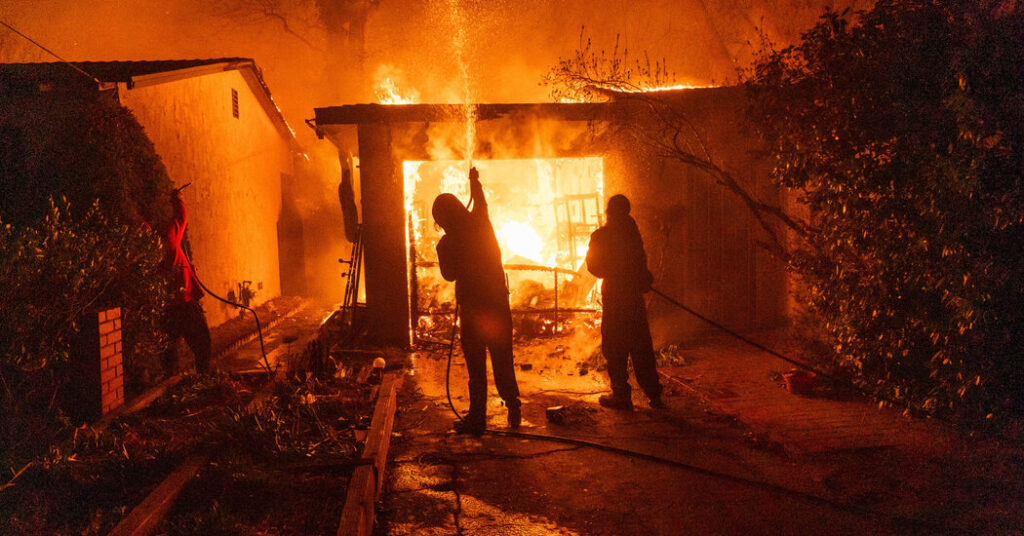
California’s attorney general announced on Thursday that he will open a civil rights investigation into Los Angeles County’s emergency response to the Eaton fire, which killed 19 people last year and decimated West Altadena, a historic neighborhood for the Black middle class.
The Eaton fire began on Jan. 7, 2025, hours after the Palisades fire tore through the Pacific Palisades neighborhood of Los Angeles some 35 miles to the west. Together, the two blazes, which were whipped out of control by winds that reached hurricane-force speeds, killed at least 31 people and destroyed more than 16,000 buildings.
While there have been numerous lawsuits and several reviews examining government failures during the disaster, the attorney general, Rob Bonta, launched the first civil rights investigation related to the wildfires. He said he was concerned that about the disproportionate impacts of the fire on the area’s Black community.
“The investigation we’ve launched is driven by one overarching question,” Mr. Bonta said on Thursday morning during a news conference. “Did the Los Angeles County Fire Department’s delay in notifying and evacuating the historically Black West Altadena community violate state anti-discrimination and disability laws?”
Mr. Bonta said that while there have been other investigations into the fire, his office is best positioned to examine whether the racial disparities broke state laws.
The Los Angeles County Fire Department did not immediately respond to a request for comment.
More than a year later, residents in Pacific Palisades and Altadena continue to confront a gauntlet of financial and logistical hurdles as they try to piece their lives back together. Most residents have yet to rebuild their homes or return to their communities.
In West Altadena — a neighborhood in the foothills northeast of downtown Los Angeles that has been home to generations of Black families — survivors have sought a civil rights investigation for months. They are angry that they were not told to evacuate until several hours after the Eaton fire ignited. They say that differed from the warnings given to residents of the wealthier, predominantly white section of Altadena, who were told to leave soon after the fire began.
That delay, residents and experts have said, appeared to have been deadly. All but one of the people who died in the Eaton fire were in West Altadena, and many of the deceased were older Black residents with limited mobility. Residents said that many who escaped their homes in West Altadena fled only because relatives or neighbors alerted them to the fact that the fire was approaching.
Mr. Bonta intends to examine that disparity and why it occurred.
An after-action review commissioned by Los Angeles County last year identified multiple factors that prevented residents from evacuating immediately. The report said that alerts were at times confusing; power and cellphone outages may have blocked communications; the dispatch system was outdated; and that some residents may not have been able to determine the severity of the situation because of alert fatigue.
The review did not, however, point to any one failure as the cause of the destruction that occurred, nor did it delve into whether West Altadena received fewer alerts and services than other neighborhoods.
Residents have said they were troubled not only by what happened the night of the fire, but also at the prospect of gentrification as the community rebuilds in the coming months and years. They fear that West Altadena will no longer be a haven for Black middle-class residents of Southern California as homeowners sell their family properties and move elsewhere.
Kimberly Jones, a lifelong resident of West Altadena, moved to Rancho Cucamonga with her mother and her son after their home burned down. Her mother had bought the property in the 1970s, and she decided to sell the land after the house burned down.
“It’s emotional for me, because I feel displaced,” she said, her voice breaking. “I’m in a city where I didn’t ask to be. But I don’t feel like Altadena is my home anymore.”
West Altadena, Ms. Jones said, had long felt neglected. And she couldn’t help but wonder whether county officials would have sent evacuation orders earlier if the neighborhood had been richer and more politically connected.
Previously, most of the blame has been focused on Southern California Edison, the electric utility whose executives have acknowledged that the company’s equipment likely sparked the fire.
The utility has been sued numerous times, including by federal prosecutors, over its potential role in the blaze, though the state has not yet officially determined the cause of the Eaton fire. Southern California Edison in October launched a program that would compensate fire victims in exchange for their agreement not to sue.
But last month, the utility filed its own lawsuit to hold emergency agencies in Los Angeles County partly responsible for the fire devastation. In the suit, Edison accused the county of not warning residents in a timely manner and failing to prevent the fire’s ferocious spread by not clearing brush in advance.
Survivors’ groups have for months been demanding that Mr. Bonta’s office investigate the county’s actions.
In a news release about the investigation, the group Altadena for Accountability said that fire survivors hoped that the investigation would lead to a range of outcomes, including civil penalties, payouts for victims and court-ordered policy changes aimed at preventing a similar disaster.
“This may be the most consequential act taken by any official in California for accountability since the fires ravaged Los Angeles,” Shimica Gaskins, a fire survivor and an activist with the group, said in a statement. She unfurled a banner on a float honoring Altadena fire survivors in this year’s Tournament of Roses Parade.
“AG BONTA,” it said, “ALTADENA DEMANDS AN INVESTIGATION.”
The float depicted a phoenix rising from a bed of sunflowers.
Jill Cowan is a Times reporter based in Los Angeles, covering the forces shaping life in Southern California and throughout the state.
The post California Asks if Civil Rights of Black Residents Were Violated During Eaton Fire appeared first on New York Times.