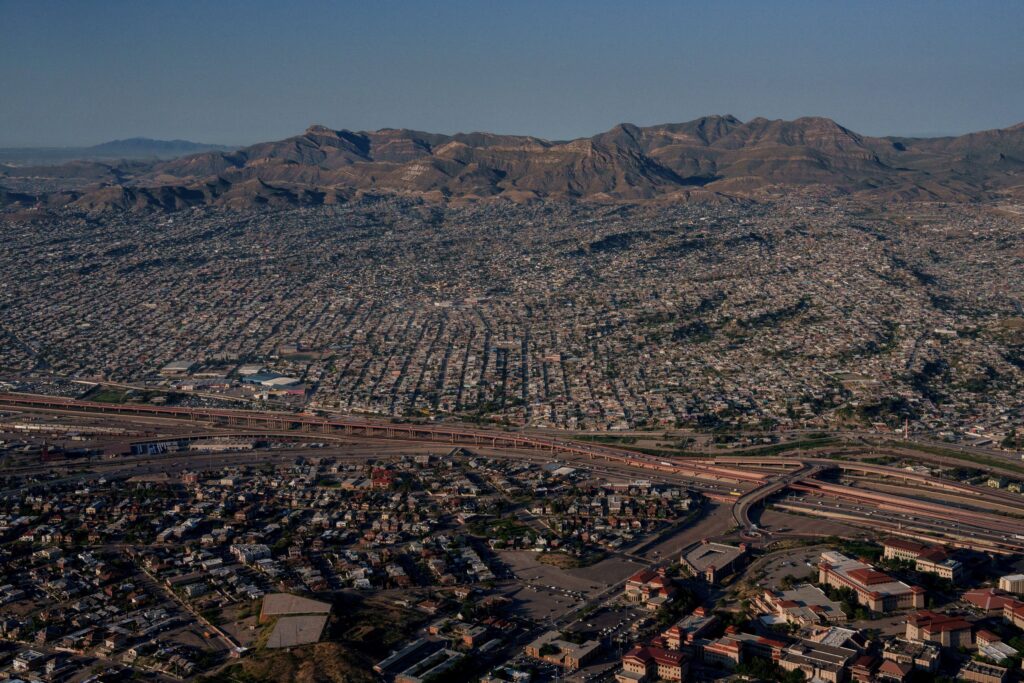
The Federal Aviation Administration imposed extraordinary 10-day flight restrictions on airspace around El Paso late Tuesday following a communications breakdown with the Pentagon and the Department of Homeland Security, after a laser-based counter-drone weapon was temporarily transferred to and used by DHS personnel, officials familiar with the matter said.
The restrictions were lifted hours later, early Wednesday, amid growing outcry over the temporary closure of a U.S. airport that serves a metropolitan area with a population of about 900,000 people. The Trump administration did not acknowledge the apparent miscommunication, instead issuing a statement that “Mexican cartel drones” had breached U.S. airspace and that the U.S. military took action to disable them.
Transportation Secretary Sean P. Duffy said on social media that the “threat has been neutralized,” but neither he nor other administration officials disclosed details about what happened or why such dramatic actions were needed.
The administration said that the Pentagon and the FAA had determined there is no ongoing danger to commercial aviation after lifting the restrictions. It is believed that the laser system was launched by Customs and Border Protection personnel at something innocuous, probably a Mylar balloon, said two U.S. officials, who like others spoke on the condition of anonymity because of the sensitivity of the issue.
The Pentagon temporarily transferred the laser system to counter drones flown by Mexican drug cartels across the U.S. border, according to two people, who spoke on the condition of anonymity because of the sensitivity of the issue. Defense and FAA officials were to meet Feb. 20 to discuss safety issues around the weapon’s deployment, but the Pentagon and DHS wanted to move forward more quickly, prompting the FAA to put the flight restrictions in place. That date prompted the 10-day airspace restrictions, one official said.
Another official said the FAA did not know how long the Pentagon’s counter-drone operation would last, and it appears the agency is still gathering information from defense officials. Use of the laser system was temporarily transferred to the Department of Homeland Security with approval from Defense Secretary Pete Hegseth, three officials said.
Pentagon officials declined to release additional details, including when the drone incursions it referenced occurred, how many there were and whether they were observed Tuesday night. A social media account for the office of Emil Michael, a Pentagon undersecretary, posted a vague message after the restrictions were lifted, showing drones and a laser being fired, with a bald eagle in the foreground.
“DEFEND THE HOMELAND,” the social media post read.
The communications breakdown, reported earlier by CBS News, highlights the continued challenges for the U.S. government in countering the proliferation of drones, including around major airports and military bases. It also marks another friction point in the Pentagon, where Hegseth and his team have come under fire for more than a year for their willingness to upend long-standing norms and withhold information from Congress, other U.S. officials and the American public.
The breakdown also underscores continued strains between the FAA and defense officials that derive in part from fallout to the January 2025 collision between an Army Black Hawk helicopter and a commercial jet at Reagan National Airport, killing 67 people, two people familiar with the relationship said. That has spilled into other areas, they assessed, including with the Pentagon withholding more information from the agency.
Drone incursions from Mexico are not new and have not been handled in such a manner in the past. Steve Willoughby, a senior official with the Department of Homeland Security focused on the issue, told lawmakers in July that cartels use drones to both monitor U.S. personnel and transport drugs.
The El Paso area has a been a point of emphasis for the Trump administration as it seeks to secure the southern border, with Fort Bliss, an Army installation, serving as a hub and active-duty troops deployed to a militarized area along the border. Bliss, home to more than 20,000 U.S. troops and tens of thousands more family members, is adjacent to El Paso International Airport.
Defense officials have repeatedly described the border mission as a success, saying the number of illegal crossings is now close to zero. Administration officials have cited close integration between U.S. troops and Customs and Border Protection for the drop in crossings.
Democrats on Wednesday raised questions over how such confusion could occur.
“The airspace closure over El Paso triggered immediate chaos and confusion and cannot be dismissed as a minor misunderstanding,” said Sen. Jack Reed (Rhode Island), the top Democrat on the Senate Armed Services Committee. “A 10-day shutdown of a major U.S. air corridor is an extraordinary step that demands a clear and consistent explanation.”
He added that the “conflicting accounts coming from different parts of the federal government only deepen public concern and raise serious questions about coordination and decision-making.”
The airspace disruption was “unacceptable,” Reps. Rick Larsen (D-Washington) and André Carson (D-Indiana) said in a joint statement Wednesday. Larsen, the top Democrat on the House Transportation Committee, and Carson, the top Democrat on its subcommittee for aviation, commended the FAA for “taking swift action to protect travelers and ensure the safety of U.S. airspace.”
They called the restrictions a “chaotic outcome” that came after the White House forced language into a recent defense policy bill, the National Defense Authorization Act, that they said allows “the Pentagon to act recklessly in the public airspace.”
Elected officials in El Paso said the FAA did not give advance notice to anyone in city government, airport management or the city’s congressional delegation.
Rep. Veronica Escobar (D-Texas), who represents El Paso, said she learned about the closure from a federal employee who tipped her off Tuesday night. She cast doubt on the administration’s explanation Wednesday morning, saying drone incursions from Mexico have been a part of life on the border “for as long as drones existed.”
“There was nothing extraordinary about any drone incursion into the U.S. that I’m aware of,” Escobar said. “There was nothing happening at Fort Bliss that would have impacted a 10-day closure or even an immediate closure.”
The FAA advisory covered airspace up to 18,000 feet over the airport and the surrounding community and began at 11:30 p.m. Tuesday local time. It did not include Mexican airspace. A separate restriction was issued for part of neighboring Santa Teresa, New Mexico, and also has been rescinded.
The FAA restrictions — issued in a Notice to Airmen, or “NOTAM” — had stated that the agency considers the area national defense airspace and that pilots who do not adhere to the procedure “may be intercepted, detained and interviewed by law enforcement.”
The U.S. Army’s Joint Task Force-Southern Border referred inquiries to the FAA, which did not respond to a request for comment.
El Paso is a city of about 680,000 on the Mexican border next to Ciudad Juárez.
The airport, which describes itself as the “gateway to West Texas, Southern New Mexico and Northern Mexico,” is run as a department of the city and serviced nearly 3.5 million passengers from January to November last year, mainly through Southwest, American, United, Frontier and Delta airlines. Airlines fly to major hubs including Atlanta, Houston, Denver, Los Angeles, Phoenix and Atlanta.
Matthew Choi, Tara Copp and John Hudson contributed to this report.
The post Breakdown between Pentagon, FAA led to flight stoppage, officials say appeared first on Washington Post.