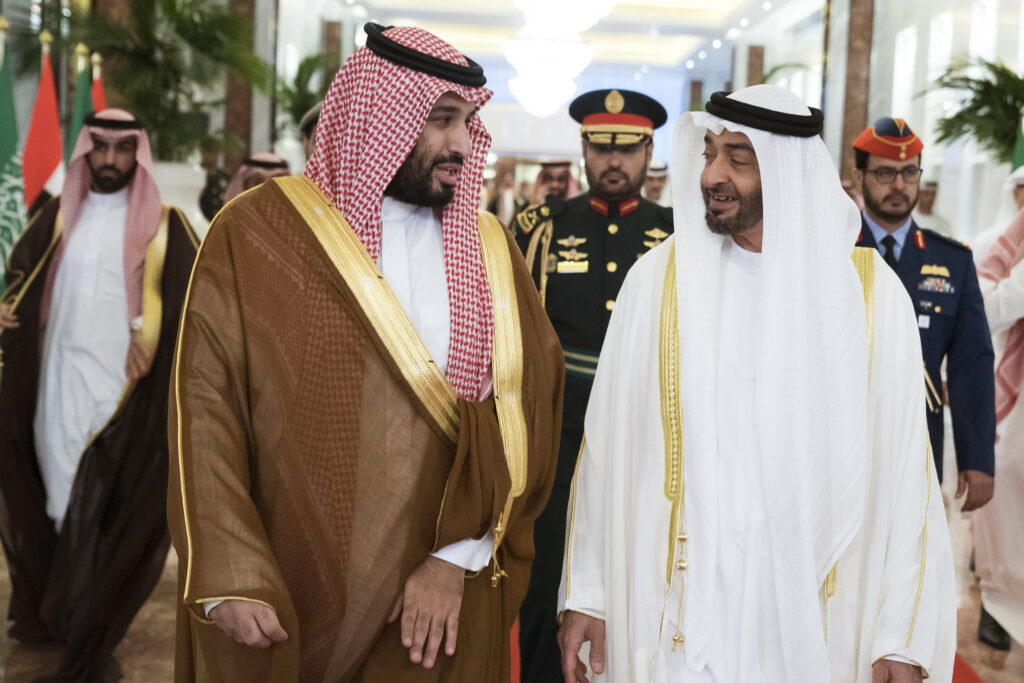
Saudi Arabia and the United Arab Emirates, the two drivers of modernization in the Middle East, should be rejoicing together these days. Iran is weak, its proxies are on the run, and an American armada approaches the Persian Gulf. But instead they have stumbled into an epic feud that could polarize the region.
When the quarrel detonated in late December, it seemed like a fight over strategy for resolving the forever war in Yemen. But it has since escalated into a social media battle in which Saudis have attacked the UAE as “Israel’s Trojan horse” and denounced the Abraham Accords, joined by the UAE in 2020, as “a political military alliance dressed in the garb of religion.”
Emirati officials believe the Saudis are waging a deliberate incitement campaign centered on the UAE’s relationship with Israel. After Saudi Arabia bombed the UAE’s partner forces in Yemen on Dec. 30, Saudi posts criticizing Israel spiked dramatically, with 77 percent of the comments attacking the UAE as “Israel’s proxy executing Zionist plans to divide Arab states,” according to media research shared with me by an Arab official.
A second social media analysis by Orbis Operations, a national security consulting firm, found that social media influencers had falsely sought to link a UAE leader with sex offender Jeffrey Epstein, in addition to claiming that the UAE was funding an anti-Islam campaign in Europe and that the country was an extension of Israeli policy. I reviewed a copy of the report, which Orbis hasn’t made public.
For the Trump administration, which has close ties with both countries, the Saudi-UAE wrangle illustrates the difficulty of working with two headstrong regional powers at once. The administration is said to have offered to mediate, but both sides have balked, according to several knowledgeable officials. Because of the intense personal feelings, one official told me, “This is not something you mediate.”
The dispute matters because President Donald Trump has placed big bets on both countries as he seeks to transform the Middle East. Trump needs unified gulf support as he threatens military action against Iran, tries to disarm Hamas in Gaza, and seeks to help expand Israel’s ties with the fragile nations of Syria and Lebanon.
“The Saudis want obedience, or at least alignment with their regional policies,” said John Gannon, a former senior CIA officer with decades of experience in the Middle East. “The Emiratis don’t want to be obedient. They want optionality.”
The tension is rooted in what had once been a close relationship between Saudi Crown Prince Mohammed bin Salman and UAE President Mohamed bin Zayed al-Nahyan, known by their initials “MBS” and “MBZ.” The Emirati leader mentored the young Saudi in 2015 and 2016 about how to modernize his conservative kingdom. Friends of both men describe the rivalrous relationship as somewhere between father and son and an older and younger sibling.
No good deed goes unpunished, as the saying goes. As MBS succeeded in consolidating power, he began to chafe against UAE tutelage. The Saudi didn’t want instruction anymore from a smaller and less powerful country, and the Emiratis didn’t want to take orders from a regional hegemon in Riyadh. Like many family feuds, it was partly about money and power but also, at a deeper level, jealousy and resentment.
Saudi and Emirati policies began to diverge. They had joined forces in fighting the Houthis in Yemen in 2016, but three years later the Emiratis began allying with forces in South Yemen that had a quasi-separatist strategy. They backed different sides in a ruinous civil war in Sudan. Their agendas differed in Syria, Libya and Somalia, too. Often, the UAE complaint was that the Saudis were allied with Islamist forces that could destabilize the region.
MBS’s White House visit in November was a flash point. The Saudis say the crown prince asked Trump to sanction a Sudanese militia backed by the Emirates, known as the RSF. But Emirati officials believe that MBS sought sanctions on the UAE itself.
Despite Saudi denials, the situation quickly deteriorated. In early December, UAE-backed forces in Yemen launched an offensive in the southern region of Hadramawt; several weeks later, the Saudis bombed more than 80 vehicles and weapons that had been delivered to the UAE’s allies — and demanded that the Emiratis quit Yemen. The UAE withdrew. Officials from both sides told me they felt “stabbed in the back.”
Ali Shihabi, an MBS adviser, posted commentary Jan. 1 that expressed Saudi frustration — and deepened UAE anger: He described a “structural imbalance” in the gulf between a big Saudi Arabia and smaller rivals. “As these smaller states acquire great wealth, they often begin to operate under the illusion that they are equal partners of the Kingdom.”
Shihabi’s dismissive tone angered Emiratis. But it was expressing out loud a tension that had been growing for several years. An example is plan for a rail and sea link, known as the “Middle East Corridor,” that would connect India to Israel and Europe. An original 2023 map showed the rail potion starting at Jebel Ali in the UAE and then moving through Saudi Arabia. But a pro-Emirati writer recently posted what he claimed was a new Saudi plan to start the line in Oman and bypass the UAE.
The regional tension directly interfered with U.S. policy last March, when the Trump administration was assaulting Houthi rebels in Yemen who had been attacking Red Sea shipping. According to a senior former U.S. official, Trump called a top UAE official and asked him to help “mop up” the Houthis. The UAE leader said he could send 2,000 troops immediately and 5,000 more soon — but he asked for a Saudi pledge that it wouldn’t support a Yemeni Islamist militia known as Islah. The Saudis didn’t deliver that promise, and the campaign never happened, the former U.S. official said.
The tit-for-tat continues. Emirati officials believe that Saudi Arabia urged friendly Muslim countries, including Kazakhstan, Syria and Jordan, to stay away from the World Governments Summit held last week in Dubai. The UAE launched the summit in 2013 as a regional forum.
Family feuds come and go in the Middle East, as around the world. What concerns me about this quarrel is the growing attacks on the UAE because of its opening to Israel. No country has a bigger stake in stopping the spread of Islamic extremism than Saudi Arabia. In its seeming encouragement of vitriolic Saudi attacks on the UAE as a “Devil of the Arabs” that takes orders from Israel, the kingdom is playing with fire.
The post An epic feud threatens Mideast stability at a delicate moment appeared first on Washington Post.