President Trump has frequently claimed that foreign countries were paying for his tariffs, not Americans. But as economists predicted, that is largely turning out not to be the case.
Research published on Thursday by economists at the Federal Reserve Bank of New York and Columbia University suggests that, through November 2025, 90 percent of the economic burden of the president’s tariffs fell on U.S. companies and consumers.
The economists reviewed the “incidence” of the tariffs — who ultimately pays the cost of new import taxes. When a good is brought into the country, the importer of record, often an American company, is first responsible for paying the tariff to the U.S. government. But the importer can pass that cost on to others by raising the prices it charges its customers, or by negotiating more favorable contracts with its suppliers.
Mr. Trump and his advisers have said the cost of tariffs would be shouldered by foreign suppliers. They believed that foreign companies would respond to tariffs by reducing their prices, to maintain their access to the large and important U.S. consumer market.
In an op-ed in The Wall Street Journal on Jan. 30 defending his tariffs, Mr. Trump wrote, “the data shows that the burden, or ‘incidence,’ of the tariffs has fallen overwhelmingly on foreign producers and middlemen, including large corporations that are not from the U.S.”
“In many cases, nations that are heavily dependent on exports have had no choice but to ‘eat’ the tariffs to avoid even worse losses from their excess capacity,” he added, appearing to incorrectly interpret some statistics.
Although data shows foreign suppliers react to tariffs by reducing their prices in some instances, economic research suggests that is not the most common response.
The New York Fed study found that, from January 2024 to November 2025, the bulk of the tariff costs fell on U.S. firms and consumers. In the first eight months of 2025, 94 percent of the tariff incidence was borne by the United States, they said.
“In sum, U.S. firms and consumers continue to bear the bulk of the economic burden of the high tariffs imposed in 2025,” the study found.
The same researchers studied the effect of tariffs in Mr. Trump’s first term, where they found that tariffs in 2018 and 2019 were wholly passed on to American businesses and consumers.
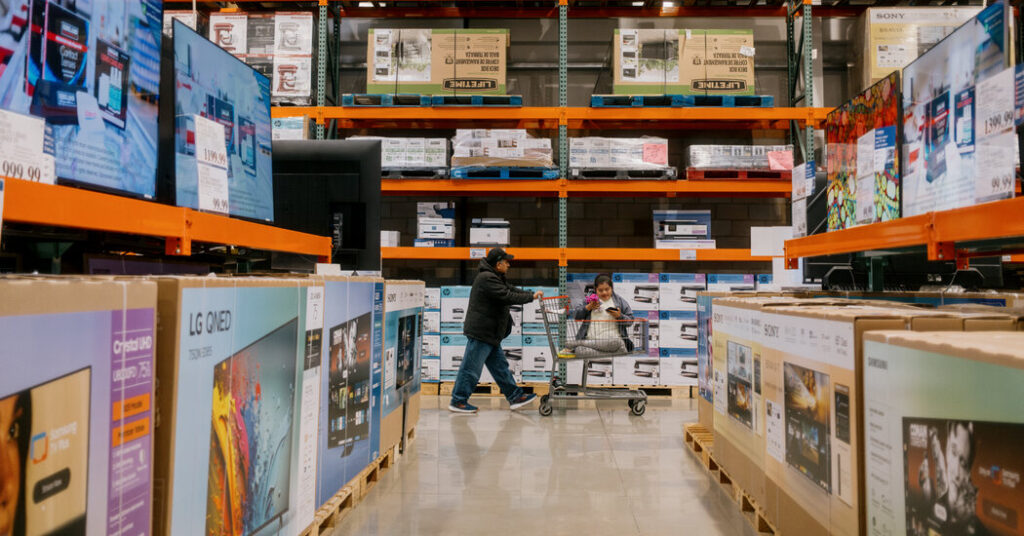
Businesses across the country have spent the last year trying to navigate Mr. Trump’s changing tariff policies. Larger companies have generally been able to handle the higher import duties without raising prices significantly on consumers.
In some cases, their size helped them to negotiate discounts with suppliers who rely on their business, helping to offset the cost of the tariffs. Because they often have a more diversified roster of suppliers, they could more easily shift production to countries that carried lower tariff rates.
China’s share of U.S. imports — which slumped when Mr. Trump waged a trade war on the county in his first term — fell further last year. But U.S. imports from Mexico and Vietnam increased to help make up the difference.
But many bigger companies stockpiled inventory before the tariffs took effect, allowing them to keep prices relatively stable. Some have also accepted smaller profit margins in the hopes that the Trump administration would reach more favorable trade deals eventually.
For smaller businesses, tariffs have been a bigger drag. Many did not have the clout to arrange deals with foreign suppliers. Because they typically operate with smaller profit margins, they couldn’t swallow the additional expenses for long. Some had to raise prices on consumers or risk going under.
Still, the impact of tariffs has been smaller than many economists anticipated, in part because many companies feared that raising prices would drive away customers. Tariffs have lifted prices on some imported goods, but for the most part, prices have not ballooned.
Who bears the brunt of the tariffs could evolve. Many companies delayed some shipments as they worked through pre-tariff inventory, pushing off the tariffs’ costs and allowing them to defer some decisions about how to manage the additional duties. As stockpiles become depleted, avoidance will no longer be an option.
The researchers at the New York Fed found that foreign suppliers started to bear a greater proportion of the tariff costs by the end of the year, likely as U.S. companies began renegotiating their contracts. Still, in November, 86 percent of the tariff cost was still passing through to the United States.
Over the year, the average tariff rate on U.S. imports rose to 13 percent from 2.6 percent, the economists said, spiking in April and May as Mr. Trump applied tariffs to exports from foreign countries, including China. Their findings imply that, overall, U.S. import prices for goods rose 11 percent because of the tariffs.
Ana Swanson covers trade and international economics for The Times and is based in Washington. She has been a journalist for more than a decade.
The post Americans Are Paying the Bill for Tariffs, Despite Trump’s Claims appeared first on New York Times.