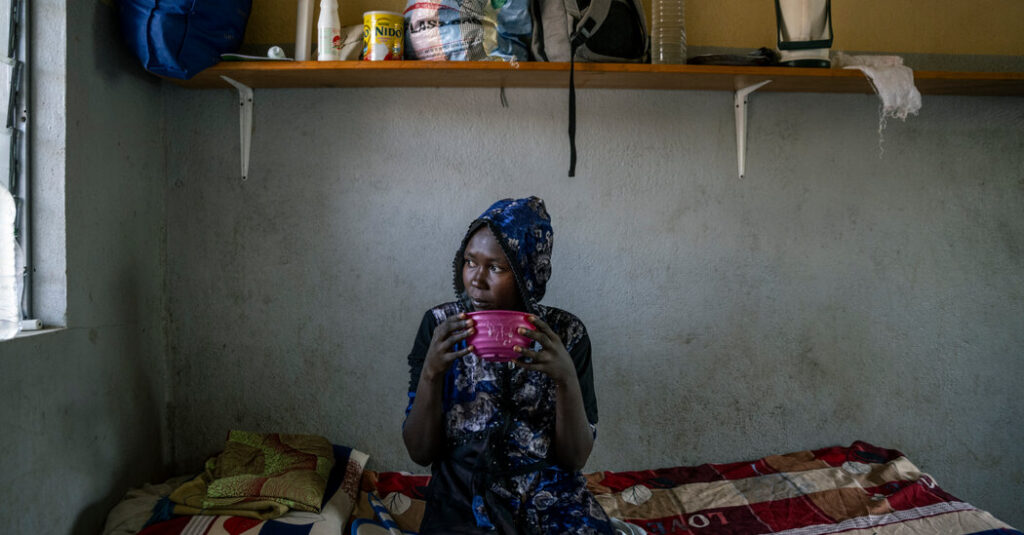
All day long, Asta Djouma sits on a hard wood bench, or on a harder concrete floor, and looks out from the doorway of the small hospital room in Northern Cameroon that is her universe.
She has been here since October, when she learned that she had a type of tuberculosis that does not respond to the most commonly used drugs. Ms. Djouma, 32, lives at the back of the hospital with a half-dozen other patients who also have multi-drug-resistant tuberculosis. Fearing they could infect others, the government requires them to stay there until they test negative for the potentially fatal disease. She had not seen her children, ages 9, 10 and 11, since she arrived.
The sanitarium model of TB treatment — confining people in isolation for a lengthy period — was declared obsolete in the United States and other high-income countries some 60 years ago. It lingered in Eastern Europe until 15 years ago, but it is still used in some low-income countries in Africa and Asia, where health systems lack the resources to update policy, retrain staff or deploy community health workers to help patients at home.
For the past 15 years, the World Health Organization has said that TB patients should not be isolated or confined, or hospitalized at all, unless they are acutely ill. Research shows that their TB treatment would be more successful if done at home, because patients would have better mental health and would be less exposed to other infections.
And the hard truth about the risk of infection is that by the time people have been diagnosed, they have probably already exposed their families and co-workers. After just a few days of treatment, their bacteria count will plunge, and so there is no further risk to having them stay among family after diagnosis.
But efforts to have the updated guidelines adopted everywhere have been hobbled by disruptions and declines in international funding for tuberculosis care.
Isolation remains the policy in Cameroon, even in the capital, Yaoundé, where there is an isolation ward at a main hospital. In the far north of the country, all patients with drug-resistant TB are sent to one church-run hospital in Maroua, the regional capital. Here, patients live in cement rooms with only a bed and a few plastic dishes for at least three months, maybe longer — until they test TB-negative at least twice.
A spokesman for Cameroon’s ministry of health said the country was gradually transitioning to the W.H.O. standard. “The transition to a new treatment protocol requires enhanced support for teams and close clinical monitoring of patients in the initial cohorts,” the spokesman, Clavère Nken, said by email. He said the constraint was not resources but simply the need to to move carefully to ensure high-quality patient care.
For patients, the isolation and the boredom are excruciating.
“We’re just here,” Ms. Djouma said in an interview in December. “We talk a bit. But we’re just here.” From where she sat, she could see the bustle in the main area of the hospital, through a gap in the compound walls. The isolation ward was silent except for coughing.
Most of the patients in the isolation center are, like Ms. Djouma, people in their 30s — parents and breadwinners, whose sudden disappearances create huge hardship for their families. Sitting six feet apart on the wooden benches, they are the living embodiment of the deep neglect of tuberculosis treatment. TB is the world’s top infectious disease killer and claimed the lives of 1.2 million people in 2024, the last year for which global data is available.
But because TB is a disease of the poorest people in the poorest places, the systems to diagnose and care for them remain antiquated. Most cases in Cameroon today are diagnosed with the same method used a century ago: looking at a smear of mucus from the lungs through a microscope. The drug regimen to cure the disease — lengthy and harsh — has barely changed since the 1960s.
Frédéric Lingom, the nurse who runs the Maroua treatment center, tells patients it is best that they isolate, he said, so that he can monitor them on the four-drug regimen — which can come with vicious side effects — and so that they do not infect their families.
In the past year, care for TB patients in rural Cameroon has become even more challenging, as essential supplies ran short after the Trump administration’s large cuts to global health funding. The United States was the largest donor to TB programs globally.
The W.H.O. recommends that close contacts of a newly diagnosed TB patient be tested immediately and placed on preventive therapy — a six-week course of drugs that ensures they won’t become ill. But hospital staff members said that because of the cuts to resources and staff, it sometimes took months to trace and test contacts in 2025. By then, some people were already ill.
Some of the community health workers who do that contact tracing were paid through U.S. funding, and lost their jobs. The United States also helped to pay for molecular diagnostic tests, and by the end of last year those had run short. Lab technicians said they were rationing them for use on only the patients who appeared most likely to be infected with drug-resistant TB, rather than using them to test every suspected TB case, as the W.H.O. advises.
Mr. Nken, Cameroon’s health ministry spokesman, said that supply shortages had been quickly resolved through changes to the supply chain, and that close contacts were being diagnosed and treated within days.
When Ms. Djouma developed a persistent fever early in 2025, she was misdiagnosed with malaria. Eventually, a local clinic concluded she had tuberculosis and started her on treatment. But that clinic didn’t use molecular diagnosis — the W.H.O.-recommended method — and so missed the fact that her infection was drug-resistant. She took the drugs at home, twice a day for five months, but just got sicker.
Finally, she went to the city’s main hospital, where a molecular test showed she had the drug-resistant version of the disease. She would need medications that were harder to obtain and more difficult to take. That hospital dispatched her to Mr. Lingom. It fell to him to break the news that she would not be going home any time soon.
“People don’t love the idea of staying here for three or four months,” he said with delicate understatement. “Imagine if you came to the hospital for something and they say you have to stay for four months — not four days, four weeks. Four months. They’re not thrilled.”
About 40,000 people developed TB in Cameroon in 2024, and 7,000 died; 620 people were diagnosed with the drug-resistant strain of the disease.
Even as Mr. Lingom runs the small modern-day sanitarium in Maroua, he worries about the effects of that isolation. “People are cut off from their family — they are all alone with their thoughts, and they get depressed,” he said.
He tries to encourage patients by telling them they won’t be putting their families at risk. And at the hospital, he can guarantee them food. To be effective, tuberculosis medications have to be taken with food. At home, many of the patients cannot afford solid meals every day.
Momini Daibou, 32, came to stay at the hospital in late October, after months of an incessant hacking cough, fever and steady weight loss. “I felt I had no more blood in my body,” he said. He shared a two-room home with his brother, wife, parents and two toddlers, and supported them all with the earnings he made as an itinerant vendor of soap, brooms and other household items. “I am here and not working so it’s very hard, especially the question of food,” he said. “They are struggling.”
Mr. Daibou’s family was not tested for TB until four weeks after he went to stay at the hospital. He was profoundly relieved when they all tested negative.
They were able to scrape together the money to come from his home village and visit him just once in his first month.
Twice each day, there is a small burst of activity in the TB courtyard when Mr. Lingom totes out the recycled cardboard cartons that hold each patient’s boxes of drugs. And there is a bit of a bustle when the call to prayer sounds from a nearby mosque and patients roll out prayer mats in front of their rooms.
Mostly, though, Mr. Daibou said, “we do nothing.”
He does have a bit of conversation, because his two sisters came to stay at the hospital in a small row of guest rooms across the courtyard from the TB patients. It’s not uncommon for family members to voluntarily take up residence there, so that they can cook and shop for their sick loved ones, and provide some companionship from 10 feet away.
Ms. Djouma is thin and has a lingering cough but says she feels stronger. She counts the days until she will go home to her children. But she accepts the enforced isolation, she said, because she knows how sick she has been. Her own parents, and an aunt and uncle, all died of tuberculosis. “Your health is the most important thing,” she said.
Stephanie Nolen is a global health reporter for The Times.
The post 4 Months Trapped in a Hospital for an Obsolete Way of Treating Their Disease appeared first on New York Times.