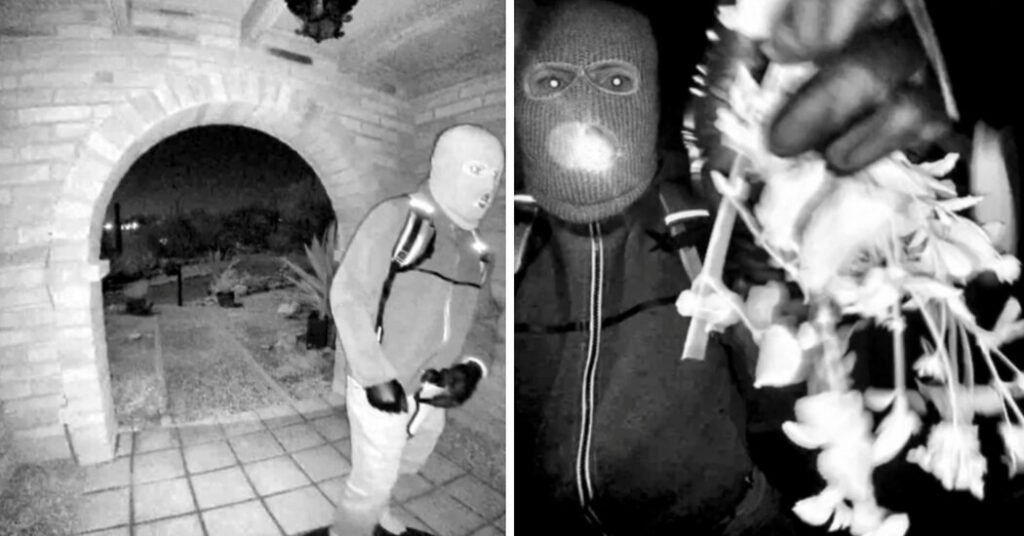
Doorbell camera footage of a masked man at Nancy Guthrie’s front door was made public on Tuesday, 10 days after her family last saw her.
The video — silent, grainy and in black-and-white — shows a person approaching Ms. Guthrie’s doorstep on the night she was abducted. The person wears a ski mask, gloves, a backpack and what appears to be a holstered handgun.
The authorities have known since last week that the camera was disconnected at 1:47 a.m. on Feb. 1. But in a statement on Tuesday, the F.B.I. and the Pima County, Arizona, Sheriff’s Department said that the footage had been uncovered only “as of this morning,” and that the images had been “previously inaccessible.”
It was unclear why the footage took more than a week to retrieve. The Pima County Sheriff’s Department referred questions to the F.B.I., which declined to offer more information.
The video does offer a clue. It is stamped in the upper right corner with a name: Nest, a home electronics brand that is part of Google.
An internet-enabled Nest doorbell, which sells for about $150, can record video and alert homeowners to sounds and movements on their doorsteps. Owners can pay a monthly subscription to get premium features, like long-term video history.
If Ms. Guthrie had had a paid subscription to a premium package, the authorities might have had access to footage stored on her account, said Adam Wandt, an associate professor and the deputy chair for technology at the John Jay College of Criminal Justice in New York City.
But Ms. Guthrie did not pay for a subscription that would have stored the video, according to Chris Nanos, the Pima County Sheriff. So while she may have been able to access real-time video, historical footage would probably be stored only on a server somewhere in one of Google’s vast data centers.
It is unclear whether investigators used a warrant to obtain the footage. They may not have been required to, because the kidnapping of Ms. Guthrie, who is the mother of “Today” show host Savannah Guthrie, might be considered an exigent circumstance — a legal exception to the warrant requirement under the Fourth Amendment.
Google did not immediately respond to questions about the footage, but Mr. Wandt speculated that finding the data could have taken days.
First, investigators would have had to to request the data from Google.
“Sometimes those requests are clear and simple,” Mr. Wandt said. “However, they often are not, and they might take more than one back-and-forth. And then the company might need a day or two, or three, to figure out how to get that data.”
Jacey Fortin covers a wide range of subjects for The Times, including extreme weather, court cases and state politics across the country.
The post Why the Guthrie Doorbell Footage Took More Than a Week to Retrieve appeared first on New York Times.