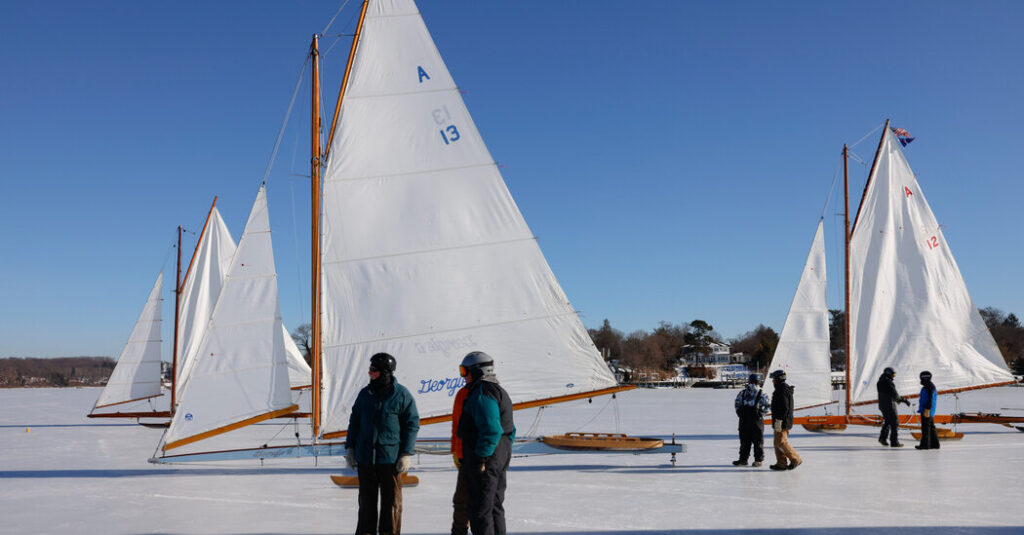
It looked like a time warp on the frozen Navesink River in New Jersey: six hulking wooden iceboats, more than a century old, had gathered to race.
Two-man crews bundled like Arctic explorers stood by boats weighing half a ton, poised to push their vessels across the starting line.
And with a blast from a miniature cannon, the Van Nostrand Challenge Cup was on.
Some boats reared up perilously on two blades. Some stalled completely. But after decades of waiting, a grudge match dating to the late 1800s would be settled by antique wooden sailboats on steel blades racing along a frozen river in Red Bank, N.J.
The two teams on the ice — the North Shrewsbury Ice Boat & Yacht Club (founded in Red Bank in 1880) and its tenacious rival, the Hudson River Ice Yacht Club (established in 1885 in Poughkeepsie, N.Y.) are among the oldest ice boating clubs in the country. But this would be only the fourth time they, or anyone else, competed for the Van Nostrand cup in nearly 140 years.
Every time the race was held — in 1891, in 1978, in 2003 — it was won by North Shrewsbury, and the sterling silver trophy (made by Tiffany & Company in 1886) has been in its possession ever since, to the enduring frustration of the New York team. After all, the cup was donated by a prominent Hudson Valley ice boater, Gardiner Van Nostrand himself. Since then the Hudson River club has glimpsed it only briefly after failed challenges.
Kevin Lawrence, one of the New York racers, said that if the cup had originally been donated to the New Jersey club, it might not mean quite as much to his side. “But it originated where we sail at, so it’s sentimental,” he said.
Each winter, the two clubs haul these old behemoths out of storage, do the inevitable repair and restoration work, and then pray for a cold snap long enough to form ice thick enough to support the boats. And year after year, promising conditions are spoiled by thawing ice or heavy snowfalls that make racing big boats on the Navesink impossible.
But the frigid winter of 2026 has created a rare solid layer on the Navesink, ideal for “hard water sailing,” as ice boaters call it.
Last month, the New York club sent a letter to its New Jersey counterparts issuing its latest challenge for the cup. The New Jersey club mailed back a letter of acceptance, and with the Navesink’s ice thickening by the day, the fourth running of the Van Nostrand Challenge Cup seemed to be attainable.
The dangerous part would follow.
Proper form requires two sailors to recline on the skeletal frames of these vintage ice yachts as they clatter along at speeds approaching 50 miles per hour, just inches above the ice. They wear crash helmets, since a single strong gust can lift the rear steering runner off the ice and cause the entire boat to spin wildly in circles.
The race had been planned for last weekend, but on Saturday, the whipping wind was too much. Sunday started out more promisingly, with dozens of spectators braving the frigid temperatures to see the race. Then a Hudson River boat on a test run was nearly blown over and needed repairs. The sailors convened in the North Shrewsbury clubhouse, an ice boating man-cave full of equipment and old photographs, and made the call. The would try again on Monday.
The Van Nostrand Cup is one of the more obscure trophies in sport. The ornate silver piece was not always jealously guarded. For a time, it was simply left unsecured on display in the North Shrewsbury clubhouse, which often remains vacant in warmer months.
“We didn’t know it was a priceless trophy,” said Jim Hadley, a world-class ice boater for the New Jersey club who helped it defend the cup in 2003.
It was eventually put into storage, its exact location known only to select members.
“This is just the second time I’ve seen it in my life,” said Chris Davison, 43, a longtime member of the North Shrewsbury club.
Most racers now use high-performance aerodynamic ice boats made from carbon fiber and other lightweight materials. But for the Van Nostrand Cup, the teams have traditionally agreed to race only the old-fashioned wooden boats.
“It’s a historical cup, so we use historical boats,” said Dave Drawbaugh, commodore of the North Shrewsbury club.
Looking like huge, elegant crossbows, the ice yachts have had only a few updates, like modern pulleys and sails made of Dacron rather the original cotton ones.
They have, however, retained the rear cockpit where the crew sits. Some are finely crafted wooden trays that resemble Victorian heirlooms.
Rick Lawrence and his son Kevin have kept the original horsehair cushions on the tray of their boat, the Ice Queen, because their heft keeps them from blowing off.
Every year, the Lawrence family, which has a four-generation history of ice boating, pulls their boats out of storage on their family’s apple farm in Newburgh, N.Y. The three Hudson River yachts racing for the cup are part of their flotilla.
The Ice Queen was built around 1900, and like the club’s other boats, it was commissioned by prominent families back when the Hudson River was the center of ice boating.
This brief golden age died out more than a century ago, and the Van Nostrand Challenge Cup was largely forgotten. But in the 1960s, a group of traditionalists revived interest in the old ice yachts and began challenging the New Jersey club again, said Brian Reid, the longtime secretary of the Hudson River club.
After being rebuffed repeatedly, some Hudson boatmen grumbled that the New Jersey team was simply afraid of losing the cup. “When you’ve got two clubs from the 1880s, there’s going to be a lot of stuff that happened over the years,” said Robert Wills, 68, a former commodore of the Hudson River club.
Relations have warmed, he allowed, but not on the race course. “Once you get going in the race, it’s respectful nonfriendship.”
By Monday morning, conditions were milder, and the race was on. A decidedly smaller audience gathered to watch as three boats from each club faced off in a best-of-three race format. In each heat, the boats would run three laps around two orange buoys placed on each side of the river, almost a mile apart.
Just before 10 a.m., the cannon was fired, and the race began.
Immediately, a younger crew for the Hudson River team — Luke Lawrence, 35, and Max Lopez, 33 — took the lead.
Their boat, the Ariel, built around 1888, led the scrum of ice yachts toward the windward mark and went on to win the first race. It certainly did not hurt that the crew members were both experienced sailors.
The second race played out similarly. On the last leg, the Ariel rose perilously high on two runners before a fortuitous gust of wind lifted it to another first-place finish.
After 135 years, the Hudson River sailors had regained the Van Nostrand Cup.
Luke Lawrence broke down in tears and gathered with the Hudson River team around the Ariel.
“In 20 years, we can do it again,” Kevin Lawrence, Luke’s cousin, quipped.
The North Shrewsbury club was gracious in defeat. “As long as we’re sailing together, it’s all good,” said the fleet captain, Steve Foster.
After the race, the two clubs gathered in the North Shrewsbury clubhouse for a buffet lunch. Mr. Drawbaugh, the club’s commodore, presented the Hudson River club with the cup.
“We hope to sail it next year up north and hopefully beat you guys up like you beat us up today,” he said. A bottle of Champagne was uncorked and emptied into it for the Hudson River team to drink.
“Four generations we’ve been chasing this thing,” Luke Lawrence said, holding the cup aloft. He promised they would accept the New Jersey challenge to win it back. “It might not be next year,” he said with a laugh. “We might make you sweat first.”
But Nels Lybeck, the New Jersey club’s rear commodore, said his club wanted to run the race again before the ice thaws. He said his club planned on immediately sending a letter of challenge.
“We’re coming back after it,” he said. “No question.”
Mark Bonamo contributed reporting.
Corey Kilgannon is a Times reporter who writes about crime and criminal justice in and around New York City, as well as breaking news and other feature stories.
The post When It’s Finally Cold Enough to Race Ice Yachts appeared first on New York Times.