“You think we can fit another couple of bodies here?” Alison asked, passing me the measuring tape. “They’ve got to fit between these dog graves. Mastiffs, unfortunately.”
“God,” I muttered, “I’ve never wanted dead Pomeranians so badly.”
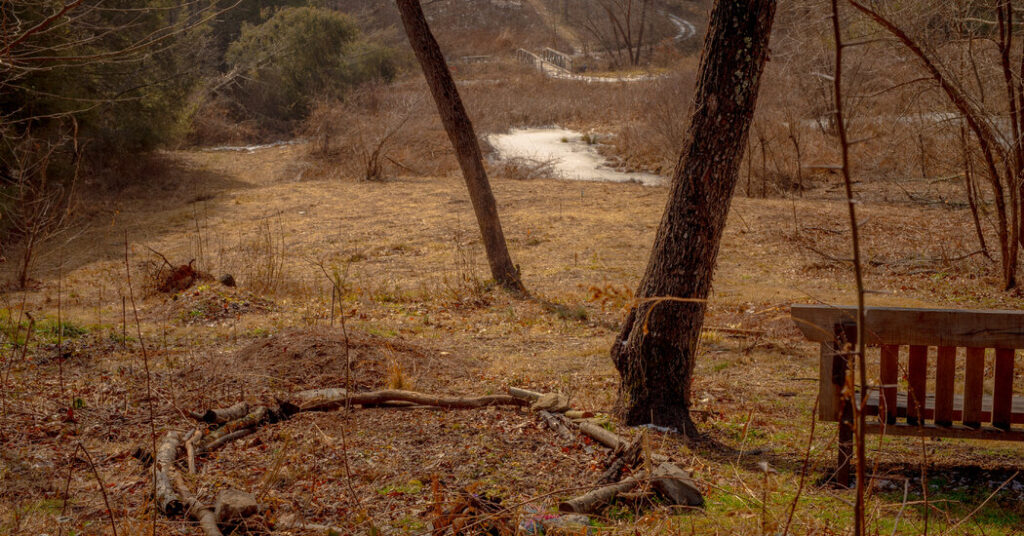
We were standing among the dead in the middle of the woods in April 2023. Two large grave mounds — quilted with Japanese stiltgrass and slightly collapsed with the years — sloped up from the dark earth, a few meager feet between them. The dogs’ owners, still living, wanted to be buried beside their pets someday, but also beside each other. This was impossible, and so Alison and I were scouting Plan B. The hillside around us was a scatter plot of existing graves, leaving little room for two new ones. We measured, jotted down some numbers, measured again.
“I mean,” Alison said, grinning, “we could always just stack them. Like bunk beds.”
It was my third month working as a professional gravedigger. I started at Carolina Memorial Sanctuary — an 11-acre ribbon of woods, wetlands and meadow south of Asheville, N.C. — in January. Alison had just been hired on as director of operations. To the untrained eye, the place doesn’t look like a cemetery. There were no sterilized rows of headstones, no AstroTurf. Graves were tucked between towering white pines and scattered along unmown hillsides. On days without digs or burials, I was tasked with clearing invasive plants, but it was the sanctuary ethos to let native vegetation run wild. Life and death are sprawling, messy matters, went the thinking; so, too, the land. Come summer, goldenrod and milkweed and wild onion and blackberry blanketed the graves, swallowing headstones whole.
Over the next year and a half, Alison and I would bury many, many bodies together. We would receive them as they came trundling down the sanctuary’s driveway in the funeral home minivan, we would haul their limp weight from gurneys onto our burial cart, we would wrap them in sheets to ease their lowering into the open earth. We would watch them disappear, clod by clod, beneath shovelfuls of ocher clay.
I had no real idea what I was doing here. I took the job because it was available, because I wanted to move back to my college town of Asheville, because I wanted to work outside. I took it because, by the end of mine, I desperately wanted to have lived an interesting life. I had the vague idea that digging graves for a living might render me more sage. I thought it might force me to look mortality in the eye, and that this would surely be a good thing.
But my stomach turned more easily than I had anticipated. Time and again, when I adjusted a casket lid or the flap of a muslin shroud, I would catch a glimpse of the sunken yellow flesh within — the rogue hand or foot or sometimes a whole waxen face — and something would seize in me. An ancient thing, prickling up my neck; brief but unmistakable. It was impossible not to picture my family, my friends, myself within the box. But instead of some sense of death’s egalitarianism, instead of the tranquil acceptance of inherent change, I felt fear.
Alison, conversely, seemed right at home. She had studied in the forensics department at nearby Western Carolina University, home to what is colloquially known as a body farm: a tract of land dedicated to open-air human decomposition. We once took a company field trip to Western, where we were greeted by a ghastly tableau — a dozen slack-jawed, bloated corpses lying in various states of decay in a small patch of woods, fenced in by razor wire (a precaution, from what I could gather, against bears and frat boys). I was astounded by the ugliness of it all — this, surely, could not be what was happening beneath our feet at the sanctuary, day in and day out — but Alison walked through the horror show practically beaming. I tried squaring this ghoulishness with her more wholesome elements. She was an avid beekeeper, for example, and co-hosted a podcast about cryptids with her 9-year-old son. I figured her the type who had seen every episode of “Law & Order: S.V.U.,” but refused to kill spiders in her house. The tattoo blossoming across her chest seemed to sum it up: a human skull, sitting on a bed of herbs, a luna moth perched on the parietal bone, bees flitting overhead.
Alison and I didn’t solve the riddle of the dog graves that day. We left defeated, saddling up the golf cart that served as our trusty steed through the sanctuary’s trails. We had no idea how we were going to bury these people when their time inevitably came.
“Well, keep thinking on it,” Alison said, reeling in the tape measure. “And just pray they don’t die soon.”
I was suspicious of Alison when she first arrived at the Sanctuary. We were between directors. My fellow gravedigger, a staunch anarchist, had gotten me jazzed about horizontal power structures. Why did we even need a director, anyway? We would unionize, surely — all two of us.
But Alison disarmed me almost instantly, proving herself more friend than boss. Our rapport was natural. Never literate in Google Calendar, I would mistakenly pin weird personal events to my work account. Alison would approach me, always in perfect deadpan, and pull up the schedule on her phone: “Hey, Will, just wanted to check in — is ‘Pumpkinhead II: Blood Wings Screening’ a cemetery event? I must have missed the memo.”
Under Alison, it became commonplace at the sanctuary to invite the bereaved to dig graves and bury their dead themselves. We would still assist, of course, and ensure that no one showed up to dig wearing Crocs. But oftentimes the sanctuary staff was very much in the background. People leaped at the opportunity to take agency in this, their last act of service. Anyone who has borne grief’s leaden weight knows how physical a process it is — that phantom anvil perched on the shoulders, the chest; that lump unswallowable in the throat. Digging a grave yourself is an exceedingly rare opportunity for catharsis. Filling one in is closure, literalized. And so I found myself digging and filling graves beside mothers, sons, dear bereft friends. I came to know the dead through their people, who thanked us for the opportunity nearly to a name.
I wondered sometimes what kind of toll the work was taking on me. Physically, it was clear enough. My shoulders ached, my hands grew calloused and dirt-caked and torn by blackberry thorns (though I mostly loved this part). Mentally, the ledger was more vague. I was well acquainted with personal grief coming into the job, but here I felt like a tourist. I watched as a widow howled in animal anguish, kneeling in black by her lover’s graveside. I watched as a whole dynasty stiffly buried its matriarch, hands jammed in pockets, words unsaid hanging humidity-thick overhead. Most days, it felt like any other job — rote, obligatory. Others, I wept for total strangers.
One evening in late September 2024, it started raining. Then it started raining hard. News of a coming storm crept into our news feeds. We had a burial scheduled for the midst of the squall; Alison and I texted “As I Lay Dying” references back and forth.
“I’ll bring the covered wagon,” I said, “you bring Anse’s teeth.”
“I haven’t read it since high school,” she admitted, “but I’ll take your word for it.”
This sense of ha-ha doomsdayism permeated Asheville. How bad, in western North Carolina, could a hurricane possibly get?
I slept through Hurricane Helene, the deadliest storm to make landfall in the mainland United States since Katrina. Helene felled trees like dominoes and sloughed whole mountainsides of mud and rock into the valleys below, and I slept. I woke the next morning to sirens and downed telephone wires and walked to the nearest river. It was unrecognizable. The French Broad typically flows at a lazy lilt, pushing craft-beer tourists on inner tubes steadily north. After Helene, the river was a feral god. I watched cars, trees, houses rip downstream. The roofs of some of my favorite restaurants peeked just above the water line. Cell towers were down, but information still trickled in through the radio: 40 trillion gallons of water had been unleashed on the Southeast, enough to cover the entire state of Texas with inches to spare. Damage expenses were expected to be in the billions of dollars. The death count was climbing.
The reported horrors were hard to square with the visible reality. It was bad, clearly, but sporadically so. No one I spoke to seemed to have lost anything more than a roof. The bulk of the damage seemed to lie in the city’s outskirts, in the countless steep, wet hollers tucked into the Appalachian mountain foothills. I tried to go through the mental Rolodex of my more rural friends, but was distracted easily. There was work to be done.
I drove to the sanctuary as soon as the roads were clear. That old prickle crept up my neck again as I braced myself for a de facto body farm, fearing that the storm had eroded graves and scattered the dead throughout the sanctuary. But, miraculously, not a single grave appeared disturbed. I loaded up some crucial supplies — shovels and rope, chain saws and cash — and hauled them back to town. I couldn’t believe our luck.
I wasn’t home when I got the call. I was at my girlfriend’s a few days later, after cell service had staggered back on, sprawled on her hardwood floor. My phone rang, and something seized in me. My co-worker spoke my name through the staticky line.
Though we can never know to a certainty how it all ended, the story goes like this. Alison’s house, one of those well outside the city, began flooding. She led her dogs and cat and her son’s spotted gecko to the top floor. She loaded her fiancé and two young sons into the car and tried to flee. The car’s wheels began losing traction with the rising floodwater. The family piled out again, tried to wade back to the house. The indifferent water surged and swept them away. Their bodies were being recovered as we spoke.
I was amazed how little my line of work had prepared me for a death of my own. Years spent shoveling, being party to eulogy, walking and digging and filling and tending to this land of the dead had made death no more familiar to me. I was gutted by my grief. It was hard to know exactly what I was grieving for; Helene had woven a complex and horrific tapestry of the stuff. I grieved for my city, my conception of Asheville as a “climate haven,” my conception of climate havens in general. I grieved for relationships, woefully strained and some broken by the cataclysm. And then, of course, I grieved in the most classic sense. I had a template now for how death looked. I couldn’t help but picture the bodies, left bloated and blue in Helene’s wake. The idea frightened me as much as it had my first day on the job.
In November, on the day of Alison’s would-be wedding, we instead held a funeral. Hundreds showed. The weight of Alison’s loss — the loss of an entire family, gone together — made it something of a proxy for post-Helene grief in general. It was the biggest service the sanctuary had held to date. Alison and her family had chosen to be aquamated, a greener alternative to cremation, in which the body is dissolved via alkaline hydrolysis. Their remains were bagged in plastic, the pulverized bone powdered into a soft white chalk. Herds of friends, family, classmates, strangers gathered around four small holes. I placed my allotted handful of soil over Alison’s remains and cried into my co-worker’s shoulder. On the very same land where Alison had spearheaded so many burials, guiding loved ones through their final goodbyes with grace, now Alison’s people were burying her. Within two years of working for a cemetery, I had gone from employee to client. The irony pulsed like an organ in me.
Life crept traitorously on. Asheville struggled to its feet. Contractors and restaurateurs muttered plans to rebuild, some right on the banks of the French Broad. The sanctuary continued to fill, plot after plot. Most of Alison’s pets were recovered, unharmed. I found myself in a place now familiar to me: grieving grief itself. I longed to remain in that window, so rare in our culture, in which we are permitted to be broken. I saw it now, from the implacable other side. This was the sanctuary’s gift. I, like so many others before me, was granted that ancient, fading opportunity to dig for and bury my own dead. My grief was allowed a life. Photos of Alison and her family circulated in local newspapers, and I was reminded of that tattoo of hers. I wondered if part of its message was that it was not just death, but grief that ushers forth new ecosystems in us.
I left the sanctuary last August. I was accepted to graduate school in Texas — just after the Lone Star state confronted a terrible flood of its own — and began packing my life into a Toyota Prius. On one of my last days on the job, I sat in the golf cart with my anarchist friend, my fellow gravedigger. Alison had been dead nearly a year, almost as long as I’d known her. I could already feel her ghost beginning to leave. So, too, was the ghost of Helene. Despite its unbelievable, biblical might, the storm was drifting from the collective conversation.
“How are you doing?” I asked my friend as we sat, chewing our lunches. “About Alison. I’ve been meaning to check in with you about it.” It was half a lie. What I really wanted was for someone, anyone, to check in with me about it. I was desperate to keep her death alive, to keep reckoning with our cataclysm, before it was all gone for good.
“It’s crazy,” my friend told me, gazing through the mud-flecked windshield. “I know the day will come when I’ll pass by that grave without even thinking about it. Just like I do any other.”
The day came sooner than expected. Several days that summer, in fact, I trundled by Alison’s grave in the golf cart, forgetting. I was distracted by other tasks, by my phone, by my yammering mind. But I forgot for other reasons, too. Come summer, Alison’s grave was invisible. It was there, somewhere, beneath a relentless thicket: beneath a burst of goldenrod and milkweed and wild onion and blackberry, beneath dragonflies thrumming through the green, monarchs and luna moths flashing their scars of color, bees flitting overhead.
The post When Grief Came for the Gravedigger appeared first on New York Times.