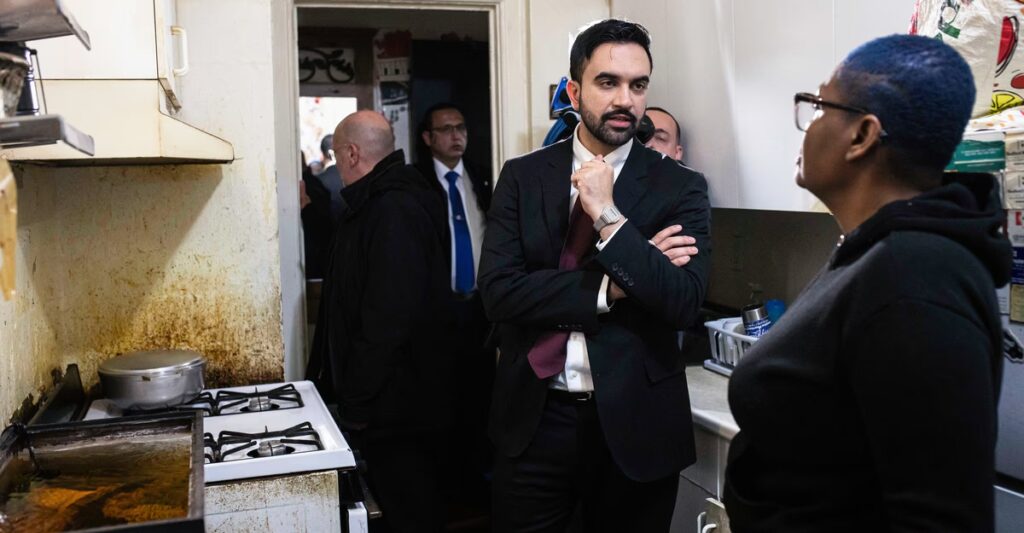
On New Year’s Day, Zohran Mamdani completed his inauguration festivities and departed for Brooklyn. In the working-class neighborhood of East Flatbush, the new mayor stepped into the lobby of an old apartment building on Clarkson Avenue and met with tenants on rent strike. Their grievances were many: The building has 201 outstanding housing-code violations, including leaks, roach infestations, black mold, and that most perilous of winter derelictions, a lack of consistent heat and hot water.
The young democratic-socialist mayor had championed working-class tenants throughout his campaign, promising to freeze rents in rent-stabilized apartments for four years and even to seize control of buildings owned by slumlords. This trip could be seen as a down payment on his intent.
Mamdani faced reporters and photographers in the lobby. “Landlords have been allowed to mistreat their tenants with impunity,” he declared. “That ends today.” Cea Weaver, the new director of the Mayor’s Office to Protect Tenants and, like Mamdani, a member of the Democratic Socialists of America, stood at his side. Her disdain for private-market landlords is no less fierce than Mamdani’s; she has argued that no tenant should be evicted for not paying rent. A few days later, the mayor would announce “rental ripoff hearings” at which tenants could excoriate bad landlords. (A social-media promotion reads like a movie poster: “Mayor Mamdani & the Mayor’s Office to Protect Tenants Present New Yorkers vs Bad Landlords.”)
[Michael Powell: The question-mark mayoralty]
As it happens, in the early 1980s, I worked as a tenant organizer in the same neighborhood, including at a building a few doors down from the one where Mamdani spoke. I empathize with the mayor’s fury and recall my own outrage as I spoke with hardworking tenants who ran their ovens with the doors open to stay warm and watched mice scamper across their floors. We confronted bad landlords and ventured into the chaos of housing court in search of justice that often proved elusive.
But over time the problems we were trying to address, and the solutions, began to look more complicated. Rage, I learned, was not enough. In my three years as an organizer, I received a bracing education in the economics of rent-stabilized apartments, the terrible cost that crime wreaks on struggling neighborhoods, and the delicate ecology of low-income housing. All of which shapes my view of Mamdani’s promises: Rent freezes and promises for the city to take over neglected apartment buildings make for good, visceral politics but poor public policy.
I was born and raised in New York City, and grew up in a rent-controlled apartment. My family’s sometimes-straitened finances meant that we would remain renters. I became a tenant organizer in my early 20s, working for the Neighborhood Stabilization Program, an offshoot of the city’s Commission on Human Rights. My plan was to change the world, or at least my corner of it.
New York at the time was far more desolate and dilapidated than the expensive, albeit deeply unequal, financial capital it is today. In East Flatbush in the early 1980s, I found blocks of attached brick homes and boulevards with once-grand apartment buildings. But Church Avenue, the commercial spine of the neighborhood, offered a dreary run of boarded-up storefronts, interrupted here and there by diners, real-estate offices, discount shops, and bodegas, where you could score a nickel bag of weed along with your quart of milk. Farther east lay blocks with burnt-out apartment buildings, ghostly at night, and lots strewn with bricks and old bathtubs, mattresses, and cribs. To reach one tenant association I worked with, I had to navigate an open-air heroin market. (I was safe enough; dealers assumed I was just another white boy in need of a fix.)
One night, as I hustled along a deserted avenue to the bus, I passed a row of commercial garages and felt momentarily hopeful: Thank God these businesses remain. Then I heard the high-pitched whine of electric saws behind metal gates, and I realized these were chop shops, where men worked through the night to reduce stolen cars to marketable parts.
The city at that point had shed jobs and residents by the hundreds of thousands. Many white residents in East Flatbush had succumbed to racist fearmongering by real-estate speculators and sold their home for a fraction of the assessed value; the speculators sold those homes to Black buyers at exorbitant interest rates. As new arrivals tried to find their footing, a tide of homicides and drug dealing swept in. In 1976, an influential former local official wrote an essay in The New York Times advising that the city should withdraw services from degraded neighborhoods, even razing apartment blocks, closing subway stations, and leaving land to “lie fallow”; he called it “planned shrinkage.” That did not happen, not exactly, but the neglect was real. The working-class West Indians, Haitians, and African Americans who poured into East Flatbush differed not so much economically from earlier white residents, but they had to fight mightily to obtain the most basic services.
Most tenants I worked with in East Flatbush hailed from the West Indies, Barbados, Guyana, Jamaica, and Grenada, and nearly all of them lived in rent-stabilized apartments. One building in particular comes to mind, on Cortelyou Road. The tenants lived in a 1920s-era four-floor walk-up with 25 rent-stabilized units. (Under New York’s rent-stabilization laws, an appointed board sets maximum allowable rent increases citywide.) The landlord, a Jamaican-born insurance salesman, was not a bad guy; at best, he was a couple of steps up the income ladder from his struggling tenants. He had sunk his life savings into the building in hopes of turning a profit, and that was proving a very bad bet.
The old boiler wheezed and stalled, the roof sprang leaks, half-century-old pipes cracked, and the lobby intercom was defunct. The building needed intensive care. But the rent roll was puny, and few tenants could have paid more even if rent stabilization had allowed for it. One evening, the landlord told us that he could not afford to run the building.
Tenant leaders were sympathetic, but this was about survival. They persuaded a housing-court judge to push the landlord aside and appoint an administrator who was empowered to spend rent monies only on heat and emergency repairs. Tougher decisions followed. A young mother of two was well liked but fell months behind on rent; when the city welfare department gave her an emergency cash grant, she declined to use it to pay the rent. A mother of three was romantically entangled with a man who had commandeered a third-floor landing for his drug business and whose clientele sometimes broke into apartments. The tenant association voted to move to evict these women, their decision no less necessary for being sad.
The landlord walked away without a penny. There were no proletarian hearings to denounce a slumlord, who in this case did not really exist. Just deeply painful decisions. But the tenants managed to assure that the building would remain what it is to this day: rent stabilized, still of somewhat-precarious finances. I remember asking a tenant leader what she had prayed for during those tough times. “A good super who understands boilers,” she replied.
East Flatbush is a much healthier place today. New, handsome apartment buildings have gone up, and you can see signs of that mixed blessing known as gentrification. Church Avenue is revived, nearly every storefront occupied, jazz clubs mixing with Haitian bistros, home-loan shops, day-care centers, and Jamaican fish shacks. But the neighborhood still feels fragile, acutely sensitive to any uptick in crime and any drop-off in city services.
The multifamily-housing stock in East Flatbush remains particularly vulnerable, as it does in all but the wealthiest of the city’s neighborhoods. (New York has 1 million rent-stabilized apartments.) Today, even many well-run rent-stabilized buildings are still only marginally profitable. That is in part because of rent-law changes pushed through the state legislature in 2019, and advocated by Weaver. These changes include laudable protections for tenants, but the economic effects are more uncertain. Previously, when a tenant moved out of a stabilized apartment, the landlord could raise the rent by 20 percent. Landlords were also allowed to substantially increase rents if they rehabilitated an apartment or made major improvements to a building. Under the new law, they can raise rents by only minuscule amounts to cover rehabilitation costs. One need not weep for landlords—some of whom have prospered mightily—to note they no longer have much incentive to fix up apartments.
[Rogé Karma: Mamdani has a point about rent control]
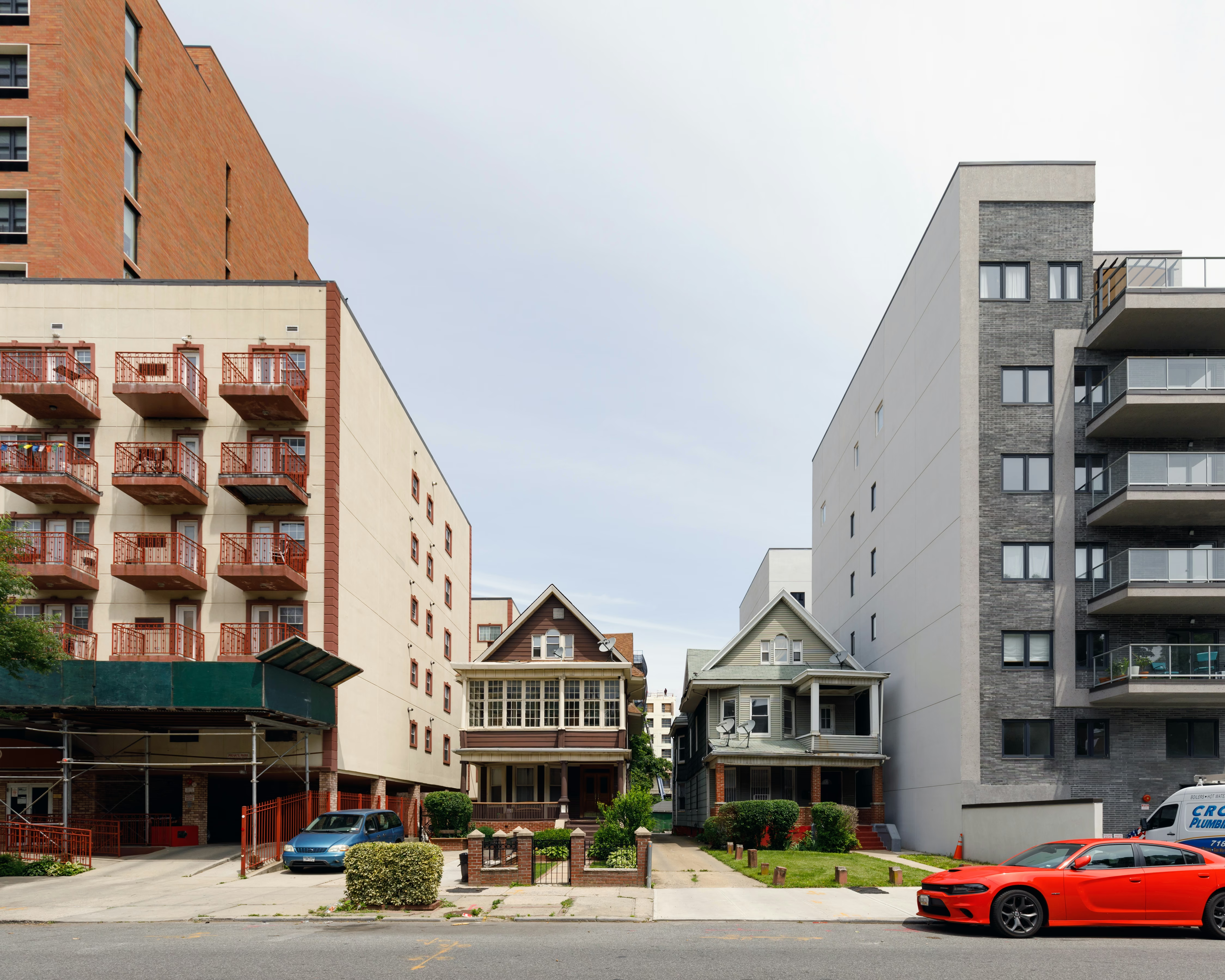
Meanwhile, operating costs are rising faster than rental revenues, according to the NYU Furman Center, which recently examined rent-stabilized housing. And rent collections in many working-class buildings in New York never fully rebounded after COVID. The result, predictably, is disinvestment: As managers have cut back on maintenance, the number of code violations has spiked—a 47 percent increase in the past five years in the rent-stabilized buildings that NYU examined. A study by Enterprise Community Partners, an organization that supports affordable housing, found that costs for affordable-housing operators—including insurance, maintenance, and administrative expenses—jumped 40 percent from 2017 to 2024; six of every 10 projects the group has financed are losing money. All of this is risky business for those who operate buildings that are 80 to 100 years old. These problems extend as well to rent-stabilized buildings run by respected nonprofits.
Even the Mamdani administration has acknowledged the near-impossible economics of rent-stabilized housing. After the mayor visited the building on Clarkson Avenue, the city’s law department sued to delay the sale of the building and 92 others owned by the same landlord in a bankruptcy auction; the landlord, the Pinnacle Group, owed the city $12.7 million in arrears and fines. The city wanted to sideline the leading bidder, and was trying to buy time, likely so it could steer the portfolio to a more tenant-friendly buyer, or even the city itself.
I have no quibble with targeting the Pinnacle Group, which is in bankruptcy proceedings on 93 buildings with 5,150 apartments, most of which are rent stabilized; these buildings have a cumulative 5,000 code violations and 14,000 complaints. But in court documents, the city’s lawyers pointed out that rents in Pinnacle’s portfolio are “very low averaging” and that those revenues are too low to constitute a “supportable business.” That is surely an obstacle to clearing up code violations. A federal bankruptcy judge denied the city’s motion, ruling that the new proposed buyer had submitted a “reasonable-sounding plan” to manage the buildings—potentially saving the city from a very expensive rehabilitation project.
All of this underlines why fixing the problem of affordable housing in New York City is not so simple as freezing rents. Mamdani’s deputy mayor for housing and planning recently said that the administration wants to lower costs for landlords—for example, through property-tax reform, tax breaks for renovating apartments, and attempts to slow the steep rise in building-insurance costs. The mayor’s primary focus, however, is on what tenants pay to live in this terrifically expensive city and the quality of their housing. That’s far from irrelevant. But the question of how to get landlords to deliver this housing without bankrupting their buildings matters just as much.
There was also, for me as an organizer, the issue of crime. Five years ago, Mamdani argued that the New York Police Department was essentially evil and should have its budget deeply slashed. He has softened that view considerably since taking office, but many DSA comrades still hold it. I can speak only to my own experience: Nothing so erodes the stability of neighborhoods and buildings as failing to address crime.
I felt its pernicious effects personally in East Flatbush. Tenants had formed an association at a building on Martense Street, at a then-sketchy corner. The building had many ailments, and the landlord seemed intent on doing as little as possible about them. Tenants identified their greatest need as a working intercom. Absent that, the front door swung ajar, a welcome sign to thieves. One afternoon, I walked downstairs after talking with the tenant leaders and found five adolescent boys jiggering locks to break into an apartment.
Yo, yo, yo, get out of here, I said loudly, waving my hands to scat.
The littlest boy pulled out a strikingly large gun and stuck it in my face. Shoot him, two boys yelled. Nah, leave the motherfucker alone, the other two said. The boy considered his options, then tucked the gun back into his waistband. He told me I was lucky to be alive. I nodded in agreement.
[Henry Grabar: The great crime decline is happening all across the country]
Such episodes threatened civic life in a most elemental fashion. A homeowner block leader who risked catching a stray bullet was far less likely to walk to an evening meeting at a local church. Tenants told me they worried that if they talked openly in their lobby about crime, snitches for local drug dealers might overhear and report them. Other tenants sometimes insisted on walking me to the subway after a meeting, placing themselves in harm’s way.
I never once heard a tenant leader or block leader argue for less policing. They wanted a respectful partnership with law enforcement. At great risk, they monitored dangerous streets and rowhouses, took notes on dealers and gangs, and passed this information along to the local precincts and to the mayor’s office. Some cops and city officials were unresponsive, even corrupt. But the best listened carefully and used that information to clear notorious corners and round up gang leaders.
I once stood watch with tenants every night for a week after we heard that their landlord had hired an arsonist—known as a “torch”—to burn down their building, so the landlord could collect the insurance money. The city’s Arson Strike Force got involved, and the building stands to this day.
The new mayor is fond of his On the Waterfront rhetoric, and tends to suggest that, before the socialists came to power, city government was dismissive of the poor and working class. He means well, but this is nonsense. Thankfully, city officials—prodded by tenants and small-business owners, clergy and homeowners, and, yes, some landlords—rejected advice to consign neighborhoods such as East Flatbush to history’s dustbin. Beginning in the 1980s, successive mayors, Democrats and Republicans, invested first hundreds of millions and then billions of dollars in what became the greatest urban-rebuilding program in American history. The city and nonprofits rehabilitated abandoned buildings and constructed new ones, along with day cares and schools. The rubble-strewn lots I once walked through are now smart-looking apartment buildings. Banks and supermarkets sit on corners where drug dealers held sway. Citywide, many fewer children are in foster care, fewer men are in prison, and far fewer New Yorkers are murdered each year.
I took a walk recently through East Flatbush, alongside the snow-laden Holy Cross Cemetery, down Church Avenue, and along a couple of boulevards of prewar apartment buildings, as achingly beautiful and, in some cases, as tattered as when I first arrived there. The city still faces many challenges, but its recent history gives me hope that a new mayor and administration committed to improving affordable housing can make a profound mark. To do that, Mamdani will need to toss aside easy moral binaries—noble tenants versus capitalist landlords, frozen rents versus runaway profits—and recognize the painful trade-offs that will come with restoring rent-stabilized housing, one of New York’s great resources.
The post What Mamdani Doesn’t Know About Tenants appeared first on The Atlantic.