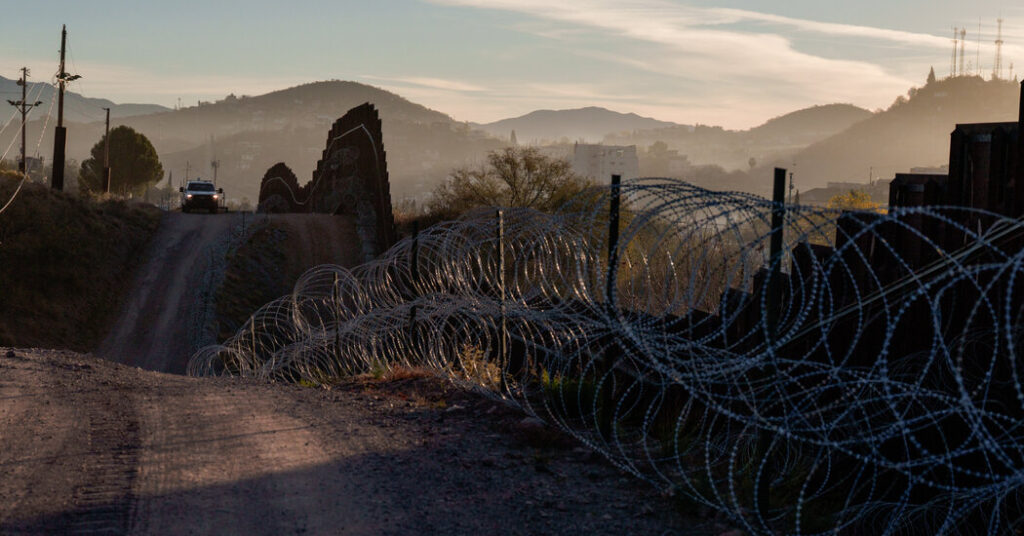
Trump administration officials have warned for months about Mexican cartels using drones near the U.S.-Mexico border, saying they are used to surveil border agents and smuggle drugs.
Mexican officials have publicly been more skeptical, downplaying the threat drones pose at the border.
What is clear is that drones have become a prominent tool and weapon used by Mexican cartels across Mexico in recent years, according to cartel operatives, security analysts and some government officials on both sides of the border.
Steven Willoughby, director of the counter-drone program at the U.S. Department of Homeland Security, testified to Congress in July that U.S. officials detected more than 60,000 drone flights within 500 meters of the U.S.-Mexico border in the second half of 2024 — or 326 flights a day — many at night and above the 400-foot maximum altitude allowed for drones.
He added that U.S. officials have seized thousands of pounds of drugs transported across the border on drones since 2019, including over 1,200 pounds in the second half of 2024. In October 2023, he said U.S. officials intercepted a drone carrying 3.6 pounds of fentanyl pills traveling from Mexico into the United States. He suggested officials had arrested more than 1,500 people in relation to such drone activity at the border.
Noting that Mexican cartels have been repeatedly shown to use drones in their warfare inside Mexico, Mr. Willoughby told Congress, “It is only a matter of time before Americans or law enforcement are targeted in the border region.”
President Claudia Sheinbaum of Mexico disputed Mr. Willoughby’s July testimony the next day in her morning press conference. She said that Mexican officials had observed the cartels using drones against one another inside Mexican territory, but not at the border.
“There is no information regarding new drones currently at the border,” she said.
She added that U.S. and Mexican officials were collaborating closely at the border but that drones were not an issue there. “There is communication, there is coordination. There isn’t anything, let’s say, to be particularly alarmed about right now,” she said.
Mexico’s navy secretary, Raymundo Pedro Morales Ángeles, added in the July news conference that the cartels’ drones “have not been detected at the border.”
On Tuesday, Ms. Sheinbaum again disputed U.S. officials’ characterization of the threat of drones at the border.
“There is no information about the use of drones at the border,” she said in her morning news conference, shortly after news broke about the temporary closure of the El Paso airspace. She said that even though Mexican airspace was not closed, her government would investigate why the U.S. side was closed. El Paso sits along the U.S.-Mexico border.
Yet security analysts and one Mexican state security official said the cartels have been using drones at the U.S.-Mexico border for surveillance and smuggling drugs.
Over the past year, officials have seen a rise in cartel drone activity at the border, including for drug smuggling and monitoring U.S. law enforcement movements, according to a Mexican state security official who spoke on condition of anonymity because he was not authorized to discuss security matters publicly.
The Cartel Jalisco New Generation, one of Mexico’s most powerful criminal organizations, has the financial muscle to acquire and deploy advanced technology for its operations. About a decade ago, it was the first major cartel to make systematic, large-scale use of drones, adapting different models for surveillance, combat and transport.
In Michoacán state, the center of a territorial war involving the Jalisco cartel and rival groups, officials have documented the widespread use of drones to drop explosive devices, terrorizing rural communities. Cartel operatives there have used drones capable of carrying up to 50 kilograms of explosives, the Mexican official said.
Jack Nicas is The Times’s Mexico City bureau chief, leading coverage of Mexico, Central America and the Caribbean.
The post U.S. Officials Have Warned About Cartel Drones at the Border appeared first on New York Times.