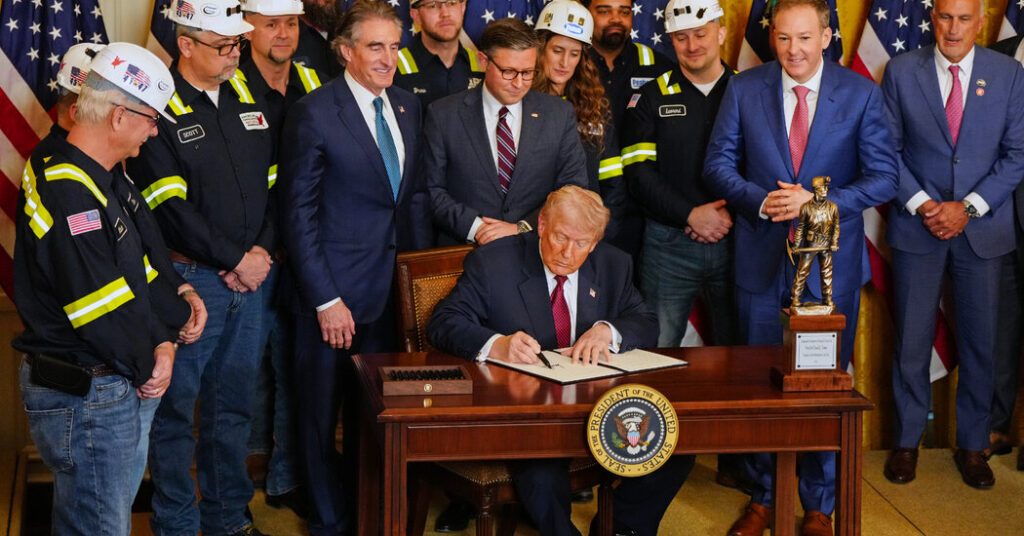
President Trump on Wednesday directed the Pentagon to start buying more electricity from coal-burning power plants as part of his efforts to revive the declining coal industry.
Mr. Trump signed an executive order directing Defense Secretary Pete Hegseth to enter into long-term contracts with coal plants across the country to power military installations. The move could provide financial support to dozens of coal plants that might have otherwise been set to retire in the coming years.
“We’re going to be buying a lot of coal through the military now,” Mr. Trump said at a White House event on coal. “We’re lifting up our hard working American miners like nobody has ever done before.”
At the event, more than a dozen coal executives and miners in hard hats presented Mr. Trump with a trophy that said “Undisputed Champion of Beautiful Clean Coal.” The award came from the Washington Coal Club, an obscure group with financial ties to the coal mining industry.
Mr. Trump also announced that the Energy Department was awarding $175 million to upgrade six coal plants in Kentucky, North Carolina, Ohio and West Virginia.
At the same time, the Tennessee Valley Authority, the nation’s largest federally owned electric utility, said this week it would postpone the retirement of its two largest coal plants, which had been set to close in 2027 and 2028.
The moves are part of an ongoing effort by the Trump administration to increase America’s use of coal. Mr. Trump likes to refer to the fuel as “clean, beautiful coal” to goad environmentalists who point out that coal is the most polluting of all fossil fuels and the single biggest driver of global warming.
It also marks a remarkable turnaround in fortunes for the coal industry, which had been declining sharply in recent years. Since 2005, electric utilities have retired hundreds of older coal plants in favor of cleaner and cheaper natural gas, wind and solar power.
Mr. Trump has been determined to stop that slide.
Over the past nine months, the Energy Department has taken the extraordinary step of ordering eight coal-burning units that had been headed for retirement to stay open and keep running. Administration officials say they plan to stop the closing of as many additional coal plants as they can over the next three years.
At the same time, the administration is taking steps to improve the economics of coal. The Environmental Protection Agency has been rolling back several major Biden-era pollution rules that would have made it much more expensive, if not impossible, for many coal plants to keep operating. Coal plants produce more air pollution than other sources, and burning coal emits mercury, a powerful neurotoxin, and other heavy metals.
Last year, the amount of electricity produced by coal increased 13 percent, which in turn led to an uptick in America’s planet-warming emissions.
Environmental and public health groups have sharply criticized the administration’s efforts to bring back coal.
“The 19th century called, and it wants its fuel source back,” said Manish Bapna, president of the Natural Resources Defense Council. “The Trump administration is using our tax dollars to prop up the nation’s dirtiest, least efficient power plants.”
“The rest of us are left to pay the price: more heart disease and asthma attacks, higher utility bills, and more frequent unnatural disasters,” Mr. Bapna added.
The new initiative by the Pentagon could provide further support to the coal industry.
There are more than 40 coal-burning plants within 100 miles of military installations around the country, said Michelle Bloodworth, the president of America’s Power, a coal industry trade group. Plants that sign long-term contracts with the Pentagon would gain some financial certainty that would allow their owners to invest in them, she said. It would also provide a steadier source of demand for coal mines.
“These long-term contracts will be a major aid to providing long-term certainty,” said Ms. Bloodworth. “It will very much keep the coal supply chain healthy.”
The Biden administration had previously directed federal agencies to buy more electricity from emissions-free sources such as wind, solar and nuclear power in an effort to tackle climate change and transition the country away from fossil fuels. Mr. Trump has repealed that order.
There are limits to how much the military alone can do to support the coal industry, said Douglas Giuffre, who leads U.S. power and renewables research for S&P Global Energy. Even if the Defense Department got all of its electricity from coal, it would only need about 3 percent of the nation’s coal power capacity, he estimated. But if the Pentagon targeted its support at the subset of coal plants that were otherwise expected to retire, that could have a bigger impact, he said.
The Trump administration’s efforts to rescue coal have been aided by a surge in electricity demand nationwide driven by a boom in data centers. Electric utilities have already delayed the planned retirements of more than 58 coal-burning units at 32 power plants since 2022, either to help meet rising demand for electricity or because of reliability concerns, according to data from America’s Power.
More utilities could end up reconsidering plant retirements now that the Trump administration is relaxing pollution rules. One Biden-era climate change regulation, for instance, would have essentially forced all coal plants to close by 2039 unless they took costly steps to capture and bury their planet-warming carbon emissions. The E.P.A. is now working to repeal that rule.
“The fact that they are working to redo those regulations will have a large impact,” Ms. Bloodworth said. Many utilities, she said, had been deterred from investing in their coal plants because of the risk that they would soon have to close.
Administration officials say that keeping coal plants open is necessary to avoid blackouts and meet rising energy needs. They point out that coal plants significantly ramped up their output during the bitter cold last month when wind turbines and solar panels were often producing relatively little power.
“When large parts of our country were hit with winter storms, it was coal that kept the power on and it was coal that never was bothered by cold weather, warm weather, it’s never bothered by anything, it just keeps on chugging, right?” Mr. Trump said.
Critics have countered that the administration’s moves to support coal could drive up electricity costs by propping up aging, expensive plants and preventing utilities from investing in newer, lower-cost replacements.
Last week, the owners of a coal plant in Craig, Colo., challenged the Energy Department’s efforts to use emergency authority to keep the unit open past its retirement date. In regulatory filings, the owners said the coal unit is not needed for reliability and is currently broken, and that the cost of repairing it will fall on ratepayers.
“We have planned for the retirement of this resource for over a decade,” said Jason Frisbie, chief executive of Platte River Power Authority, one of the plant’s owners. “While Platte River will continue to comply with federal law, we disagree with the need to keep the plant open.”
It remains to be seen whether the administration can permanently lift up the fortunes of the coal industry or merely stave off its decline for a few years.
“One big problem in the United States is that these coal plants aren’t getting any younger, and the average age is well over 40,” said Brendan Pierpont, director of electricity at Energy Innovation, an energy and climate policy research group. “The costs of maintenance are rising, their reliability is declining, and there’s only so far you can push that out before these issues really start to bite.”
Coal mining jobs also continue to dwindle. Roughly 40,000 people are employed in the coal mining industry today, down from about 173,000 in 1985, as much of mining is increasingly automated.
Repealing environmental rules could improve the economic fortunes of some existing plants and mines, Mr. Pierpoint said, but it’s not clear that utilities are willing to invest billions of dollars in building new coal plants given the possibility that pollution regulations could be reimposed in the future.
“It goes back to risk,” he said. “Are you going back to put a lot of capital into a technology where the long-term fundamentals are pretty shaky?”
Brad Plumer is a Times reporter who covers technology and policy efforts to address global warming.
The post Trump Orders the Pentagon to Buy More Coal-Fired Electricity appeared first on New York Times.