President Trump has identified what he says is a clear culprit holding back the housing market: corporate investors buying up single-family homes and renting them out.
“Homes are built for people, not for corporations,” Mr. Trump said in a speech last month in Davos, Switzerland. “America will not become a nation of renters.”
But buried in Mr. Trump’s recently announced executive order that seeks to bar large investors from acquiring single-family homes is an exemption that allows them to build homes for renting out.
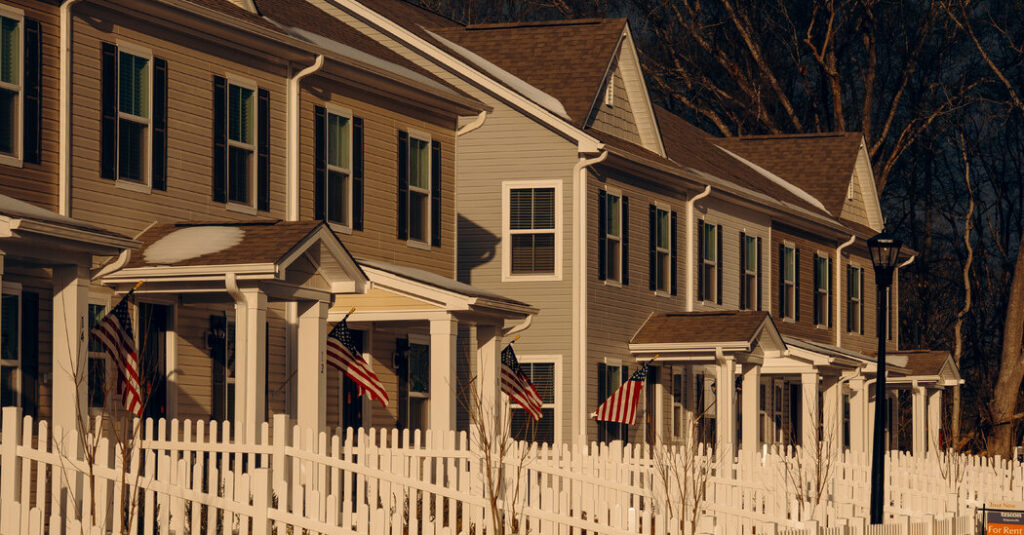
These build-to-rent housing communities are a growing niche of the market and involve some of the same Wall Street landlords that Mr. Trump has blamed for preventing average Americans from owning their own homes.
In recent years, private equity firms like Blackstone have been building new subdivisions of single-family houses that are all for rent. Large home-building companies like Lennar and D.R. Horton have also gotten into the business, building single-family homes dedicated as rentals. One of the president’s own top housing officials, Bill Pulte, had a small business of buying newly built rental homes before he joined the administration.
The build-to-rent exemption may seem at odds with the Trump administration’s stated goal of making more homes available for sale to middle-income Americans by cracking down on Wall Street-backed landlords. Similar proposals have garnered support from some Democratic and Republican politicians over the years.
But housing analysts say, from a policy perspective, build-to-rent communities make sense because they are improving the availability of quality rental housing.
Rick Palacios Jr., director of research for John Burns Research and Consulting, a housing research firm, said build-to-rent communities catered to parents with young children who weren’t quite ready to buy a home.
“Build-to-rent is really a natural steppingstone for homeownership,” he said.
Last year, some 66,000 homes in build-to-rent communities were completed, according to Zonda, a home-building data and research firm. By comparison, just 11,000 build-to-rent community homes were constructed in 2021.
The president’s executive order could give a boost to the nation’s home builders, at a time when many Americans cannot buy single-family homes because of high mortgage rates, rising home prices for existing homes and a severe shortage of newly constructed affordable homes.
D.R. Horton, the nation’s largest homebuilder, said in a recent regulatory filing that it sold 3,546 single-family rental homes last year, compared with 83,622 that were mainly sold to ordinary buyers. Lennar started a dedicated online platform in August for investors looking to buy newly built rental homes. Both Lennar and D.R. Horton declined to comment.
Alan Ratner, a managing director at Zelman & Associates, an investment bank focused on the housing industry, said build-to-rent deals provided a “built-in hedge” for builders. The ability of a homebuilder to presell a significant number of rental homes in a given development to a large institutional buyer gives the builder comfort to build more homes than it normally might, he said.
Today, almost all of the big Wall Street landlords — Invitation Homes, American Homes 4 Rent and Blackstone — are either cutting deals with homebuilders to buy newly constructed homes in dedicated rental communities or setting up their own construction firms.
Last month, Invitation Homes, one of the original Wall Street landlords, acquired a build-to-rent developer that specialized in constructing single-family rental home communities in several Southeastern states.
Invitation Homes, which already owns 80,000 rental homes, announced its deal roughly two weeks after Mr. Trump announced his ban on corporate investors turning single-family homes into rental units.
For many years, Invitation Homes and its private equity owner at the time, Blackstone, were the public face of the Wall Street-backed landlords. The aftermath of the 2008 financial crisis, which left millions of Americans in financial ruin, was a buying opportunity for Invitation Homes, which acquired tens of thousands of foreclosed homes to operate as rentals.
Wall Street-backed firms’ buying of foreclosed homes helped stabilize the housing market in some regions because it took vacant homes off the market and helped put a floor under falling home prices. But over time, the Wall Street landlords became a lightning rod for critics who said the deep-pocketed firms were crowding out first-time home buyers in places like Atlanta, Nashville, Phoenix, Las Vegas and Tampa, Fla. — where most of the firms concentrated their buying.
In recent years, several members of Congress introduced bills that would limit institutional investors from buying large numbers of homes to operate as rentals. But the measures were not adopted.
Mr. Trump’s executive order would similarly require congressional action to be fully put into effect. The executive order also instructs the Treasury Department to come up with a definition of what constitutes a big institutional buyer and operator of single-family rentals.
Eric Seymour, a Rutgers University professor who has studied the impact of Wall Street landlords on the housing market, said the federal government could have had more of an impact on the ability of Wall Street to buy homes if it had acted a decade or so ago during the Obama and first Trump administrations.
Most of the big Wall Street landlords — which came into existence in the wake of the financial crisis — long ago moved on from buying large numbers of existing homes. Soaring home prices and low foreclosure rates have made such purchases less profitable.
Today, Wall Street landlords make up only a small segment of the homebuying market. By some estimates, they own 1 to 3 percent of all single-family rentals in the country. Blackstone, in a fact sheet, said it owned 22 percent fewer homes than it did eight years ago.
Most investors buying single-family homes are mom-and-pop businesses that own a handful of rental homes and are not expected to fall under the executive order. Other active buyers are smaller investment firms that have acquired a few dozen rental homes, as opposed to whole communities.
Investing in single-family homes had been lucrative for Wall Street. Blackstone took Invitation Homes public in 2017 and fully exited its investment in 2019, generating $7 billion in gross proceeds, about twice its original investment.
Two years ago, Blackstone got back into the business in a big way, acquiring Tricon Residential, a large single-family rental firm that already had been active in the build-to-rent market and is continuing to manage rental communities in Texas, North Carolina, South Carolina, California and Georgia.
Last year, Tricon broke ground on a development that will include 93 rental homes and town homes in Simpsonville, S.C. The company is working with a Florida-based builder to construct the development, which will include a pool, a dog park, a playground, and pickleball and tennis courts. A sign at the development said: “Brand New Homes for Rent.”
Like President Trump, Mr. Pulte, his director of the Federal Housing Finance Agency, has been a vocal critic of corporate landlords. But before he joined the administration, Mr. Pulte was an investor in build-to-rent properties.
In recent years, several of Mr. Pulte’s investment firms had bought more than a dozen single-family homes, including from his family’s former home-building business, PulteGroup, and from other big builders like Lennar and Toll Brothers.
At the time, Mr. Pulte said those rental properties would help “give the experience of a new home to Americans who cannot afford it.” Asked on Monday about Mr. Trump’s executive order, Mr. Pulte said: “Unlike small landlords, corporations that are owning 100,000-plus homes are not where we should be in America.”
Matthew Goldstein is a Times reporter who covers Wall Street and white-collar crime and housing issues.
The post Trump Decries a ‘Nation of Renters’ but His New Policy Promotes One appeared first on New York Times.