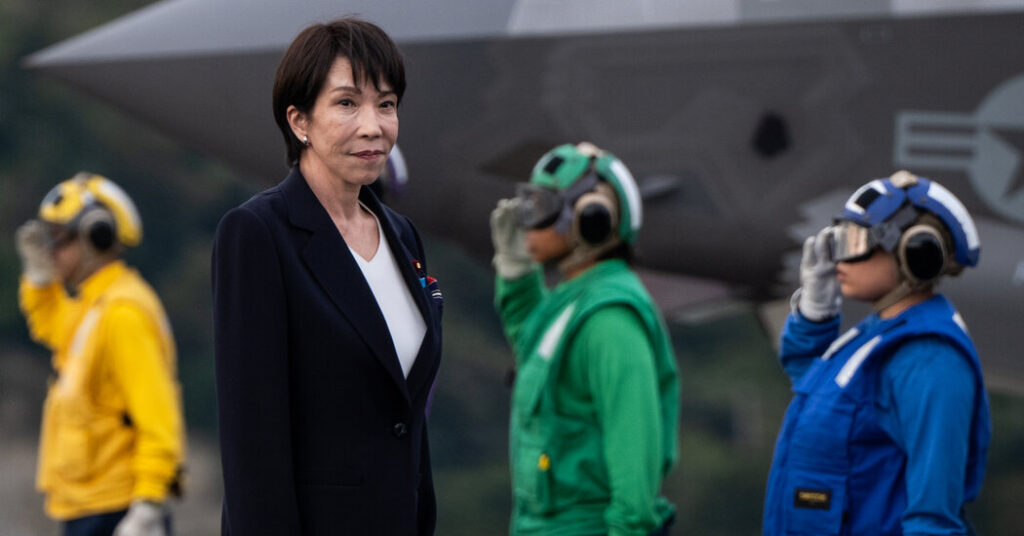
I’ve written about Sanae Takaichi, Japan’s still new-ish prime minister, before. She was a big story when she was first elected last fall and became the first woman in Japan to occupy the office of prime minister (she is also, as it happens, an amateur heavy-metal drummer).
But she’s an even bigger story now. Takaichi — a hard-line conservative nationalist who has made a point of taking a tough stance against China — just won the mother of all mandates in a snap election. She has a supermajority in Parliament that is unprecedented in modern Japanese history, which gives her the power to potentially transform Japan and bury its postwar pacifist identity. I spoke to my colleague Javier Hernández, our Tokyo bureau chief, about what that means for her country and the world.
Takaichi’s big majority, and big plans
So Javier, how much of Sanae Takaichi’s election victory was about her, and how much of it was her policy agenda?
It’s definitely mostly her. She’s been a lawmaker for decades, but has never really had the spotlight on her before. Now that she does, she’s managed to connect with people in a deep way.
She’s got a lot of personality. She plays the drums, she loves motorcycles and baseball, and she’s a constant presence on social media.
She also comes across as authentic. Ahead of the G20, a lawmaker commented on her wardrobe, saying that she should dress better and wear Japan’s finest fabrics. As the first female prime minister, she could have used that moment to, say, denounce the sexism in the question. Instead, she said on social media, You know what, I’m going to these international meetings and I am going to try to start wearing the best clothes so that people don’t look down on me. She seized the moment to signal that she wanted to represent Japan in all of its glory and in all its beauty.
She just has a political instinct that Japan hasn’t really seen in a leader in a long time, and she’s getting a lot of love for that. (Read Javier’s analysis here.)
So she’s clearly a different kind of politician, maybe a politician who meets this moment. But she’s also said she sees herself as a transformative politician. What is her policy agenda?
Her two most immediate priorities are the economy and immigration. She was able to convey to everyday working families that she knows electric bills are too high, that a bowl of rice is too expensive. And she’s very attuned to a general feeling here that Japan has become too open, that foreigners — immigrants and even tourists — bring trouble.
But potentially the most transformative part of her agenda is her ambition to strengthen Japan’s military in ways that we haven’t seen in decades.
How easy will it be for her to do that?
Not easy.
Japan, because of its role in World War II and the trauma of the nuclear bombs on Hiroshima and Nagasaki, has had pacifism enshrined in its Constitution, which explicitly calls for the renunciation of war. There is a military, the Self-Defense Forces, but there are restrictions on what it can do.
Takaichi wants the Japanese military to be a normal military. She represents this faction of Japanese politicians who believe that for too long Japan has been apologizing for what happened during World War II at the cost of building up its armed forces.
And she has not shied away from saying it should revise the Constitution to achieve this. But that’s a complicated process, and she’ll have to bring the public along — the country is still split on this.
How do China and the United States feel about a more muscular Japan?
Donald Trump wants Japan to increase military spending. And Takaichi has been eager to show Trump that she’s doing that. She is accelerating military spending to 2 percent of G.D.P. this spring, two years ahead of schedule.
But China is very concerned about the return of a more muscular Japan. There was an explosion of anger in China when Takaichi was first elected. She’s one of the leading China critics in Japan’s government, a staunch ally of Taiwan, and she now has huge popular backing. That combination is frightening for them.
Concretely, China and Japan have been locked in a dispute over comments Takaichi made about Taiwan. She said in November that Japan could get involved militarily if China were to attack Taiwan.
What does all this mean for regional stability?
There is a real risk that tensions will rise. I was formerly a China correspondent in Beijing and I’ve seen firsthand China’s efforts to expand its presence in the South China Sea and in the area around Japan. I think everyone worries about the chance of a mistake because every day there are so many planes and so many ships out there. The possibility of something inadvertently going wrong is still a top concern in Beijing and Tokyo.
Takaichi and her administration have tried to be cautious, even as Beijing has been fuming. They’ve tried not to aggravate the situation. But when I went to the westernmost point of Japan, Yonaguni Island, in December and talked to residents there, the fear of a conflict breaking out was on everybody’s minds.
ASK A CORRESPONDENT
Your questions about Saudi Arabia
A kingdom once known for its religious police and its ban on female drivers has become, in the span of a decade, a place where women can travel, work, even attend mixed-gender raves, and where some people can even buy alcohol.
Saudi Arabia’s recent transformation has been overseen by Crown Prince Mohammed bin Salman, who has, at the same time, deepened political repression and turned himself into a global power player.
Tell us what you’d like to know about Saudi Arabia from our Gulf bureau chief, Vivian Nereim. Ask your questions here.
MORE TOP NEWS
A search for a motive after Canada’s mass shooting
The Canadian authorities yesterday disclosed details about the suspect in a mass shooting in a remote community in British Columbia. They said the 18-year-old killed her mother and stepbrother before fatally shooting six others at a local school in the town of Tumbler Ridge. She then died of a self-inflicted injury.
A police official said the suspect was biologically born male and began transitioning to female six years ago. Authorities have not yet disclosed a motive in one of the worst murder sprees in Canadian history. Most of the victims were 12- or 13-year-old students killed in their school library.
Read the latest live coverage.
OTHER NEWS
-
In a White House meeting, Trump told Prime Minister Benjamin Netanyahu of Israel that he wanted to continue negotiations with Iran.
-
Bangladesh is holding a national election today, the first since a student revolution ousted the prime minister in 2024. Here’s what to know.
-
Some Iranians shouted “death to the dictator” amid mass rallies on the anniversary of the 1979 Islamic Revolution.
-
A Hong Kong court convicted the father of Anna Kwok, an exiled activist, of a national-security crime, a first for the city. Read her interview with The Times.
-
The U.S. will send 200 troops to Nigeria to help train the country’s military to fight Islamist militants.
THE EPSTEIN FILES
-
A French ’80s cultural icon. Prime Minister Narendra Modi of India. The Dalai Lama. The list of prominent names that have surfaced in the files is growing.
-
Grainy videos from inside Epstein’s Florida home appear to show him on hidden cameras with young women.
WHAT ELSE IS HAPPENING
-
A new documentary explores King Charles’s love of nature.
-
Baboons feel jealousy just as people do, especially toward their younger siblings.
-
Top of The World: The most clicked link in your newsletter yesterday was about Canada’s bridge that Trump hates.
WINTER OLYMPICS
Speedskating: The American Jordan Stolz set a new Olympic record and won gold.
Hockey: Slovakia beat Finland in the men’s preliminary round. Follow our live coverage.
Biathlon: After a bronze medal finish, a Norwegian athlete confessed to cheating on his girlfriend.
AMATEUR SCIENTISTS OF THE DAY
Seals
— Weddell seals in Antarctica dive and feed in waters that ships could never reach, making them ideal data collectors for studies on ocean physics and climate change. Here’s how ecologists enlist new recruits with darts and a blowpipe.
MORNING READ
Sonja Lyubomirsky doesn’t like to oversimplify her research. But if pressed, she will talk about the secret to happiness: “Connection and relationships. Positive thinking, which includes gratitude. And a sense of control in your life.”
Her new book, “How to Feel Loved,” also shares some crucial advice: listen to people without trying to change them. Here’s how to give it a try.
AROUND THE WORLD
Kosher eats in the heart of Syria
Syria once had a small but vibrant Jewish community, estimated at about 30,000 people, but many fled as wars broke out. Today, only about half a dozen Syrian Jews are thought to remain in Damascus. But in the post-Assad era, more Jews are visiting the country — and creating a new demand for kosher food.
One Damascus hotel restaurant has risen to the occasion, offering dishes that meld religious dietary requirements with the local cuisine: kosher steaks, dairy-free dough, eggplant salad. Some Syrian Jews hope that having at least one place to eat will encourage others to return. Read more.
RECOMMENDATIONS
Rebound: Here’s what Olympians can teach you about failure.
Read: “The Blood Countess” asks if a Hungarian noblewoman was history’s most prolific female killer — or a victim of disinformation.
Watch: Charli XCX’s new film, “The Moment,” is “every bit as stressful as a Safdie brothers movie.” Read our critic’s review.
RECIPE
This quick ragù rich with dried porcini mushrooms is inspired by a pasta dish at the lone restaurant in the tiny Tuscan village of Acone. The mushrooms provide a velvety intensity in practically no time. Get the recipe.
WHERE IS THIS?
Which desert is this?
TIME TO PLAY
Here are today’s Spelling Bee, Mini Crossword, Wordle and Sudoku. Find all our games here.
You’re done for today. See you tomorrow! — Katrin
We welcome your feedback. Send us your suggestions at [email protected].
Katrin Bennhold is the host of The World, the flagship global newsletter of The New York Times.
The post Takaichi’s New Superpowers appeared first on New York Times.