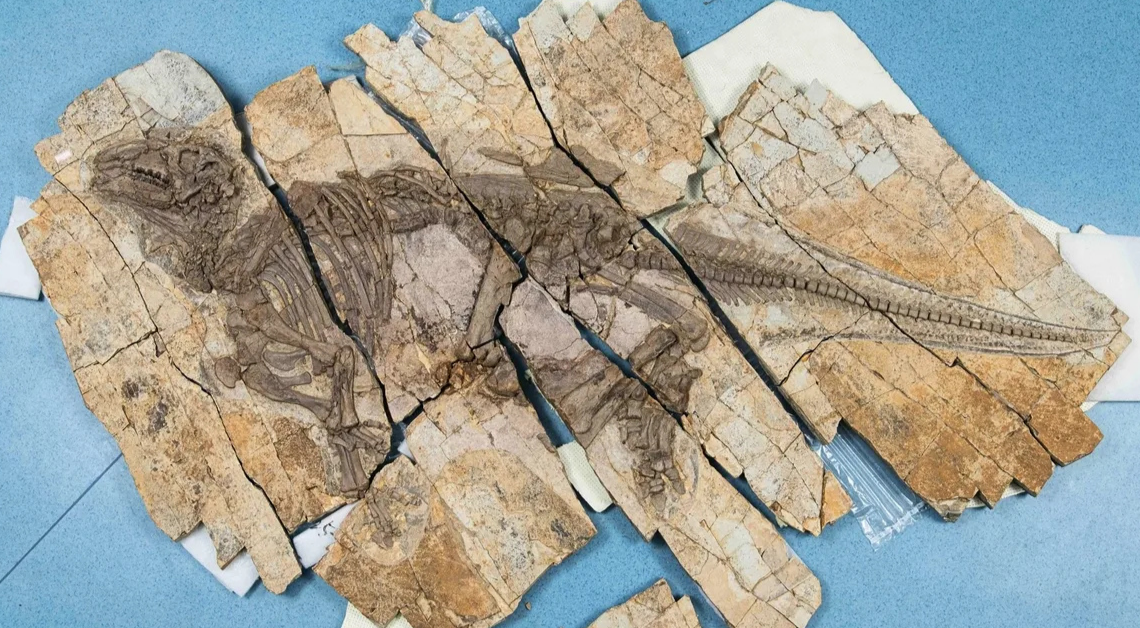
For a while, we thought dinosaurs were pretty much just huge scaly lizards. And then we found evidence of fossilized feathers, which altered our image of many species from oversized iguanas to nightmarish bird things. Now, a fossil find in northeastern China is forcing paleontologists to rethink everything about dinosaur skin.
The species, named Haolong dongi (translation: spiny dragon), was a plant-eating iguanodontian that lived about 125 million years ago. Unlike a lot of its relatives, it appears to have been covered in hollow, hair-like spines closer to mammalian quills than reptile scales.
The team’s findings were published in Nature Ecology & Evolution. In this study, they detail that the animal’s bones looked pretty ordinary for an iguanodontian. The surrounding rock preserved a detailed imprint of its skin, which was decidedly out of the ordinary. The imprint revealed two kinds of scales along with a surprisingly dense mix of small and large spines embedded among them.
Haolong dongi spines were hollow and cylindrical, made from the same material as its scales, pressed into a new defensive role. The smallest measured just a few millimeters long, while the largest reached nearly two inches.
The fossil belongs to a juvenile, about eight feet long, and its unfused vertebrae suggest it was still growing. That observation got the researchers wondering if adults kept their spines or lost them with age. Maybe evolution gave juvenile Haolong dongi thorny spines as a means of self-protection to ensure they made it to adulthood? That could be extremely useful, especially against smaller predators, whose wide mouths could have been vulnerable to sharp spikes. The researchers theorize it could have some secondary benefits, like keeping them warm in cold climates or attracting mates.
If these were indeed thorny spines, then dinosaurs weren’t just scaled or feathered. Some of them were living pincushions.
The post New ‘Spiny Dragon’ Dinosaur Species Identified With 125-Million-Year-Old Skin appeared first on VICE.