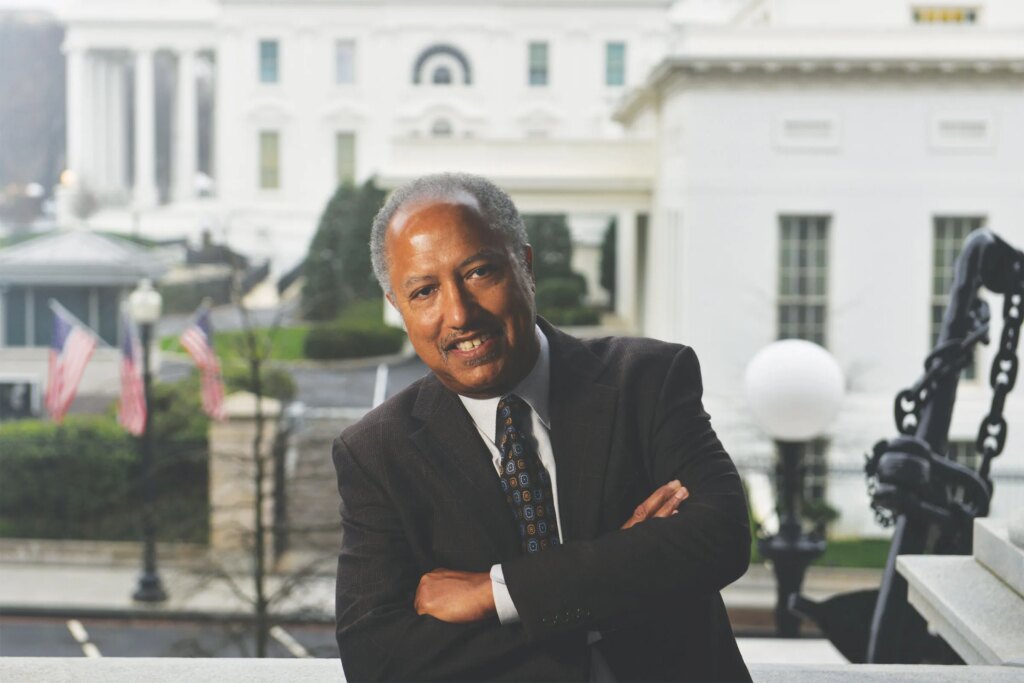
I grew up in the White House. Though I never officially resided there, I spent my entire life connected to the White House in one way or another. I attended Easter Monday Egg Rolls on the South Lawn in my youth. I attended Christmas parties and watched Fourth of July fireworks displays at the White House for as long as I can remember.
[time-brightcove not-tgx=”true”]
My Dad, John Woodson Ficklin, was a White House employee when I was born. With a five year interruption for military service during World War II, his White House career spanned nine presidencies from Franklin D. Roosevelt until Ronald Reagan. He began as a pantryman, and was later a butler, head butler, and finally, maître d’hôtel.
On the sunny afternoon of Nov. 22, 1963, when I was seven-years-old, my Dad was at work and my best friend and I were playing catch outside his home in Northeast D.C. His mom suddenly appeared and told me, “Go home now.”
Bewildered, I obediently raced the three blocks home. I found my mother in tears in front of our small black-and-white television. She was a big soap opera fan, but I had never seen her cry over the “soaps.” She told me that President John Kennedy had been shot and asked me to sit and watch the news bulletins with her.
When Mom reached Dad on the telephone in the White House pantry to commiserate over the earth-shattering news, Dad’s response was disbelieving. There was no television in the pantry, and he had not heard the news. Dad would soon learn the facts. Over the next several days, Mom, my big brother Woodson, and I watched as our nation sank from shock into mourning. Dad did not come home to join us in our grieving. His prolonged absence was due to his service as a loyal butler tending to the needs of the first family of the United States.
On the evening before the funeral, J. B. West, the chief usher, called Dad to his office to tell him that Mrs. Kennedy wanted him to serve as an usher at the president’s funeral. Dad tried to talk his way out of it, arguing that there was so much work to be done preparing for the meals after the service, but Chief Usher West told him that there was no way out of it. Dad had to scramble to rent a morning suit from a local men’s formal wear shop. The Usher’s Office located the shop’s owner, who opened his shop that evening and made alterations on a morning suit using Dad’s measurements. A White House chauffeur picked up the suit for Dad at 7:00 a.m. the next morning, allowing Dad to arrive at St. Matthew’s Cathedral by 8:30 a.m. to begin ushering at the funeral service.
On Nov. 25, as the three of us watched coverage of President Kennedy’s funeral, my mom gasped and pointed to the TV. She said, “Look boys, there’s your Dad!” I vividly remember seeing my father wearing a morning suit, standing beside the casket with the other ushers. At that moment I realized that my father was special. Seeing my Dad on television was a big deal, and to see him participating in our president’s funeral service was beyond my youthful comprehension.
My father had grown up in Amissville, Virginia. He was born in 1919, the seventh of 10 children of Strother and Vallie Lee Ficklin who made a living farming their land, raising chickens, and making molasses. My grandfather, Strother Ficklin, was born a slave in about 1854. He told his children that he did not know his father and was separated from his mother in 1860 and raised by a family named Anderson in Rappahannock County, Virginia. He had one sister and three brothers that he never saw or heard from after 1860. My father recalled that Strother told stories about being “the water boy who carried buckets to the field hands.” He is also said to have been a water boy and manservant to an Anderson family member who was a Confederate soldier during the Civil War. Strother was about 10 years of age when the Civil War ended. I have his Bible and his reading glasses, and still maintain his land in Amissville.
After Strother’s death in 1932, Dad continued going to school and working hard on the farm trying to maintain his family’s quality of life. In a 1983 interview by the Rappahannock newspaper, my father reflected on what Strother’s death meant to him, explaining, “He was a poor man, and I mean poor. We all couldn’t stay around doing nothing.”
That same year Dad’s brother Charles began his career as a butler in the White House, during the Franklin D. Roosevelt presidency. In October, Charles was able to help Dad get a part-time job as a pantryman. Dad would joke that the impressive title of “pantryman” really meant a glorified dishwasher, washing the silver and fine china in the White House Pantry. The pantrymen also did anything that the butlers did not have time to do. This came full circle as I worked for a while as an on-call pantryman when Dad was the maître d’.
So many Ficklin family members worked in the White House in the late 1940s through the early 1950s, mostly on a “part-time-as-needed” basis for large events, that Butler John Pye observed, “A Ficklin here, a Ficklin there, I see Ficklins everywhere,” according to my Aunt Flossie, Dad’s youngest sister who herself served as a part-time White House Pantry employee. In addition to his brother Charles a full-time employee, three other members of the Ficklin family—Aunt Flossie Malachi, Uncle Samuel Ficklin, and Aunt Mary Anderson—would serve “as needed” in butler, maid, or pantry worker capacities.
My first job was meant to be a summer job with the White House Messenger Service, but my time at the White House lasted a lot longer than three months. I recall first working for Dad in the Pantry in the spring of 1974, before I resigned from the White House Messenger Service. Though I had been in the Residence and the Pantry, and around Dad’s colleagues many times as John’s son, working in the Pantry was my first time witnessing Dad managing his staff, “like the conductor of a symphony orchestra,” to borrow a description from Preston Bruce. It was wonderful to be part of his team. Dad shared the following words of wisdom with me and Woodson: “If you are going to do something, do it the best you can.” I learned a lot working for Dad.
I worked in the Pantry frequently in the summer of 1974—running the dishwasher, taking out trash, retrieving and returning place settings. For a State Visit, I would begin my day early, about 7:00 a.m., with Dad, to prepare for the tea after the Arrival Ceremony, and I would leave after the State Dinner, again with Dad, at about midnight.
My career would later take me up the ladder of the National Security Council. I began as a GS3 in 1975 and retired in 2015 as a special assistant to the president for national security affairs after 40 years of service.
But to be sure, my father and I were both committed to our careers. To work a job for more than 30 years, you had to be. We both respected the Office of the President and were proud to serve. What Dad and I accomplished was rooted upon the foundation that my Granddad built. Thirty-seven acres and a mule or two. Our lives were easy compared with my Granddad’s, each generation working hard to pass along a little something to make the next generation’s life just a little easier.
And that is what America, and the White House, means to me.
Adapted and excerpted with permission from An Unusual Path: Three Generations From Slavery to the White House.
The post My Family Worked in the White House for Nearly a Century appeared first on TIME.